CHAPOLI: “When there is a fire, human beings can raise their voice and seek help, but can wild animals do so?” laments Shirish Pai, a local and member of the Biodiversity Committee of Shristhal Panchayat. Pai’s sentiments resonate within the panchayat as he talks about the recent fires at Chapoli Hills that destroyed three hills and uncounted wild animals.
“This was an act of sabotage,” he thundered, as Herald TV decided to speak to local body members about the fire and its aftermath and the way forward.

Sometime ago documentation work to audit the wildlife around the area was conducted by the members of the Biodiversity Committee along with students from the nearby Mallikarjun College in Canacona. The document, although ready, is yet to be printed for public consumption. Herald TV decided to speak to a few locals and members from the local panchayat, who now believe that much more needs to be done by the State government in order for such fires not to be repeated and enrich the existing flora and fauna in the area.
According to Shristhal sarpanch Sejal Purshottam Gaonkar says that the government needs to provide additional funding to develop the hills around the Chapoli Dam. She said, “We appeal to the Goa government for better funding. We need these funds to protect the wildlife at Chapoli.”
“There is an urgent need to protect the wildlife. Even if the State government gives us a scheme it will be beneficial,” she pleads.
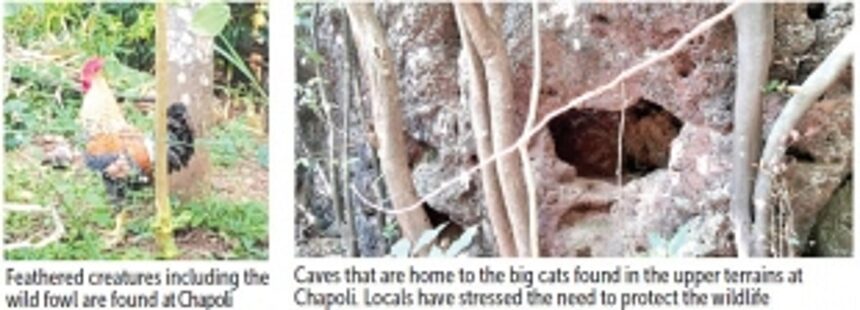
In the study that was conducted, members and students came across various caves in the upper reaches of the hills that may be home to big cats including leopards, black panthers and even tigers. Herald TV is the only one in Goa to be in possession of the photos of the caves. While there is no official audit to suggest the presence of tigers, officers from the Forest Department confess that indeed the Chapoli Hills that are also part of Karmal Ghat is indeed a tiger corridor. “A proper audit by a State instituted board will be able to shed more light. Locals have mentioned sightings of the wild cats but in order not to create panic, a study is the need of the hour,” said the officer, while refusing to come on record.
The study also came across moss growing in the upper ranges, suggesting the clean air. Small streams in the lower area of the forest are also home to invertebrates and fish, making it an ideal hunting location for other wildlife. Locals also recount frequent sightings of the beastly Indian Bison (Gaur), which is Goa’s State animal at the Chapoli Dam to drink water.
Pictures with Herald TV throw light on other arthropods that have made the hills their home, along with feathered creatures including the colourful wild fowl.
Damodar Chari, Biodiversity Committee Member and former deputy sarpanch claims to have seen a big cat a few years ago.
“I was returning at around 6 pm from the Chapoli Dam area on a two-wheeler, when a huge leopard jumped onto the road and ran away immediately. Many others have seen such tigers and leopards and often they enter villages to eat the livestock,” said Chari, who was one of the members, who also led the study atop the hills at Chapoli.
Echoing similar sentiments, BMC chairman and local Vinay Tubki said, “There are many Gaurs who come to drink water at the nearby dam. I once saw a huge wild cat, who with just one leap, managed to cross the road. It looked like a tiger but not sure, since it could be a leopard too.”
With documentation yet to be officially out and like-minded citizens coming together to declare the Chapoli Hills as an eco sensitive zone officially, the murmurs have definitely become a chorus. As such, they believe the government needs to wake up and with the help of locals, build a mechanism to protect the big cats and ensure no more flames engulf the pristine hills in Canacona. But will the roars of the striped felines be heard?