AUGUSTO RODRIGUES
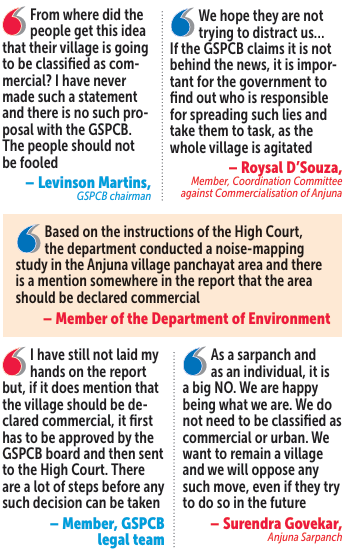
Resi dents of the Anjuna-Cais ua village panchayat have called off their proposed protest outside the office of the Goa State Pollution Control Board (GSPCB) af ter the board clarified that it has made no proposal to classify the village as a ‘commercial area’. “From where did the people get this idea that their village is going to be classified as commer cial? I have never made such a statement and there is no such pro posal with the GSPCB. The people should not be fooled,” GSPCB chair man Levinson Martins clarified. “I am very clear, there is no such proposal from us and I do not know where such information has come from. Please speak with our legal team as I have nothing to say on a subject the depart ment is not involved with,” Martins added. Despite withdrawing their protest after the clarification, locals remained sceptical. “We hope they are not trying to distract us,” said Roysal D’Souza, a member of the recently formed Coordination Committee against Commercialisation of Anjuna. “If the GSPCB claims it is not behind the news, it is im portant for the government to find out who is responsible for spreading such lies and take them to task, as the whole village is agitated,” reasoned D’Souza. Ambient air quality standards for noise differ between residential and commercial areas. Anjuna-Caisua is cur rently classified as a residential area, where the permissi ble noise limit is 55 dB Leq from 6 am to 10 pm and 45 dB Leq from 10 pm to 6 am. In commercial areas, the limits are higher — 65 dB Leq from 6 am to 10 pm and 55 dB Leq from 10 pm to 6 am. The prospect of higher permissible noise levels has united residents in opposition. Documents accessed by O Heraldo indicate that the De partment of Environment undertook a sound-mapping exercise in the village after noise-monitoring systems in stalled under the directions of the Goa Bench of the Bom bay High Court were unable to produce accurate readings. The report is understood to have suggested that the Anju na-Caisua village panchayat be classified as a “commercial area”. “Based on the instructions of the High Court, the depart ment conducted a noise-mapping study in the Anjuna vil lage panchayat area and there is a mention somewhere in the report that the area should be declared commercial,” admitted a member of the Department of Environment on condition of anonymity. “I have still not laid my hands on the report but, if it does mention that the village should be declared commercial, it first has to be approved by the GSPCB board and then sent to the High Court. There are a lot of steps before any such decision can be taken,” said a member of the GSPCB legal team, while assuring villagers that they need not worry. “From the reaction of the people after the urbanisation move, this reaction to this false narrative is not surprising. I can reassure you that nobody in the GSPCB is even aware of this so-called proposal to classify Anjuna as a commercial area,” the legal team member added. Backing the villagers is Sarpanch Surendra Govekar. “As a sarpanch and as an individual, it is a big NO. We are hap py being what we are. We do not need to be classified as commercial or urban. We want to remain a village and we will oppose any such move, even if they try to do so in the future,” he said. “We are writing this formal representation to express our absolute consternation, distress and vehement opposi tion to the recent moves by the Goa State Pollution Control Board to recommend notifying the Anjuna-Caisua Village Panchayat as a ‘commercial area’ under the provisions of the Noise Pollution (Regulation and Control) Rules, 2000. This retrograde proposal represents a direct betrayal of the local community and an attempt to reward environmental lawbreakers at the cost of citizens’ right to a peaceful life,” reads the memorandum signed by villagers, which was to be submitted to the GSPCB. “Proposing to reclassify the village as a ‘commercial area’ is a blatant attempt to bypass judicial oversight. By con verting the zone into a commercial area, the GSPCB seeks to artificially increase the permissible noise thresholds. Shifting the goalposts to accommodate lawbreaking es tablishments rather than shutting them down is an abuse of administrative power,” the memorandum states. A sig nature campaign in support of the memorandum has also begun.