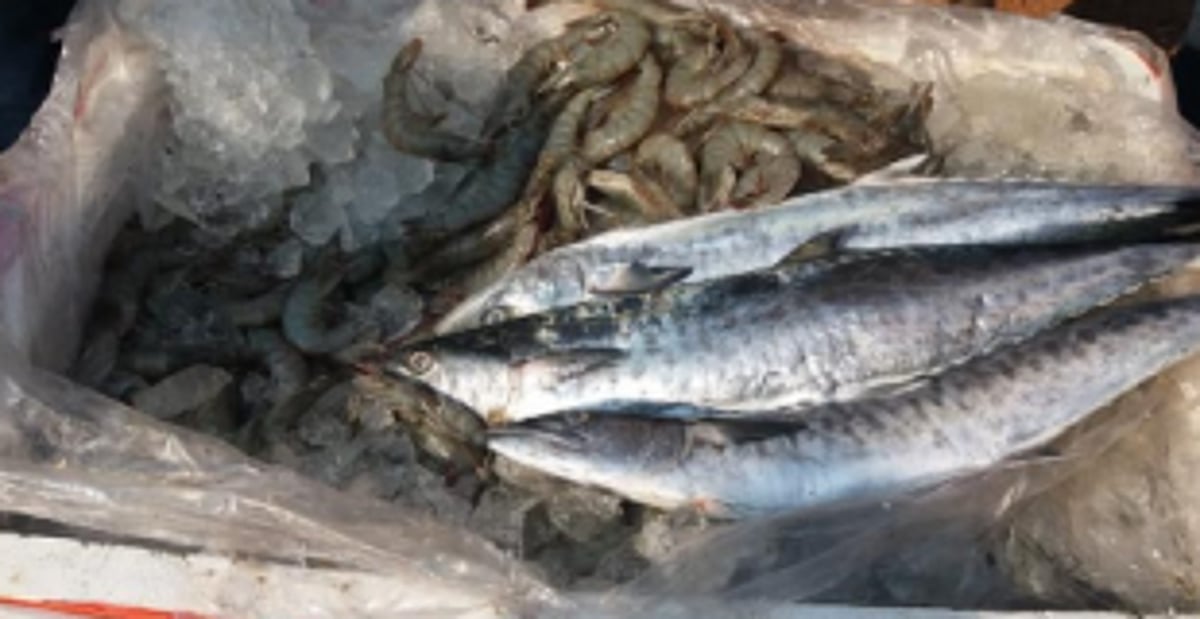
An on the spot inside look at how your fish is declared ‘formalin free’
POLEM (Goa-Karnataka border): Each day, and well into the night, upwards of 20 trucks and going up to much more, enter the State. This is the main entry for consignments from Kozhikode (Calicut). The trucks arriving at midnight through the Goa border are with fish caught at sea off Calicut, the previous night or the same morning which have been loaded by noon to leave by road from Kozhikode upwards through Mangalore on the Karnataka coast to South Goa.
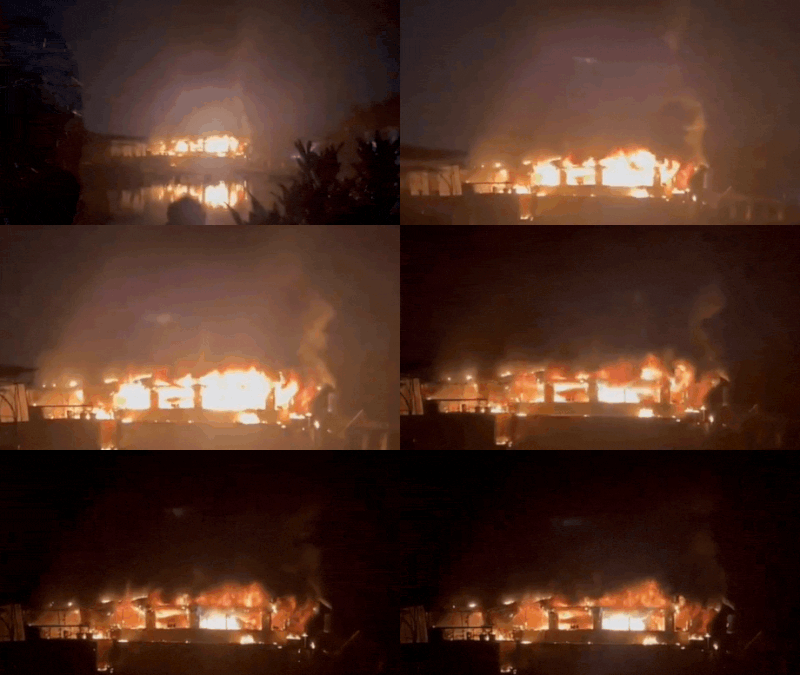
11 pm, Polem Border. Team Herald stakeout watching the operation of fish being tested for formalin at the border of Goa & Karnataka at Canacona
Big container truck with 300 boxes of fish crosses and parks. ‘Checked’ and passed in under 10 mins
The trucks were gliding in from the Karnataka side of the check-post at Polem into Goa, in the silence of the night. It was close to midnight. The constant drizzle made watching the movement difficult. Team Herald had to park across the road from the office of the Quality Control of India, which is no more than a room, turned into an almost fortress, with signs that it is restricted pasted on its doors. The QCI has been appointed by the Food and Drugs Authority to carry out testing for formalin in the fish entering the Goa border

There are three or four men who wait for the truck to come in. It’s massive, containing (at a rough estimate) about 300 boxes of fish from Kerala. The truck reverses towards the entrance of the QCI office. The driver jumps out and hands over a sheaf of documents which seem to be scanned (from a distance) and taken into the room. The rear door of the truck opens just a bit. A blue tray is brought out of the door and then taken back. It wasn’t clear if any fish samples were taken. But it is all over in ten minutes. No boxes were taken out. The doors of the container truck shut, the driver jumped back with a paper and off it went.
Truck 2
Quickie ‘check’. Stop, Jump-out with papers, get clearance and out. Time taken: 5 mins
This was a smaller truck, waiting alongside the big truck. While the checking of the bigger tuck was going on, one of the staff came and took the papers of the smaller truck. By the time the smaller one backed in for its turn to be checked, its process was almost over. The door opened. One box was taken out and back in. Stamped Good to go. Consignment passed.
Truck 3
Herald moves in
Enough of distance watching. Team Herald now decided to step out of the car and walk straight to the spot where the checking was actually taking place to get a clearer view of the testing process, the hygiene and safety standards maintained by checking staff and most importantly to see if the checking was thorough or cursory.
Shock after shock followed.
When this reporter kept walking towards truck number KL 18 Y 5313, (Calicut registration number) he was stopped by a young mask-covered man, who happened to be the shift in-charge of the QCI office. “No one’s allowed here,” he said. “Isn’t this a public place,” this reporter asked. “This is our area and even the area in front is our area.” This reporter calmed him down and asked basic questions which went like this: “How many trucks have you checked? How many boxes do you check per truck? Can you show me a sample of any one of the results? The answer to each of these questions was, “We cannot give you any information. Speak to our offices in Margao or the FDA in Panjim.”
Asked why all trucks were not checked the shift in-charge quipped, “Trucks that are carrying fish for export are not checked.”
Next question: But are there trucks coming into Goa now with fish meant for export? Response: Silence
Then, as if sensing our presence, the truck doors fully opened and some men climbed to take out a few boxes from which fish were taken out and taken into the office in trays.
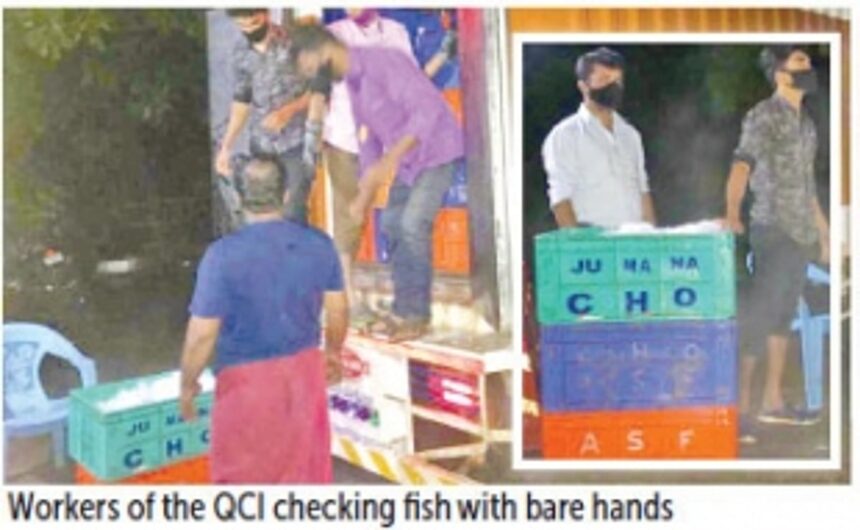
But one didn’t just see the fish trays. We saw the men. There were wearing no PPE equipment, just ordinary masks, and no gloves. One later learned that they were boys from Karwar in Karnataka who had a pass to get into Goa each day across the border to ‘check’ the fish boxes. Obviously not regular staff, they have been given no protection/and even the few boxes that they touch to take the fish out is done by bare hands.
The shocker doesn’t end here. Between checking one box with bare hands and the next, there is no washing of hands or even a sanitiser rub.