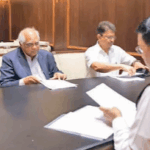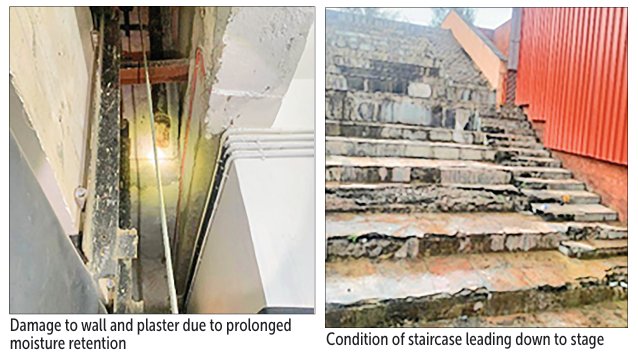
A task force ap pointed to review the ren ovation of Goa’s iconic Kala Academy has raised serious concerns over ex tensive structural damage, waterproofing failure and systemic defects, following a draft assessment by IIT Chennai that paints a trou bling picture of the cultural landmark’s condition. The findings are based on a comprehensive visual field inspection conducted by an IIT Chennai team on Septem ber 23, 2025, which revealed widespread deterioration across the complex, despite the completion of costly renovation works. The draft report flags multiple points of water ingress, structural distress and compromised services, prompting the task force to express strong dis satisfaction with the quality and effectiveness of the re pairs carried out so far. According to the report, the building suffers from chronic dampness and seep age, necessitating urgent corrective and preventive measures to safeguard its long-term durability. The IIT team recommended infrared thermal scanning across ma jor areas to detect concealed moisture behind cladding, false ceilings and surface fin ishes, indicating that damage may be far more extensive than what is visible. At the auditorium level, the inspection uncovered persistent water ingress, attributed largely to high groundwater pressure. A sump tank beneath the wooden flooring — equipped with a pump that ac tivates during high tide — was cited as evidence of long-standing seepage. Electrical wiring and junction boxes within the sump showed signs of moisture exposure, placing critical electrical and mechanical systems at serious risk. Poor indoor air quality, likely caused by prolonged dampness and possible mould growth, was also noted.
Structural concerns were flagged in several load-bearing elements. Cracks were observed in beams and columns near the stage, along staircase walls and in access areas leading to the catwalk. Some cracks appeared to have been crudely con cealed with uneven plaster, suggesting cosmetic patchwork rather than proper structural repair. The IIT team recommended corrosion testing, condition assessment of reinforcement bars, and electrochem ical repair techniques to arrest further deteriora tion. The terrace was identified as a major failure point. The existing waterproofing system was declared non-functional, with drainpipes not connected to floor traps, causing uncontrolled water flow and stag nation. Widespread map-cracking of the china mosa ic flooring has further increased the risk of seepage, contributing to deterioration of the structural slab and the spaces below. A complete redesign of the ter race drainage and waterproofing system was deemed essential. In the open-air theatre, inspectors noted water stagnation near seating areas, defective drainage and deterioration in staircases leading to the stage. Re verse slopes were detected in most steps, raising con cerns about settlement and long-term safety. Water ingress was also observed in motor and pump rooms, along with dampness in false ceilings of storage areas beneath the auditorium. The report concluded that unless comprehensive drainage correction and waterproofing measures are undertaken immediately, continued moisture exposure could accelerate reinforcement corrosion, weaken the auditorium slab and raft foundation, and significantly shorten the structure’s service life. The inspection was conducted in the presence of representatives from the Chief Conservator of For ests, Public Works Department, Kala Academy, the Task Force Committee and the structural consultant. Discussions focused on assessing the remaining ser vice life of the building and evaluating the effective ness of earlier repair works. Reacting sharply to the findings, task force member Francis Coelho said public money had been wasted. “Around Rs 60 crore spent by the government has ef fectively gone down the drain. So far, Rs 50 crore has already been paid to the contractor, and we are not satisfied with the repair works,” he said. The revelations raise serious questions over ac countability, quality control and oversight in the renovation of one of Goa’s most prominent cultural institutions.