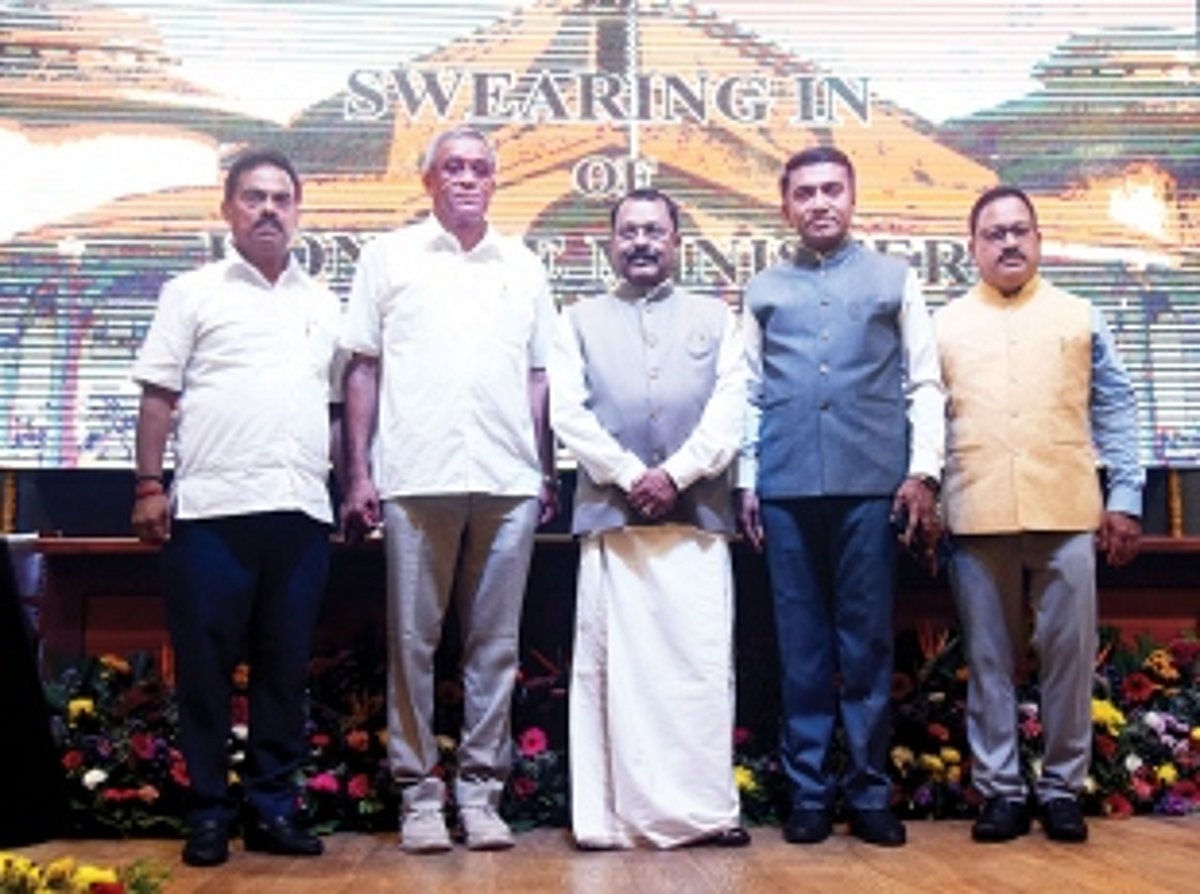
This is something that no Goan ever imagined. There is no Minister from Salcete in the BJP government of Pramod Sawant. Since the time Goa became a State, there has always been a minister from this politically volatile and significant region of South Goa. After all Salcete is not just a taluka. It’s a state of mind, it’s synonymous with quintessential Goan identity and a repository of Goenkarponn much before it became a political buzzword.
Five of Goa’s 13 Chief Ministers have come from Salcete, a reflection of the quality and political height of the taluka’s leaders and the kind of presence they commanded either in their parties or in the different coalitions that they managed to head, especially during the very fluid and ever-changing nineties.
From a taluka that used to literally lead the political narrative, it is playing the role of the supporting cast, with many of its elected MLAs either rushing to offer support to the ruling party or sending feelers to switch and get ministerial berths.
The BJP with a majority literally has, and this may hurt many Xaxtikars, decided to show Salcete its place (as the BJP sees it), giving a clear message that it need not go overboard to “accommodate” the political interests of leaders from the region in order to expand its base in the State.
The Reality
For the first time since statehood Salcete does not have a single minister. Nor is the leader of the opposition from Salcete. Does that mean that even the Congress, which used to once add at least seven seats to its kitty from Salcete even before the elections, does not think that their senior-most leader and veteran Digambar Kamat is the natural choice for the Leader of the Opposition role?
So, what led to this? Do Xaxtikars even realise what and why this happened?
First and foremost, let us not forget the most used adage to describe democracy – “We get the government we deserve”. And if we look at the results in the seats of Salcete alone, the results have been the product of divided choices the voters of Salcete have made.
*Xaxtikars swayed by RG
Let’s get some facts right. People of Salcete unknowingly allowed themselves to be used. The manner in which the Revolutionary Goans managed to sway the people of Salcete, especially the young has led to RG getting about 20,000 of its 90,000 votes in the Assembly elections from the eight Salcete seats alone. This basically led to the Congress loss in about four seats with the BJP, AAP, and independents gaining. The independent, Aleixo Reginaldo Lourenco, who won immediately pledged his support to the BJP.
Institutions of faith gave confusing signals to followers
Moreover, institutions of faith, meant to guide the people gave divided and often confusing signals and guidance. In some cases, these institutions asked people to vote for whoever in their area was best suited to defeat the BJP, leaving it to the subjective judgment of voters. This led to the absolute chaotic vote division in the history of Goan politics.
Take Navelim for instance. The acute and multiple splitting of votes threw up a result that was exactly the opposite of what voters wanted. The Congress, NCP, TMC, RG and AAP got almost 15,000 votes but the BJP with 5,084 votes won.
In Benaulim, the 3,784 RG votes helped AAP win over Congress and TMC. In Curtorim RG’s 3,423 votes damaged Congress which got 3,805 votes.
In Velim the RG factor clearly cost Congress. RG got 3,604 votes to the Congress 5,067 giving AAP with 5,279 votes a slender win. TMC’s 4,039 votes too did the damage.
In the three seats where voters voted decisively in favour of the Congress, it won in spite of the Revolutionary Goans and TMC and AAP. In Cuncolim the 9,572 votes for Yuri Alemao were far too much for the vote cutting RG to do any damage even though it polled 2,402 votes. The decisive vote in favour of the Congress also reflected in the TMC and the AAP hardly getting any votes which establish the fact that if the people of Salcete had voted decisively in favour of the Congress, it could have won all seven it contested. In Margao, the 13,345 votes Digambar Kamat got; made the fragments of votes that TMC and AAP or RG got irrelevant. And in Nuvem, though the RG could have done damage as it did in other seats the 8556 votes that Congress’ Aleixo Sequeira got, was double that of RG. In Fatorda, the Congress ally Goa Forward won because it boiled down to a two-way fight between GF and BJP. With no vote split, the BJP lost yet again.
– The BJP tactfully gave party tickets in Curtorim and (also Cortalim) not to win but cut votes to ensure that an Independent won and then supported them. In Curtorim, the voters fell for that trap as did the ones in Cortalim (though it is not in Salcete, the strategy applied was the same).
– Poor selection of Congress and the last-minute acquisition of rejected candidates caused a further dent. And here the former GPCC resident Girish Chodankar and the way he conducted the candidate selection exercise was what many in the Congress and those who left, felt led to the party’s losses.
The BJP played a political game and used the division in the votes to ensure that though it won only the Navelim seat and got support from the Curtorim independent, and check the Congress’ march.
After its Salcete strategy worked, BJP had no more need to make anyone a minister from Salcete. No one figured this out while dividing votes
The message is clear. Neutralise the main opposition party in its potentially strong area, and then form a government of hardcore BJP people.
Salcete feels hurt and left out. But it needs to think deeply and realise that they alone are to blame for this. And for the diminishing importance of the taluka in the political ecosystem of Goa.