The English question paper of the Goa Board of Secondary and Higher Secondary education has indeed caught itself in the eye of a storm questioning its raison d’être. As a parent of a teenager who has answered this paper (the very first after a stressful COVID-induced lockdown), I am distressed, disturbed and concerned. At the same time, being an English teacher for the last two decades, I want to voice my views to inspire the teachers who have a huge social responsibility as educators and agents of positive change.
The paper is seemingly set in haste, without meticulous proof reading and overlooking quality and precision of content. The paper which is divided into four sections (A, B, C and D) has Section A for comprehension, Section B for the text-book related questions, Section C to test grammar and syntax and Section D for interpreting pie chart, reporting telephonic conversations in writing, letter-writing and article writing (with internal choices). If one looks at the pattern in its entirety, it is obvious that only a quarter of the portion (i.e. Section B) is what the students have to study as it is text-book-related. The rest is totally unseen, which tests the students’ skills at grammar, comprehension, writing and applying learnt knowledge and skills to answer. In such a scenario, there is ample scope for the paper setter to inculcate good values, positive ideas and inspire young minds with innovative thoughts.
The paper begins with the first passage in Section A which poses the tender minds to a Catch- 22 situation. Two friends, Vinay and Nelson are happily sailing in a boat at sea. Suddenly there is a storm and they have to jump into the sea. They catch a plank to stay afloat, but only one person can use it as a lifebuoy. The other will drown. Nelson is a married man with a family and Vinay is a bachelor with a mother and sister. The passage concludes: “Vinay told Nelson that if he died, Nelson could support his family but it would be inappropriate to support his family. After telling this, Vinay let go off the plank and he was washed away by the storm. Nelson survived and supported his family and that of his friend”.
This is deciding for the youth on what is the appropriate form of behaviour and ends with a suicide. The passage overtly states that it is appropriate for a bachelor to martyr himself and deprive two women (his mother and sister) of their son/brother in the greater interest of saving the so-called complete family of husband-wife and children, and not vice versa. I fail to understand the values which such a prejudiced handling of a dilemma situation imparts. Are we intending to thrust our own pre-conceived ‘appropriate forms of behaviour’ on tender malleable minds of the 21st century? Isn’t it possible to leave the passage open ended and ask questions like “What would you have done if you were in this situation?” Comprehension should make you think, understand, imagine, be creative and write with wisdom and thoughtfulness. Sadly, one can see that the mind(s) who sets these questions, think otherwise.
All is not bleak in this paper. The second and third passages in Section A, make an attempt to educate and create awareness about pertinent matters like ‘Disaster Management’ and ‘Drug Abuse’. They are in good taste and inspire positive energy, unlike the first. Likewise, Section-B is text- based and meant to test students who have read, understood the text thoroughly. Except for the Question 6 where the word ‘two’ is missing (an oversight due to poor checking), the rest is quite clear. The question here is, can we condone the printing error/ absence of the missing word in the question or aim at impeccable proof-reading and seek to redress the grievance of hapless students who are left wondering what to do! The Board has assured us that the decision will be taken after due deliberation to benefit the students. A little counter-checking could have sorted this avoidable error.
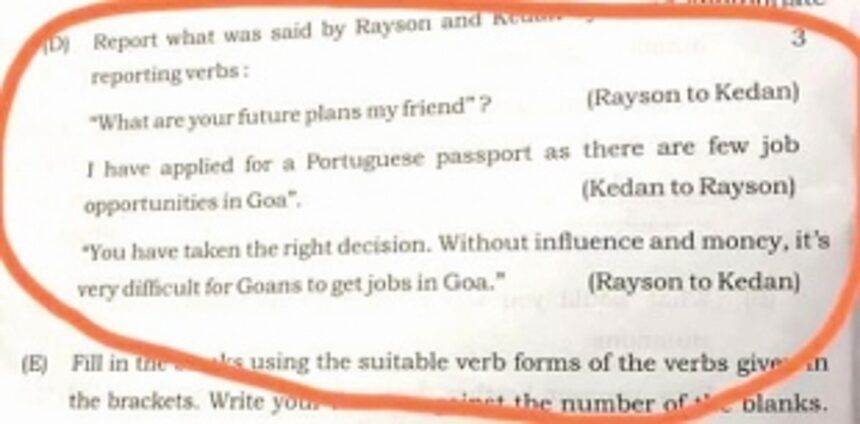
Something is rotten in the State of Denmark…I mean Goa here! That scum has permeated in the education which we impart our children today. The report writing exercise in Section C- 7D is a fall-out of this social reality which enters our ever-porous educational system. The conversation between two friends Rayson and Kedan discussing their future plans has opened a can of worms in a State where ‘without influence and money, it’s very difficult for Goans to get jobs’. So Kedan had made a Portuguese passport to seek a job in UK. The question paper setter has innocently set this dialogue, inspired by his/her social reality (and the authority overseeing this has turned a Nelson’s eye to its semantics). From the grammatical point-of -view, it is a fair question.
But, the multiple shades of meanings which the question draws indicate that it is in poor taste and lacks tact. The content is anti-establishment and castigates our government for its inability to provide jobs. Incidentally, this content is created by a teacher (and overlooked by an authority) who is employed by the same government to teach and prepare Board papers. Therefore, it injects in the tender minds the prejudiced view that there are few jobs in Goa. So, the ultimate exodus to UK via Portuguese passports to secure work in odd positions there as settlers, is the way out.
Is this really true? If so, why were we having lakhs of immigrants from other States thronging in Goa for jobs prior to lockdown? Are all jobs secured sans merit and qualifications? Or is this a generalisation based on a few unfortunate instances? Can we allow our youth to be victims of such prejudiced notions? Is a Board exam question paper the apt platform to address such controversial and one-sided political matters?
The Section C, 7(C ) (iv) makes a blatant statement: Corruption has affected Goans in Goa, and drags the issue further. The question asks for a change of voice from Active to Passive. This is yet another statement (however factual), which is laced with negativity and pessimism. As if this is not enough, Section D, 8(A) hits the nail in the coffin real hard when a pie chart is given which graphically represents the responses of Goan villagers at the panchayat-level, where a survey was conducted addressing the question “Should more powers be given to the Panchayat?” The pre-designed pie chart shows fifty per cent of the Goan respondents saying that powers should not be given to the panchayat members as they misuse them. And only a mere 10 per cent, saying that more power should be given for the improvement of the village.
This pre-cooked pie chart when read by a young mind is out rightly intended to create an image that Goa is suffused with corruption from the panchayat grassroots to the top positions where unemployment of the youth is rife and you need a god-parent in the bureaucracy to write your success story. Such negativity which is injected into a ‘mask-wearing teen’ (pun intended) who is already grappling with the COVID-crisis under lock down for over seven weeks, to make him ingest the same putrid and sad reality over and over again, is like rubbing salt and vinegar to already festered wounds. The justification that we are exposing the Goa social reality to the youth does not hold water, as it presents only the bleak side of the picture. The positive side is curtained by prejudices.
The damage is done. It can only be addressed with an apology and an assurance that such avoidable fallacies are not repeated in the future. A question paper which gives ample scope to impart value-based education should not be under-utilised by injecting prejudice, unpatriotic sentiments and anti-establishment ideas. We are living in sensitive and critical times where tensions and storms are rife. We are all compelled to wear masks by a microscopic virus.
Let us not use the question papers of a Board exam as a platform to unmask the frailties of our government and address one-sided political matters.
There are better platforms for the same and our children can decide to grow up as responsible adults and address them in due course. It is here that we teachers have a vital role to play.
Let us expose our youth to relevant problems by not leading them by the nose towards preconceived ideas, but rather inspire them to be mentally atmnanirbhar (self-reliant) and intelligent thinkers who decide for themselves by weighing the pros and cons. Let us nurture tender minds by surrounding them with positive ideas and awe-inspiring hope, especially when they are embroiled in an ambience of cynicism, uncertainty and negativity. Only then we can have a new generation of leaders who will love themselves, their land, and people and grow to be responsible citizens who work to build a corruption-free Goa.
(The writer is Assistant Professor, Department of English, Carmel College- Nuvem. The views expressed herein are entirely that of the author)