Team Herald
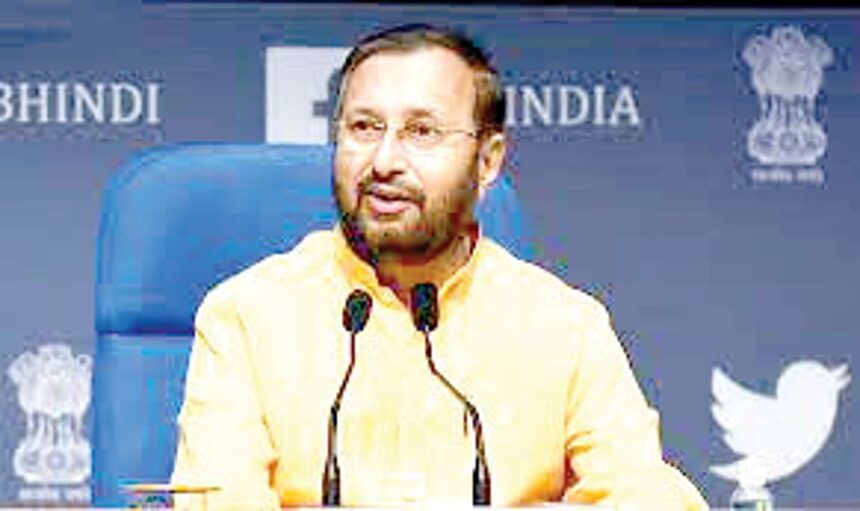
PANJIM: Minister for Environment, Forest and Climate Change Prakash Javadekar on Friday released detailed project report of LiDAR based survey of forest areas in Goa and nine other States for water and fodder augmentation.
Besides Goa, the other States are Assam, Bihar, Chhatisgarh, Jharkhand, Madhya Pradesh, Maharashtra, Manipur, Nagaland and Tripura.
Releasing the detailed project report of LiDAR based survey in a virtual event, Javadekar said that projects will help augment water and fodder in forest areas and enrich efficiency of regeneration of forests. “All State governments should work in earnestly to make this project successful and showcase the effect of use of technology,” he added.
Javadekar informed that the project which was awarded to WAPCOS, a PSU under the aegis of Ministry of Jal Shakti, Government of India is a first-of-its-kind and a unique experiment using LiDAR technology which will help augment water and fodder in jungle areas thereby reducing human-animal conflict, help in groundwater recharge, help local communities.
The Union Minister also asked State forest departments to use Compensatory Afforestation Fund Management and Planning Authority (CAMPA) funds towards implementation of these projects in right earnest and in accordance with the ‘Ridge to Valley’ approach of watershed management.
WAPCOS prepared these DPRs using LiDAR technology in which the 3-D (three dimensional) DEM (Digital Elevation Model), imagery and layers of the project areas were used for recommending different types of soil and water conservation structures such as Anicut, Gabion, Gully Plug, Mini percolation tank, Percolation Tank, Field bund, Sunken pond, Farm pond etc. These structures will help in catching the rain water and prevent stream run off, which will help in recharging of Ground water.
WAPCOS with the participation of State forest departments identified one major ridge inside a forest block in these states with average area of 10,000 ha selected in each State for preparation of detailed project reports for planning and identifying locations and structures for construction of appropriate and feasible micro soil and water conservation structures consistent with site specific geography, topography and soil characteristics.
States/UTs identified one major ridge inside a forest block with the criteria that area selected should have average rainfall of the State and the area requires assisted natural generation which means the density of forests should be less than 0.4 or below, but should have reasonable potential to regenerate with the ANR interventions.
The project was awarded to WAPCOS in July 2020 at a cost of Rs 18.38 crore for implementation in 26 States over 2,61,897 hectare. For the first time the Central funds were used to survey forest areas of 26 States. The DPR’s for the remaining 16 States will also be released shortly.