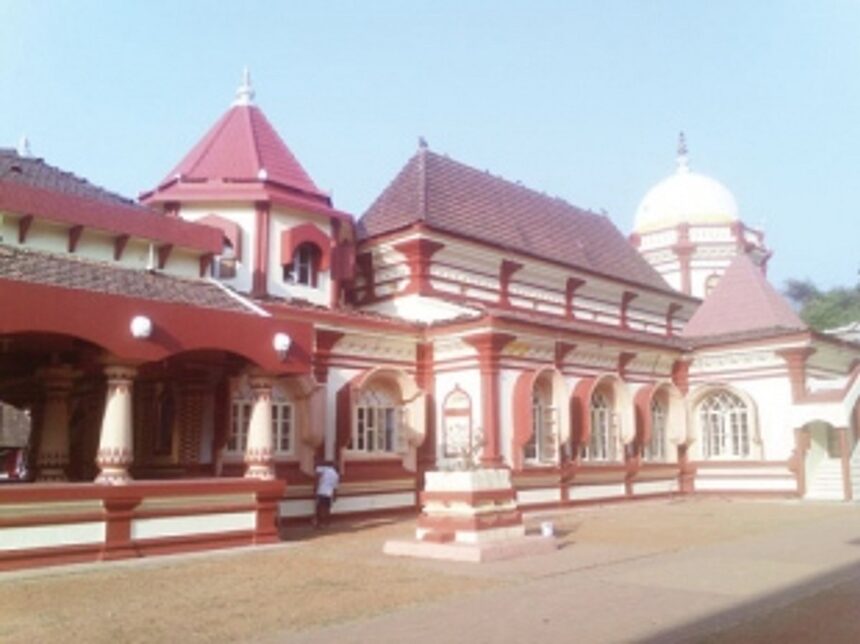
Even though the Marcaim Temple idol replacement issue is sub judice, there have been clashes between the Mahajans and Bahujans over the right to celebrate religious festivities in temple.
For the last two months, the Marcaim locals have been agitating against the Navdurga Temple committee’s decision to replace the old Navdurga idol with a new one.
The temple committee has claimed that the temple is private and they have the right to take decisions on religious matters, including changing the idol which has allegedly developed cracks.
Marcaim locals feel that the Mahajan Act, formed during the Portuguese era, is an injustice to them as it deprives them of their religious rights. They also stated that they had been worshipping the Navdurga idol long before the Portuguese rule.
The villagers further said that their ancestors were illiterate, and hence, did not know what had been written in the Mahajan Act, which governed their temples. They stated that their generation was literate and wanted their rights regarding temples.
The villagers recently met the Ponda mamlatdar, who is the Administrator of Temples, and asked him to approach the government with their demand to scrap the old Mahajan Act, based on which the Mahajans of temples were denying the Bahujans their religious rights.
Shailesh Panajikar, who leads the villagers under the banner of Navdurga Prathishtan, said that the exact age of the sculpture in the Navdurga Temple was not known and there was no proof that the temple was established by the Mahajans of the temple committee.
He further said that the villagers had been worshipping the old idol since ancient times. He called for the government to preserve the idol and added that the villagers had filed a petition in the District Court for the same.
The hearing has been completed and all eyes are on the verdict, which will be delivered on April 20.
“During ancient times, the villagers of all classes and communities used to come together and construct temples at the centre of their villages. Such old temples are of public character. As per the law, articles, images, and idols that are at least 100 years old have to be preserved as ancient monuments by the Archaeology Department of Goa,” said Panajikar.
He further said that Deccan College of Archaeology, Pune, said the idol belonged to the 14th century, whereas the villagers claimed it was installed during the Kadamba Dynasty.
“Merely creating a Comprimisso (by-law of temple) in 1910 under the Mahajan Act and stating that members of temples should belong to a higher community, does not give the Mahajans rights over the temple. Many temples belonging to Bahujans were grabbed by higher class communities or people of similar castes during the Portuguese era. Thus, the clashes are continuing,” he said.
Panajikar said that the Mahajans, who claimed the temple was private property, should prove their ownership, who were their ancestors, who had donated the land for temple, who had founded the temple and when temple was built and idol installed.
According to local Ashwin Kumar Naik, Article 1 of the Comprimisso of the Marcaim Temple stated that the Navdurga idol was shifted from Gavshim in Tiswadi, while the Comprimisso of the Kundaim Navdurga Temple also claimed that its idol was from Gavshim. He questioned which of these two Comprimissos should be trusted.
Naik added, “Recently, the Mahajans issued a notice of suspending rituals in the Navdurga Temple, citing law and order problems. If they can’t manage, they should handover the temples to the Bahujans.”
Adv Amrut Kansar, who is representing the villagers, had argued before the court that the idol originally belonged to Marcaim and existed since ancient times.
“It is certainly not a private temple as claimed by the Mahajans. As per a Supreme Court verdict, a temple that receives donations from the public, offers paid seva and puja to the deities, and whose festivities takes place through public participation, are public temples. This applies to the Navdurga Temple,” said Kansar.
Meanwhile, the advocate for the Navdurga Temple committee has argued before the court that, “As per the Mahajan Act, the temple belonged to the Gowd Saraswat family, and the Comprimisso also mentioned their rights over the temple. Merely allowing the public to visit the temple does not make it a public temple. It is a private temple.”