On Christmas Eve, the image of farmers in Shiroda toiling hard to save their paddy cultivation, due to flooding caused by a breach in the bandhara (a story that Herald has front-paged) was startling on many counts. The sight of the true sons of the soil of Goa struggling to save their livelihoods and their immediate future, on one of the biggest festive days of the year, was a moving sight.
And this leads us to look inwards. Less than 10 kilometers from Shiroda where these farmers were fighting the fight of their lives to get the water off their paddy fields, is the now “ready” new Zuari bridge, months and years after schedule, on which people were clicking selfies reflecting the grand achievement of infrastructure.
Any large-scale infrastructure certainly brings value and enhances the quality of life. But where “Infrastructure” really matters is in the day to day lives, especially of those, who are not within plain sight of decision-makers sitting in Panjim.
Infrastructure to many is primary health care, taxis on call, and bandharas that don’t break destroying their paddy fields with flooding
For every commuter on the new Zuari bridge who will save 20 to 30 mins of their driving time from Margao to Mapusa, there will be twice the number of those across Goa who need far more critical infrastructure like primary health care facilities without going to GMC, a taxi in the middle of the night to go to a hospital or to pick up a loved one from the airport (which is going to be 2.5 to 3 hours for many).
In the deeper rural recesses, infrastructure for a farmer will mean having bandharas that do not break and flood their paddy fields and destroy their crops, the only source of livelihood for their families
For those who are retired infrastructure could simply mean less paperwork and not having to make any further effort to get their monthly pension and their benefits in time.
For those who have lost land including their verdant cultivable paddy fields. Infrastructure would mean alternate fertile land and/or speedy compensation at three times the market rate immediately, without legal disputes about title holders of the land losers taking over two decades to settle.
For almost all common Goans litigation and fighting for what is their right is life’s greatest struggle. To them, infrastructure is simply expediting justice
When the rest of Goa celebrated Christmas, a sensitive government will check on this that may not be.
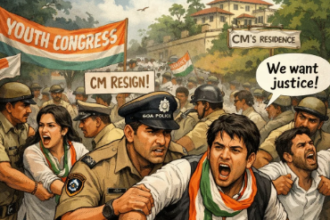
Those slapped with mounting criminal cases for leading a people’s movement against double tracking, those who lost all their cashew trees bulldozed to make the Mopa Link Road, cruelly cutting off their only source of earning; those who have faced brutal police atrocities like the farmer activist from Satarri, Hanumant Parab, the farmers whose fields will be inundated if the Western bypass in Benaulim is not built on stilts. From Pernem to Palolem, from Vasco to Valpoi and everywhere in between, there are people who simply want the justice infrastructure to hear their grievances at any level and deliver justice.
On Christmas day, there are still people waiting for compensation for their flooded fields, or a reimbursement of their hard-earned money spent repairing bunds, when that is the government’s expense anyway.
There are those who are waiting for the investigation into the death of their loved ones passed off as suicides or unnatural deaths.
And there are still others whose ancestral properties were grabbed and sold to third parties, making them aliens on their own lands. They wait for the Special Investigation Team to investigate their cases and put them up to the commission of inquiry, so the process to get their family properties back from the land sharks, begins.
Christmas is all about empathy, understanding, giving, and thinking of the poor, the downtrodden, and the suffering. Many of those who are indeed suffering in Goa are those whose lives have been disrupted by large development projects like bridges, airports railway tracks, and so on. They in turn want the system’s infrastructure to put their lives back on track from the crushed lives they lead today.
Can infrastructure ever be meaningful in the truest sense if those whose futures have been taken away to purportedly build a future for the state and the system, cannot put balm on their pain and be happy stakeholders in the state’s future?
A true season of joy will happen when hearts are joyous, families are safe and healthy and the door of the courts does not have to be knocked for demanding what is right and due to each and every citizen
As the State, and those who control its levers, celebrates festivals, shouldn’t they spare a thought towards those who cannot because its very system has put off the flames in their candles of hope?