Team Herald
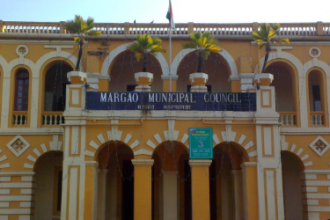
PORVORIM: The town of Mapusa has expanded manyfold in recent years. The rapid pace of construction and development has put a considerable load on its infrastructure. One of the problems being faced by the residents is the disposal of garbage.
Around 15 to 20 tons of garbage is generated in Mapusa every day. The Mapusa Municipal Council (MMC) started door-to-door garbage collection in 2009 and charged Rs 200 per year for this service. In May 2013, MMC had implemented the two-bin system of garbage collection to segregate wet and dry waste at the household level.
MMC has distributed 5-litre bins of black (dry waste) and green (wet waste) colour – which were given by Goa State Urban Development Agency (GSUDA) – to households to dispose of wet waste like fish, meat and kitchen waste in the green bin and dry garbage like paper and plastic bags in the black bin. MMC has employed around 70 labourers on contract basis to collect domestic waste from households. Wet garbage is collected every day, while dry waste is collected thrice a week – Monday, Wednesday and Friday.
Former MMC Chairperson and Councillor Sandeep Falari mentioned that before April 2015, MMC used to spend around Rs 60 lakh on collecting domestic waste from house to house, while they received garbage fees of only Rs 32 lakh from the residents. MMC suffered a huge loss with this service, and therefore, decided to increase the garbage fee from Rs 200 per year to Rs 400 with effect from April 1, 2015.
After implementing the 100 percent hike of garbage fees, the civic body has collected Rs 63.65 lakh in fees over six months. After the hike, the revenue from garbage fees is expected to be three times more than the revenue of the last financial year i.e. 2014-15. In 2014-15, MMC collected Rs 39.74 lakh from households and Rs 3.64 lakh from commercial establishments.
MMC has also kept around 350 community garbage bins of 240 litres each in its jurisdiction. The collected garbage is then dumped at the Assagao plateau by trucks. At Assagao, MMC has installed an organic waste converter (OWC) and a baling machine. The garbage is segregated into wet and dry garbage; the dry garbage is compressed with the bailing machine, while wet garbage is treated in the OWC and converted into manure. The baled plastic is collected by the agency appointed by the state government once in a week.
MMC has also installed an OWC near the fish market to treat wet waste generated in the market area. Besides, there are composting stations in Wards 1, 2, 3, 4, 5, 13 and 14. The wet garbage collated from these wards is treated in these composting units. Mapusa resident Sohan Dessai stated that MMC is undoubtedly doing its best to solve the garbage problem, but its efforts aren’t enough.
He said, “The problem is not going to be solved by installing one or two OWCs. It can be solved only with garbage treatment plants and daily garbage collection.”
MMC has acquired around 32,000 sq meters of land at Cuchelim at a cost of Rs 2.30 crore for setting up a garbage treatment plant, but this project is lying in cold storage due to strong opposition from the locals.
Deputy Chief Minister and Mapusa MLA Francis D’Souza also stated that MMC is doing its best to keep the town clean. He continued, “MMC had decided to set up a treatment plant at Camurlim, but the locals objected to it. The residents should refrain from dumping garbage in the open spaces. If any one is found dumping garbage, a photo of that individual should be clicked and loaded on WhatsApp or Facebook. This will act as a deterrent for others.”