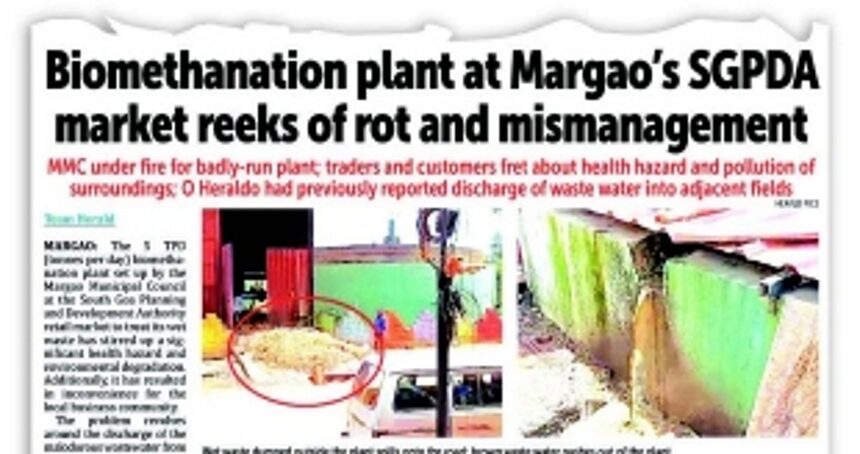
MARGAO: In response to environmental concerns, the Goa State Pollution Control Board (GSPCB) has directed the Margao Municipal Council (MMC) to relocate the bio-methanation plant currently situated in the SGPDA market area. Citing spatial inadequacy and the plant’s proximity to a bustling marketplace and commercial hubs, the Board has stressed upon the urgency of this action, even as this development is the latest of a series of severe setbacks the civic body has faced due to the erratic and problematic bio-methanation plant.
Moreover, in their notice, the GSPCB has mandated that the MMC formulate a comprehensive plan for the establishment of a wet waste treatment facility at the Sonsoddo solid waste management site.
MMC has also been instructed to furnish a compliance report to GSCPB in two weeks.
GSPCB Member Secretary (MS) Dr Shamila Monteiro, also cautioned that failure to adhere to these directives will compel the Board to pursue legal recourse against the MMC Chief Officer (CO) under the provisions of the Water (Prevention and Control of Pollution) Act, 1974, and Air (Prevention and Control of Pollution) Act, 1981, without any further notice.
This decision by the GSPCB follows a recent inspection of the bio-methanation plant. The MS emphasised upon the findings of the inspection report, highlighting the plant’s suboptimal operation and its detrimental impact on the surrounding environment. The Board asserted the need for relocating the plant, given the constraints of the current location, which exacerbate issues such as odour emissions during waste unloading.
In addition to relocation, the Board has instructed the MMC to address immediate concerns, including the clearance of dry waste from the plant premises and the cessation of domestic wash water discharge outside designated areas. These measures aim to mitigate environmental degradation caused by improper waste management practices at the site at present.
The significance of the GSPCB’s directive to establish a waste treatment facility at Sonsoddo is underscored by the limited validity period of this biomethanation plant’s operational consent. With consent issued for a mere six-month period from January 29, 2024, the need for sustainable waste management solutions becomes increasingly urgent.
This directive poses a formidable challenge for the MMC, raising uncertainties about the its ambitious bio-methanation project and its future plans for broader waste management initiatives such as setting up a waste management plant.
Municipality officials do a no-show at plant inspection
MARGAO: GSPCB officials also pointed to the absence of supervisory personnel or MMC representatives at the time of the inspection. The GSPCB inspection team noted that the bio-methanation plant was not operational at the time of inspection, with the collection tank devoid of shredded/crushed waste.
Furthermore, the inspection revealed unsealed openings in the plant’s infrastructure, although no evidence of slurry discharge outside the premises was found. The area behind the plant was observed to be littered with dry waste, raising hygiene and cleanliness-related concerns.
Additionally, instances of domestic wash water discharge outside designated areas were attributed to labourer families residing on-site, further highlighting the need for comprehensive waste management practices.