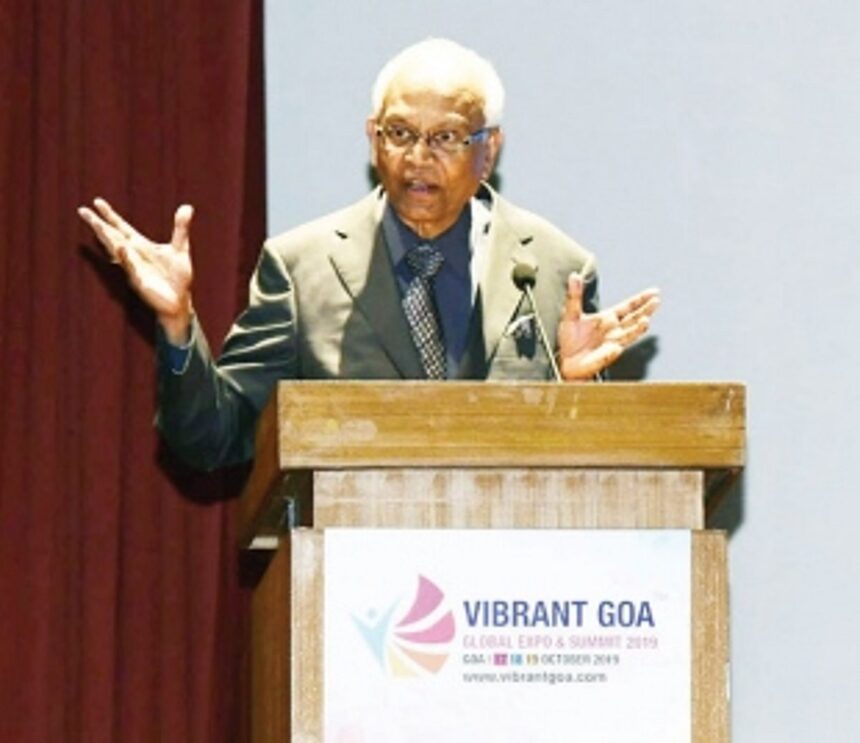
PANJIM: Seventy-six year old Padma Vibhushan Dr Raghunath Mashelkar, son of the soil, could not hide his happiness and a child-like excitement that he was in Goa. A man who has won several accolades, awards and highly decorated has contributed immensely in the world of science has now moved along with the changing times. He now also advocates that with Artificial Intelligence now entering in the technology field there will be a scope for the emergence of new kinds of jobs which we have not thought about so far. He also emphasised the need for self-learning to bridge the gap between rapid technology growth and the present day education system in India.
The eminent scientist and chairman of the board of advisors of the Vibrant Goa Foundation was addressing college students, entrepreneurs and members of the general public at the inaugural session of Vibrant Goa’s Knowledge Lecture series at the National Institute of Oceanography (NIO) on Thursday morning. The lecture series is a precursor to the Vibrant Goa-Global Expo and Summit to be held in Goa during October 17-19 this year.
Dr Mashelkar who was speaking on the topic of ‘Exponential Technology and future of jobs’ explained how the advent of technology like the internet, big data analysis, blockchain, robotics and artificial intelligence was making jobs redundant. “The brawn is being looked after by robots and the brain is being looked after by artificial intelligence. In such a situation what is left for the human beings to do?” asked Mashelkar.
However the decorated eminent scientist said that the situation was not completely dismal. “Technology growth leads to more jobs. Young working professionals will need to have people skills, creativity and emotional intelligence to keep pace with the rapid technology growth,” Dr Mashelkar added.
The scientist also said that no industry and area of business will be spared in the face of rapid technological growth. “This will include the health care, media, insurance, finance, education, marketing, advertising and legal professions among others,” he said.
Dr Mashelkar also advised the government to welcome technology, make technology transfer a precondition
before issuing licences to foreign companies, improve the skill sets of workers in the small and medium scale companies and offer expert career counselling to the youth of our country.
Stressing the need for innovation, he explained how innovation was capable of converting knowledge into money. Citing the example of Harshvardhan Zhala, the 14-year old young Indian teenager who recently designed a drone which could not only detect land mines but can also defuse it, has managed to get a commitment from the Gujarat government for a Rs five crore manufacturing grant. “These are the success stories, which are inspiring,” added Dr Mashelkar.
However there is a concern that though India’s position on the global innovation index had improved from number 62 in 2011 to number 52 in 2019, it was still far behind China (which is at 14) and this was a worrying thought.
In the panel discussion which followed the lecture, Prof Varun Sahni, Vice Chancellor of Goa University highlighted the deficiencies in the Indian education system by stating, “We are teaching 21st century students, 20th century education material in 19th century institutions.”
Adding his own perspective to the discussion, Dr Mashelkar admitted that the skill gap was worrying. “In China, they have begun teaching artificial intelligence in primary schools beginning as early as Class V, while children in Amercian schools were comparatively more ready for a rapid technological change than elsewhere in the world,” Dr Mashelkar said.
Prof Sunil Kumar Singh, Director, NIO, Mr Nitin Kunkolienker, c
Chairman, Vibrant Goa Foundation, Mr Rajkumar Kamat, President, Vibrant Goa Foundation and Mr Jagat Shah, chief mentor, Vibrant Goa also spoke at the event.