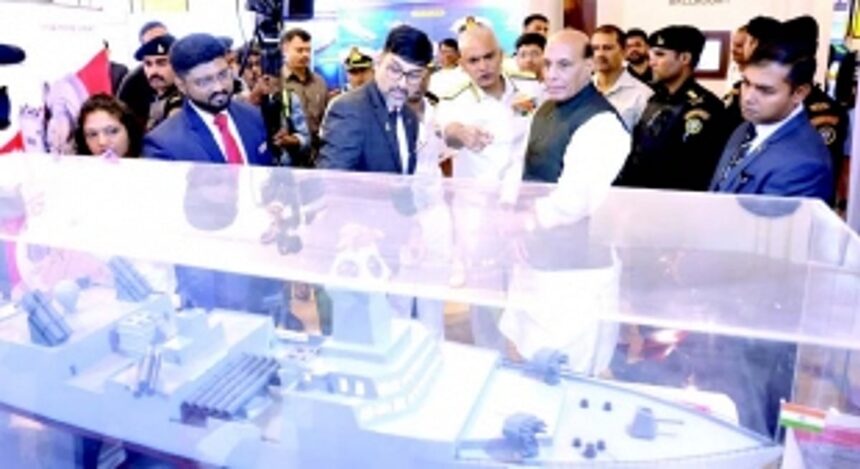
PANJIM: Focusing on the need to establish a multi-national collaborate framework to successfully tackle common maritime challenges in the Indian Ocean Region, Union Defence Minister Rajnath Singh stated that ‘might is right’ has no place in a ‘free, open and rule-based’ maritime order.
In his key note address,at the fourth edition of Goa Maritime Conclave organised by the Indian Navy held at Bambolim, the Defence Minister on Monday called for establishing multinational collaborative mitigation frameworks in the Indian Ocean Region to effectively tackle common maritime challenges such as climate change, piracy, terrorism, drug-trafficking, overfishing and freedom of commerce on high seas.
The theme for this year’s edition is “Maritime Security in the Indian Ocean Region: Converting Common Maritime Priorities into Collaborative Mitigating Frameworks”.
Singh expressed concern over Unreported and Unregulated (IUU) fishing stating that it is a challenge which relates to resource over-exploitation. “A multinational collaborative effort for compilation and sharing of surveillance data is the need of the hour to tackle illegal, unreported and unregulated fishing,” he asserted.
Singh emphasised that common maritime priorities need to be addressed cooperatively by avoiding selfish interests that make the region less secure and less prosperous. He underlined the importance of respecting the international maritime laws, as enunciated in the United Nations Convention on the Law of the Sea (UNCLOS) 1982.
“A free, open and rule-based maritime order is a priority for all of us. ‘Might is right’ has no place in such a maritime order. Adherence to international laws and agreements must be our lodestar. Our narrow immediate interests may tempt us to flout or disregard the well-established international law, but doing so would lead to the breakdown of our civilised maritime relations. Our common security and prosperity cannot be preserved without all of us committing to cooperatively adhering to the legitimate maritime rules of engagement. Fair rules of engagement are crucial for fostering collaboration and ensuring that no single country dominates others in a hegemonic manner,” he said.
On climate change, Singh stated that the collaborative mitigation framework can involve the countries working together to reduce carbon emissions and transition to sustainable practices. He pointed out that the world could overcome this problem if all countries accepted the responsibility to cut emissions by investing in green economy and share technology & capital with the needy countries.
The Defence Minister also urged nations to work together to reduce carbon emissions and switch to sustainable practices to deal with climate change.
Union Minister of State for External Affairs Meenakashi Lekhi batted for cooperation among IOR nations to ensure peace and prosperity in the region. Underscoring the importance of IOR, she lauded the Indian Navy for protecting the nation’s maritime interests and being the first responder in the region in times of crisis.
Chief of the Naval Staff Admiral R Hari Kumar emphasised the changing nature of threats, both traditional and non-traditional and those emanating from the sea.
The conclave, is attended by representatives of 11 other Indian Ocean nations – Bangladesh, Indonesia, Madagascar, Malaysia, Maldives, Mauritius, Myanmar, Seychelles, Singapore, Sri Lanka and Thailand.