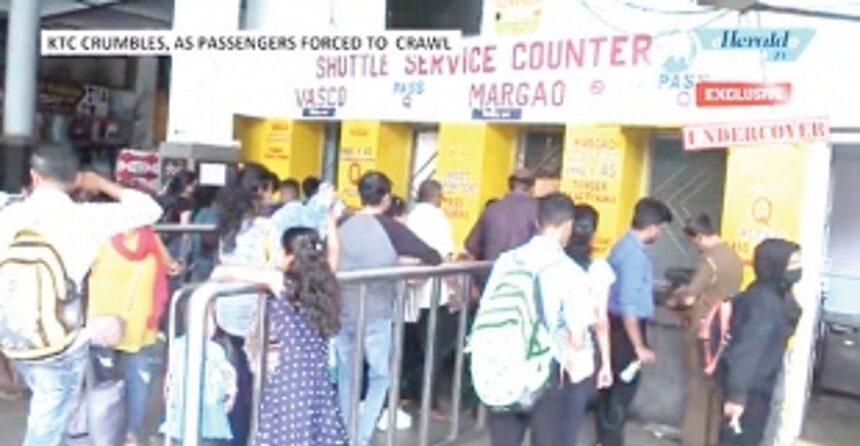
MARGAO: As Goans and tourists reel under the unbearable heat of the summer, the shuttle services of the State-run Kadamba Transport Corporation Limited (KTCL), are nothing short of a boiling cauldron for its bus passengers.
A ground report by Herald TV reveals how passengers are made to wait in serpentine queues for hours to board an AC shuttle bus and are ultimately told they will not be able to do so.
One of the most affected routes is from Margao to Panjim. Office goers particularly are the most affected, especially while travelling to Panjim in the morning. Almost all these office goers purchase a monthly bus pass costing Rupees 1,815. Yet they struggle to get on board an AC shuttle bus. In conversations, KTCL staffers confess there is no fixed schedule for the shuttle AC bus services and hence the probability of a bus commuter entering the KTCL bay, is almost nil. Herald TV also found out that a male staffer of KTCL at the booking counter in Margao claimed that an AC bus might be available in half an hour, but there was no guarantee.
So where are the newly-introduced AC Electronic (EV) buses? Well, the State government has diverted the new AC EV buses at the Manohar International Airport at Mopa and at Dabolim, without augmenting the trouble; both financially and otherwise it would burden commuters. Similarly, 20 EV AC vehicles that were recently introduced, have now been deployed for the ongoing G20 meetings in the State.
But that’s not all. The mess of the KTCL is akin to an onion. With every layer peeled, the stench only grows. While on one hand, both Goa and the Central Government are pushing citizens to embrace online payments, KTCL staffers would prefer not to.
The Herald TV reporter went to book a fortnightly AC bus pass, which costs around Rs 1,065 in Margao, the cashier stated that only a debit card or cash would be acceptable and not any UPI-based payments. This is despite the fact that KTC terminuses in the State are plastered with PayTM posters asking passengers to avail of cashless payments . Photocopies pasted on ticket counters too are seen asking passengers to go cashless. A male staffer at the booking counter confessed that the management has said no to payments via UPI and in case someone wanted to pay in cash, citizens would have to tender exact change.
There are several such chronic issues affecting the beleaguered bus corporation. In the first series of exposes carried out as part of our ongoing series, two problems clearly stand out. One, passengers will have to make do with old rocketry buses that are similar to empty tins filled with live coals, and two; bus commuters will have to carry enough cash instead of following the government’s outreach programme to go digital.