PANJIM: The ravaging of oceans due to excessive human activity is leading to issues like warming of ocean, noise pollution and presence of chemical laden microplastics which are having serious repercussions in Goa like depleting fish catch, erratic monsoon and is also posing severe health risks, experts said here on Thursday, commemorating World Ocean Day 2023.
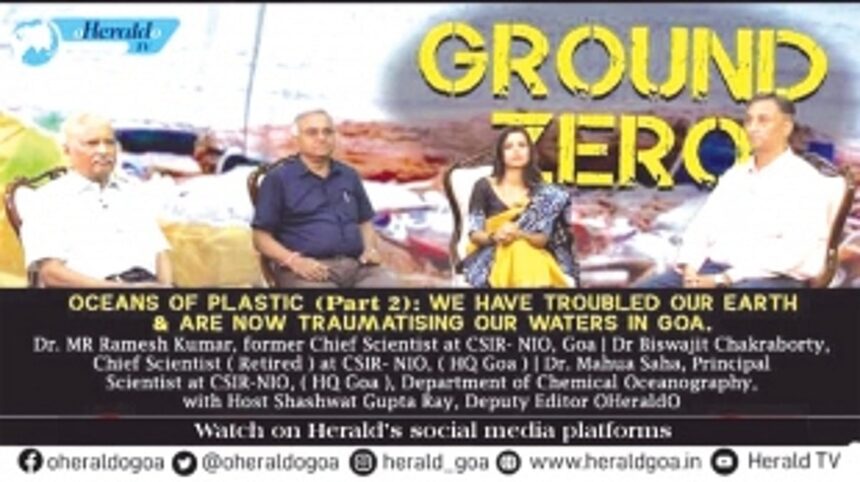
In a special discussion on Herald TV on World Ocean Day “Oceans of Plastic” senior scientific experts on Ocean studies had an intense discussion on the ravaging of the oceans with specific references to the damages in the seas in and around Goa.
“Due to climate change, the oceans are warming up, which is having a direct bearing on the monsoon, which is so crucial in terms of water availability for drinking, farming and various other activities. Erratic monsoon on the one hand can lead to drought if there is deficit rainfall, it can cause floods if there is excess rainfall,” Former Chief Scientist, CSIR-National Institute of Oceanography (NIO), Goa, Dr R M Ramesh Kumar said.
Speaking at a special panel discussion, Dr Ramesh Kumar said, “Coastal areas like Goa are worst affected due to climate change and extreme weather events. Goa this year has witnessed 56 percent deficit in pre-monsoon showers, which generally occur between March and May. The weather was also extremely hot,” Dr Ramesh Kumar said.
“In contrast, Gujarat had 863 per cent of excess rainfall in this same period, while our neighbouring States – Maharashtra and Karnataka had about 163 per cent and about six per cent excess rainfall respectively,” the former NIO Chief Scientist said.
“If you take the entire Indian subcontinent, we actually had 12 per cent excess rainfall,” the former NIO Chief Scientist said.
“Also, being a coastal State, the warming of oceans would mean the fish will either migrate to cooler waters or they will go deep down. This can lead to the extinction of many popular marine species like the shellfish and clams, which are consumed by Goans,” he said.
Citing examples of extreme rainfall events in Goa, the veteran ocean scientist said that rainfall that is generally recorded over 10 days or even a month is occurring in a day.
“That’s actually bad. It causes floods and adversely impacts our crops and drinking water facilities. This is followed by a prolonged break in between rainy days. So, the amount of rainfall remains the same, but it is happening in a much shorter time span. This also impacts our wildlife and biodiversity,” he added.
Speaking on the problem of noise pollution in the rivers in Goa and the sea, off Goa coast, former Chief Scientist, NIO Dr Bishwajit Chakraborty said, “There has been a spurt in commercial activities in the sea and rivers of Goa. Be it drilling the sea bed for building bridges or movement of big cargo ships, there is a lot of noise created.”
From the studies done by Dr Chakraborty and his team at Grande Island, off the Goa coast, a lot of variability in day and night temperature was recorded.
“The problem of loud sound underwater is getting amplified due to the warming of the ocean because sound travels faster in hot temperatures. Due to the excessive noise pollution, fish production is affected,” Dr Chakraborty said.
He said that fish communicate among themselves before their reproductive activity.
“If the background sound is more, then it masks their sound. This hampers their communication. They cannot listen to the mating calls. So it is quite natural for the mammal and for the fish to look for different environments and go away from their present location,” he said.
This means that in the long run, the fish availability in coastal regions like Goa will reduce drastically.
Highlighting another problem of plastic in the ocean, Principal Scientist, Chemical Oceanography, NIO Dr Mahua Saha said that plastic pollution in Goa’s coastline poses a huge health risk to the locals as well as the huge floating population that comes to Goa.
“After standardising the protocol to study microplastics, I collected samples from our Goa coast in two phases, first in 2015 and again in 2021. We started from the most polluted beaches like Calangute and Colva and moved to the most remote beaches like Galgibaga and Keri. We covered six to seven beaches and studied the distribution of microplastics,” Dr Saha said.
“We found quite a high abundance of microplastics. But the interesting part is, in 2015 we found almost more than 50 per cent of samples were macro plastic (larger plastic) and 20 per cent microplastics. But, after five years, I found the same beaches had more than 40 per cent microplastics,” Dr Saha said.
So, in a five years gap, those plastics which were lying for several years on the beaches, degraded and formed into microplastics.
“While trying to find out the sources of microplastics in Goa, we collected a lot of samples from the sewage which is coming directly from the treated and untreated. So surprisingly, we found microplastics even in the treated water,” she said.
She warned that these chemical-laden microplastics are entering our food chain, posing severe health risks.
“Shellfish and clams, which are part of the fish thali consumed by locals and the tourists, are consumed by Goans as well as a large number of tourists coming here. These hazardous microplastics, when entering our body through seafood, can cause severe diseases like cancer,” Dr Saha said.
While human activity on the ocean can’t be stopped totally, its regulation is essential along with changes in human behavioural patterns to conserve the lifeline of earth.