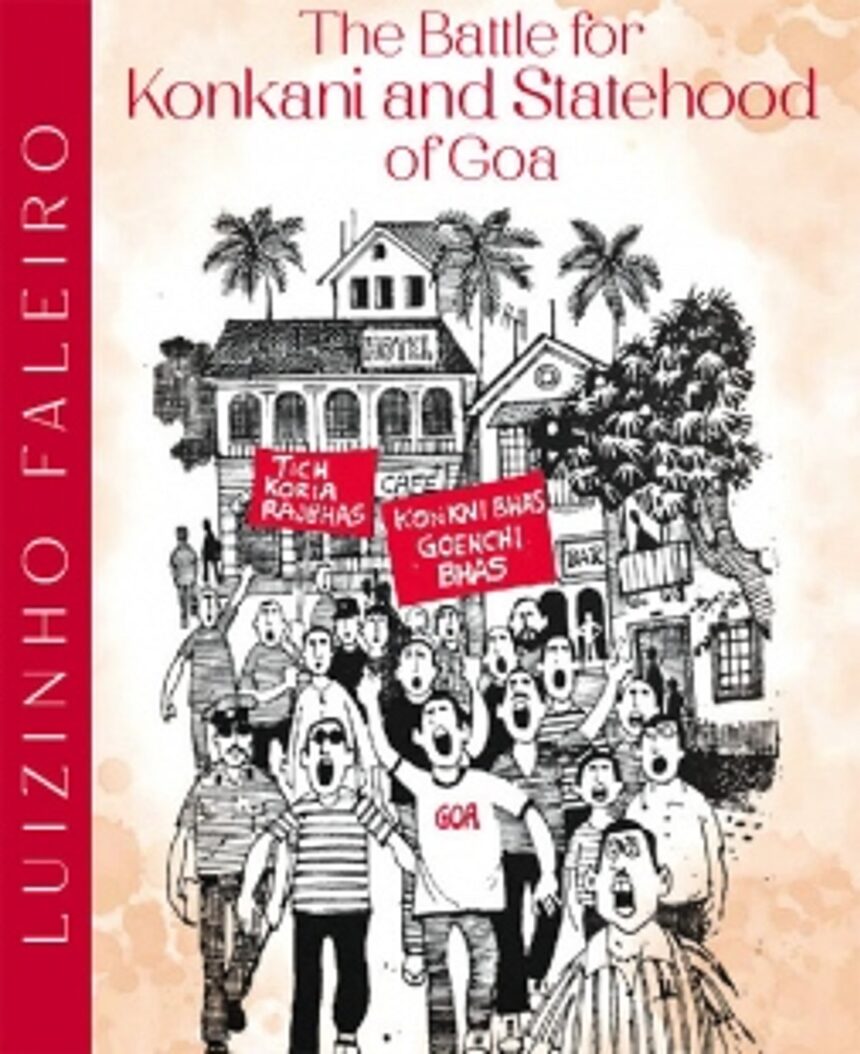
The Battle for Konkani and Statehood
Luizinho Faleiro
I have been and still remain nothing but a foot soldier for the causes of Goa and Goans. I am one of the many that this land we all love has given birth to. From being a student to being a politician, but always a student of history, Goa’s crusade for Konkani and tryst with Statehood became an integral part of my life. It is that journey that I recount in these pages as a duty to my land and its people, and as a tribute to all those who participated in the movement that bestowed Official Language status on Konkani and gave Statehood to Goa.
The battle for Konkani and Statehood has been the most passionate of movements Goa has ever seen or that Goans will ever witness. While the Opinion Poll of 1967 may have settled the question of merger of Goa with Maharashtra, it neither protected Konkani nor granted Statehood to Goa. It was a status quo and it was over 25 years after Liberation that we were able to obtain Official Language recognition for Konkani and Statehood for Goa. Neither would have been achievable had it not been for the people who, unlike at other times, came together, stood resolutely and did not waver in their determination to make Konkani the Official Language of Goa. It turned into a veritable battle waged by the people of a pacific land, a land that has since time immemorial been known for its unique history, geography, culture and, most important of all, peace. But then there came a period when the people of the land aspired for nothing less than Official Language status for their mother tongue Konkani and Statehood for their land Goa. To obtain both, they battled the odds and emerged victorious.
The Opinion Poll ensured Goa would retain its Union Territory status. But, did it lift that Damocles Sword of merger that hung above the heads of Goans?
States in India had been carved out on the basis of language. Even after the Opinion Poll had been won by the anti-mergerists, the Maharashtrawadi Gomantak Party which was elected four times to form the government in Goa did not relent on its promotion of Marathi. In doing so, the party emerged as the champion of lost causes, having championed the cause of Marathi as the language of Goa and that of merger of Goa with Maharashtra, both unsuccessfully. Even after the Opinion Poll had rejected merger, the party did not give up on this. Even in 1971, its party MLAs introduced a Private Members’ Bill in the Legislative Assembly of the Union Territory of Goa, Daman and Diu, aimed at making Marathi the Official Language of Goa.
One has to understand that the motivation behind such Bills could have had just one aim – that of merging Goa with Maharashtra. Merger would be a simple corollary of Official Language status to Marathi as States had been reorganized on linguistic basis. The Official Language of Maharashtra was Marathi, so if the language of Goa was Marathi, the demand for merger would immediately follow. The Maharashtrawadi Gomantak Party continued to espouse Marathi as being the language of Goans and as long as this idea was propagated, the question of merger could not be wiped clear off the slate. Despite the victory of the Opinion Poll, deep down I knew that only Statehood for Goa would put to rest all speculation and the possibility of merger. But Statehood would not come without first settling the question of language.
As a young MLA, I was thrust into the Konkani movement, assuming, along with the Konknni Porjecho Avaz the leadership of the movement, with me handling the political side and the writers, artistes, poets doing the rest. Yet, the movement would not have been successful, had not the people responded to the call in the manner they did. The Konkani movement was truly a people’s movement. For their language, for their mother tongue Konkani, Goans united irrespective of class, creed, caste. To me, Konkani was the language of Goans, still is the language of Goans and will always be the language of unity. I believe that just as it brought together Goans in the 1980s, it will bring Goans together today and tomorrow, whenever there is a threat to their identity.
When I look back at the events that occurred between the years 1980 and 1987 that led to Konkani being bestowed Official Language status and Goa raised to Statehood, I feel a deep sense of accomplishment. These were the twin aspirations of Goans that I had promised to achieve and a long struggle later, I did deliver on these assurances. It wasn’t easy achieving this. This was no sprint that one could race, it was not even a steeplechase with known hurdles, it was truly a cross country race, run on a course that was unknown, that was fraught with unexpected new obstacles at every corner.
Many will remember that period for the bandhs that brought Goa to a standstill, for the arrests that put many people behind bars, for the meetings that drew hitherto unimaginable numbers of people and the deaths that cast a pall of gloom over the land. But the movement went beyond all that.
What you will read in the chapters that follow are my recollections of the movement that delivered for the people the golden aspirations of Goans – Konkani and Statehood. This was a movement entirely of the people and the leadership was there merely to give it direction and rein it from going out of hand.
Neither a historian am I, nor a political thinker, but I believe that I should commit to paper the people’s movement, I would call it the people’s battle for Konkani and Statehood, as I had seen it from the closest possible quarters. My view is not coloured. I was there. I saw and experienced the passion, the commitment, the involvement and the great sacrifices of the people of Goa, even the ultimate sacrifice of shedding their blood for the language. Even today, remembering this brings my hair to stand on end. How can one think of this period and not remember the sacrifices that the people made?
I was there to see and sense the fury and determination of the people from the closest possible quarters. I talked with the people, I walked with the people, I was flung into the movement that can only be described as a volcanic eruption that swept all that came its way. All it required was one call and people would emerge in large numbers. There was anger in the people, but there was also a resolve to see that their language Konkani, the language that bestowed upon them their identity, their culture and which had been kept alive by their ancestors, would be respected by the government of the day by it being made the Official Language of the Union Territory, and that at no point of time would future governments attempt to change that status or even dilute it. For that they suffered the pain of the police lathis, they were arrested, they took bullets and a few shed their blood, making the supreme sacrifice for the language and the land.
During that period, between mid-1985 and early-1987, my house turned into the nerve centre of the battle. It was from here that plans were made and then executed. Anybody walked into my house in those days, and there was always an army of advocates prepared to draft and file bail applications or other legal applications required to release those arrested by the government. I was witness to it all, I was in the midst of it all and, I reiterate, I don’t believe that what happened at that time will ever repeat in Goa. Neither am I, nor is this book, attempting to bring you the chequered past of Goa’s conquerors or conquests. There have been many conquests, and I will let history speak of those. What you will read here is the definite and verifiable account of a phase in Goa’s post-liberation period, as I see and remember it and which, I most humbly believe, should not remain just oral history, but be written down, nay inscribed, in letters of gold.
These are my memories – the personal recollections and a foot soldier’s account – but they are also facts that can be corroborated through newspaper reports of that time, and through transcripts of the debates in the Legislative Assembly. This is not a story for entertainment, this is a narrative of an event in history so that generations of Goans will not forget how those who came before them, battled to bestow upon their language it rightful position and preserve for Goa its identity through Statehood.