AMAN VERMA
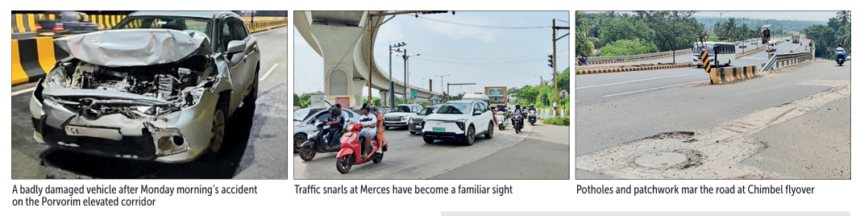
The accidents on the Porvorim Elevated Corridor may have put road safety under the spotlight, but the questions they have triggered do not begin or end in Porvorim. From Merces to Chimbel and Porvorim, recurring complaints over access, turning movements, merg ing, road geometry and lo cal connectivity point to a larger concern — whether Goa’s road-building strat egy is designed primarily to move traffic through an area rather than accommo date the people who live and travel within it. At Merces, activist Fran cis Coelho questions the logic of forcing local traffic into circuitous movements even as major infrastruc ture is built to speed up highway traffic. “If you are going fromMerces to Chimbel, why should you have to go up, travel ahead and then take a U-turn?” he asks. His question goes to the heart of the problem: traf fic may move faster along a flyover or elevated corridor, but that does not necessarily make the road network more functional for local users. Merces sits at the inter section of traffic from the highway, Old Goa, Chimbel, Atal Setu and surrounding areas.

Coelho describes the resulting movement as “completely chaotic” and questions whether the in frastructure is being de signed principally around through-traffic. “Does this flyover benefit the local Goan people or only the highway traffic?” he asks. At Chimbel, the same issue has played out over the years. The flyover was intended to ease conges tion at the old signal and improve the movement of through-traffic. But lift ing vehicles over a junc tion does not eliminate the movements of those who need to turn, enter or exit. Those movements have to go somewhere — to another junction, another merge or another U-turn. That is where the real test of road planning begins. The issue has become impossible to ignore in Por vorim following the fatal crash soon after the elevat ed corridor was inaugurat ed, a second accident at the same location, subsequent restrictions on two-wheel ers and changes to access arrangements. Another ac cident was reported in the wee hours of Monday, badly damaging two vehicles. No injuries were reported. The government has since brought in an IIM-Nagpur team to examine traffic movement and safety ar rangements. The accidents themselves do not establish that the corridor’s design caused them; police have attributed the fatal crash to rash and negligent driving. But the subsequent changes and technical review have inevitably placed the corridor’s traffic design and ac cess arrangements under scrutiny. For Porvorim resident and activist Dipesh Naik, the con cerns extend well beyond the crashes. “Since they have compromised right from day one, there is no complete solution,” he said, raising concerns about road width and access. “Many places lack proper width for two lanes and proper access,” Naik said.
Whether each of these concerns is borne out by a techni cal assessment remains to be established. Local resident Sigmund de Souza focuses on the interac tion between local roads and faster-moving traffic. “You can’t have side roads opening out onto main roads at right angles,” he said, arguing that vehicles entering the main carriageway need sufficient space and distance to merge safely. At Merces, he suggested that vehicles descending from Atal Setu should run parallel to the lower road for around 25 to 30 metres before joining the main traffic stream. “Entry and exit ramps should not be at the same point,” de Souza said. The point is not simply about driver behaviour. Vehi cles entering a traffic stream need room to accelerate and merge, while those leaving need adequate space to slow down and manoeuvre. How these movements are designed into a road can determine whether traffic flows smooth ly or competing movements are compressed into conflict points. “You don’t need an IIM team to come here and sort these problems out,” de Souza said. “It’s just common sense.” Transportation engineer Dr Jorson Fernandes also ques tioned what traffic analysis was undertaken before the Por vorim corridor was opened. “Road engineering is basically an engineering subject which calls for technocrats and not management gurus. The technocrats are needed first to analyse the data and design roads for smooth flow of traffic,” Fernandes said.
He said traffic studies should account for vehicle vol umes, speeds, density, travel time, headway and the mix of two-wheelers, cars, three-wheelers, light commercial vehi cles and heavy vehicles. The purpose, he said, is to understand how traffic will behave not merely on the main carriageway but also at points where vehicles enter, leave, merge and turn. “Traffic data collection is critical before launching any project of this sort,” Fernandes said. He also questioned whether the government’s technical review should examine the physical design of the corridor in sufficient depth, including lane geometry, gradients, bar riers, sight distances, merging arrangements and drainage. “The government will have to clarify if the Nagpur-based management group offers expert technical corrections to physical design flaws, including entry and exit arrange ments, geometric issues and drainage failures,” he said. Fernandes has called for an independent technical and road-safety audit involving specialised transportation and highway engineering expertise. That scrutiny should not be confined to Porvorim. Activists have also questioned basic supporting infra structure around the corridor. Sanjay Barde, citing infor mation obtained under the Right to Information Act, said 14 promised bus shelters and two public toilets along the service road had not materialised. He also said only 169 of the 343 electricity poles tendered had been installed.
Barde said the local MLA had assured residents during con struction that the bus shelters and toilets would be provided, and demanded that the government clarify their status. Activist Xencor Polgi, meanwhile, has called for the govern ment to acquire land currently used for parking near the Neo Majestic Hotel and use it to widen the road and ease conges tion. He also alleged that ministers who had taken credit for the project had “beat a hasty retreat” after the accident. Critics say infrastructure is not only the flyover, bridge or elevated carriageway visible in project photographs. It is also the service road, bus stop, footpath, junction, turning pocket, drainage system, entry and exit ramp, and the route by which a resident reaches home. That is where Porvorim connects to Merces and Chimbel. The locations are different, but the recurring complaint is strikingly similar. A wider road does not automatically provide better access.
A flyover does not automatically re solve congestion. An elevated corridor does not automati cally improve local connectivity. That makes Porvorim more than an isolated post-acci dent controversy. Critics say it should prompt a review of how Goa plans major road infrastructure wherever high-speed corridors intersect with established settlements. The test must also be whether a resident can enter the road safely, leave it predictably, turn without unnecessary detours, merge without crossing conflicting traffic and reach a bus stop or neighbouring locality without navigat ing an obstacle course. Porvorim has brought those questions into public view. Merces and Chimbel suggest they have been waiting much longer for answers. (With inputs from Marcos Gonsalves and Vithaldas Hegde)