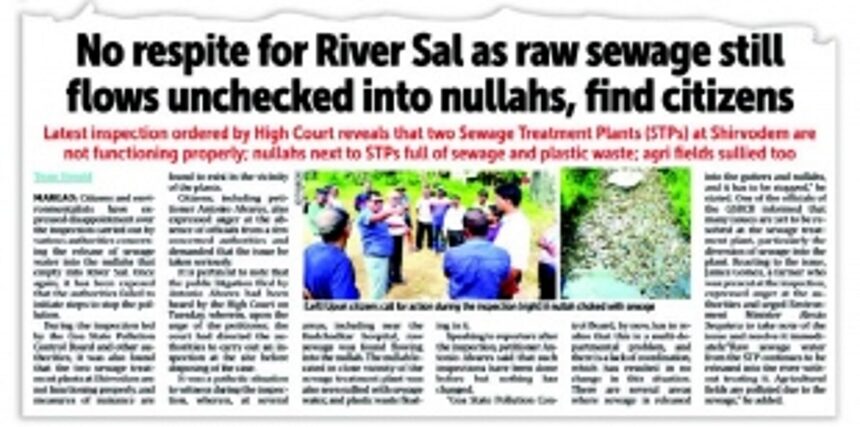
MARGAO: Ahead of the High Court taking up the Public Interest Litigation (PIL) on the unabated sewage discharge into Margao’s nullahs on January 24, the petitioner Professor Antonio Alvares has questioned whether Goa State Urban Development Agency (GSUDA)’s Master Plan for Margao has taken into consideration the issues faced by residents on the town’s periphery – especially sewage flow into Navelim fields and River Sal.
Alvares questioned whether GSUDA has factored in Margao’s drainage network map in the Master Plan, emphasising the need for comprehensive planning.
Recently, the Margao Municipal Council (MMC) submitted Margao’s drainage network map to the HC, following court instructions to finalise the drainage plan in coordination with GSUDA.
Highlighting the recent sinking sewerage chamber issue in Nagmodem, Navelim as an example, Alvares underscored the inadequacy of Navelim’s two Sewerage Treatment Plants (STPs) in handling Margao’s sewage, leading to reluctance among residents to connect their houses to the STPs.
Alvares also pointed out that in the year 2011, the government had insisted that they needed to acquire one lakh square metres of land near the Saipem lake in Navelim to act as the STPs’ buffer zones, irrespective of the fact that farmers use this land for cultivation.
He recalled that while Japan International Cooperation Agency (JICA) had said such additional land was not required as the technology is sufficient, the then District collector had said the land is required as the population of Margao is likely to increase multi-fold in 20 years and thus more plants would need to be set up.
However, Alvares pointed out that till date no plant had come up in the buffer zone.
Expressing concerns about overpopulation and development without basic infrastructure, Alvares questioned whether the new Margao Master Plan will address drainage issues, audit slums, and ensure building setbacks.
Referring to government inspections, Alvares highlighted commercial and residential establishments lacking sewage connections, exacerbating the situation in slums with pipes discharging into nullahs.
To back his arguments, the Goa State Pollution Control Board (GSPCB) inspection reports have also revealed alarming findings regarding the widespread discharge of sewage into stormwater nallahs in Margao. (see box)
Despite numerous inspections over the past two years, including those by GSPCB, there have been no effective solutions for sewage disposal through stormwater drains.
Sewage, stagnant water in almost all nullahs in Margao: Pollution Control Board report
During monsoon months, STP at Navelim faces practical challenges, leading to sewage being diverted into nullahs that empties into Saipem Lake, and eventually into River Sal
MARGAO: The Goa State Pollution Control Board inspection report specifically emphasises sewage and stagnant water in almost all examined stormwater nullahs in the Margao sector, painting a grim picture of sanitation in the commercial capital. The focus on Margao raises concerns about the situation potentially being worse in the Fatorda area.
A closer look at GSPCB’s findings unveils the disturbing reality of rampant sewage flow into the once-beautiful Saipem lake in Navelim. The report details sewage entering a uallah before reaching Saipem lake and, subsequently, the Sal. Specific sites, starting with Saipem Lake, were identified, with observations of sewage flow, including non-biodegradable waste like plastic bottles and tube lights accumulating along the nullah leading to the lake.
The report notes that the 20 MLD STP at Shirvodem, Navelim, treats sewage from October to May but faces practical challenges during monsoon months. Consequently, sewage diversion towards the STP is halted, leading to the flow through the nullah towards Saipem Lake.
Further investigations highlight sewage flow from the Kudchadkar Nursing Home nallah to Saipem lake, originating from areas like Gandhi Market and Malbhat with no established sewer network.
Noting the operational status of the two STPs, GSPCB observed that the effluent monitoring system for the 6.7 MLD STP is not connected to the GSCPCB server.
The final two sites, Khareband and Azadnagar, also depicted sewage flow through nullahs inslum areas.