CURTORIM: One interesting and perhaps unaccounted aspect of the move to restrict and prevent the transfer of agricultural land to non-farmers, in Salcate, is the fact that more than 70% of the Agricultural land is under the control of comunidades.
For the government, taking the Comunidades, the custodians of community land, into confidence and making them a part of the decision-making process will go a long way in achieving the goals of this bill.
The Goa Restriction Transfer of Agricultural Land Bill, 2023 also aims at giving assurances to the several Comunidade in Goa that their agricultural land will be protected under the new law.
However, most of the comunidades are of the opinion that the right to decide the future of agricultural land owned by them should be bereft of what they call “political and government interference”.
In this taluka, nearly 70 to 80 percent of agricultural land ownership is with comunidade and farmers hold the rights on just 20 to 30 percent of agricultural land, informed the agricultural department.
But some from the rural communities in Salcete also feel that since a large number of farmers cultivate the paddy crop as tenants and not as the owners of the paddy fields; the new bill may give a good scope for community farming in Goa.
According to J Santano Rodrigues, a farmer, and head of the Bio Diversity Committee of Curtorim, the land cultivated is mostly owned by the concerned comunidade and there are few paddy fields owned by the actual farmers.
“One must remember that the paddy fields which are not converted or not transferred are basically those which have tenant farmers. The rest have already transferred their paddy fields to somebody else, followed by conversion,” said Rodrigues.
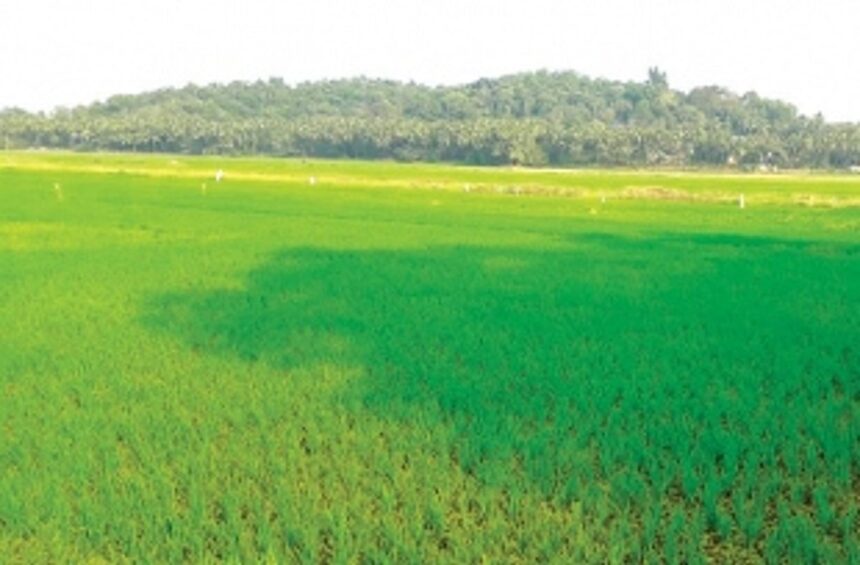
But the bill aims to protect whatever is remaining. Information gathered from the zonal agricultural office at Margao states that presently nearly 5200 hectares of paddy fields are under cultivation. Five years back it was nearly 4975 hectares. Hence there has been a small increase of 225 hectares, wherein community farming has increased to some extent in the Salcete.
The scenario of fallow agricultural land is an interesting one. In 2020 the department had recorded 2653 hectares of fallow land. Till March 2023 only 200 more hectares of the area have been brought under paddy cultivation.
Camilo Barretto, Attorney of Comunidade Davorlim said, “The government needs to take comunidades into confidence before taking the decisions of the agricultural land owned by comunidade. It is our right to decide upon the land owned by comunidade.”
But there is scepticism from some quarters. Santano Rodrigues said that there is not much increase in paddy cultivation in the village.
“The ground reality is different from what the government wants to take forward with the help of a new bill. This bill has no benefit to the farmers in general,” he said.
Xavier Fernandes, another farmer from Chador also expressed a similar opinion and said that the new law is a good one but it will hardly benefit the farmer in general.
“I see nothing extraordinary in the bill that has been introduced by the government,” he stated.
Pointing out the clause that farmers cannot sell agricultural land to non-agriculturists unless the collector concerned grants permission, many farmers asked, what if the Collector gives his nod to transfer agriculture land?
“The intentions of introducing the bill may be good but it will not serve the purpose as there are provisions for cooperative farming societies, industries who intend to buy agricultural land to pursue farming.
Bruno Rodrigues, a farmer and Secretary of the Betalbatim Tenants Association said that he too was in a confused state of mind pertaining to the bill and benefits to the farmers.
“There are several other issues pertaining to agriculture that need to be resolved immediately. The government should have also consulted the representatives of the farmers before introducing the bill,” he added.