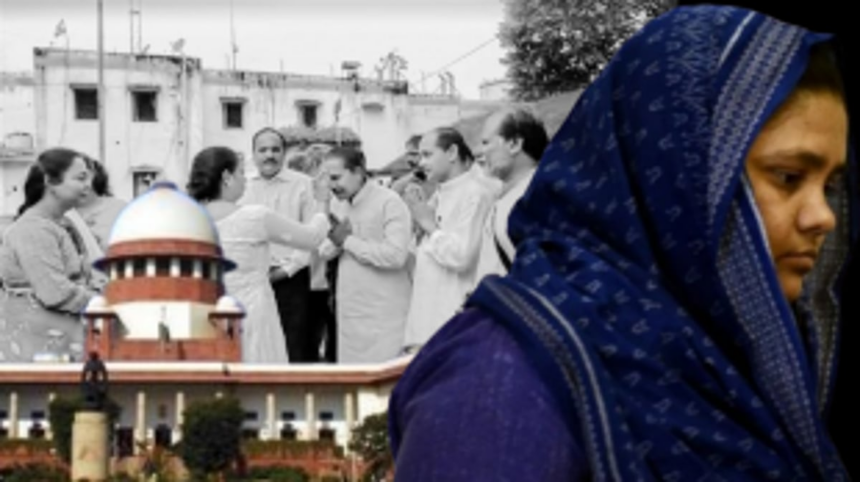
In a significant ruling on Monday, the Supreme Court nullified the Gujarat government’s decision to grant remission to 11 convicts involved in the gangrape of Bilkis Bano and the murder of seven of her family members during the 2002 Gujarat riots. The court also rejected the convicts’ plea to protect their liberty and directed them to report to jail authorities within two weeks.
The court declared that the Gujarat government had exceeded its jurisdiction in entertaining the remission application and issuing orders, emphasizing that the appropriate government to decide remission is the state where the accused were sentenced, not the state where the offence occurred or the accused were imprisoned. The bench of Justices B V Nagarathna and Ujjal Bhuyan further asserted that the May 2022 order directing the Gujarat government to decide on remission was obtained through the suppression of facts and fraudulent tactics, rendering it null and void.
The controversy arose when the Gujarat government, on August 15, 2022, released the 11 convicts under its 1992 remission and premature release policy. This move followed a petition from Radheshyam Shah, one of the convicts, who had completed 15 years and four months in jail after being sentenced to life imprisonment by a CBI court in Mumbai in 2008. Bilkis Bano, the survivor, approached the Supreme Court, expressing her shock and dismay at the en masse premature release of the convicts, describing the crime as one of the most gruesome in the country’s history.
Recalling the horrifying incident, Bilkis Bano, who was 21 years old and five months pregnant at the time, was gang-raped while escaping communal violence triggered by the Godhra train burning incident. Tragically, her three-year-old daughter was among the seven family members killed during the riots.
It is important to note that in 2008, a Mumbai trial court sentenced the 11 convicts to life imprisonment, a decision later upheld by the Bombay High Court in May 2017. The recent Supreme Court ruling overturning the Gujarat government’s decision marks a crucial development in the pursuit of justice for the victims of this heinous crime during the 2002 Gujarat riots.