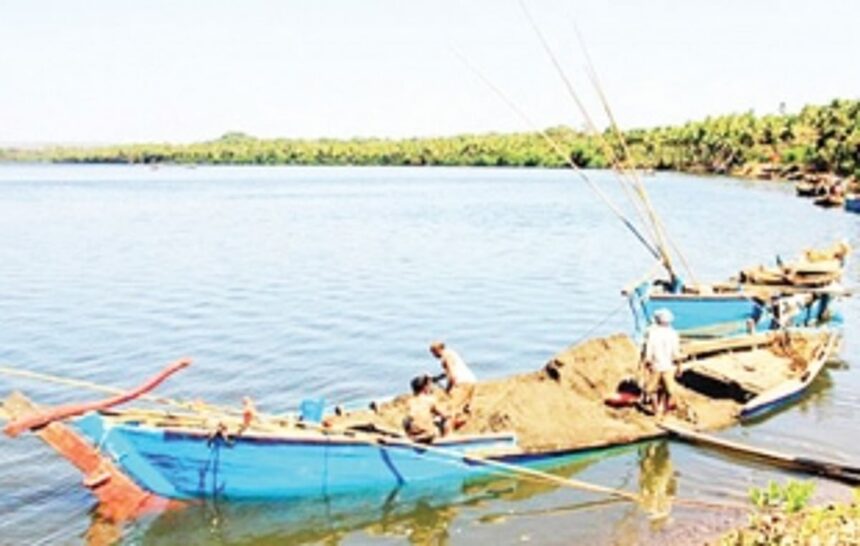
PANJIM: The State Expert Appraisal Committee (SEAC) has permitted sand mining activities, only by manual method, along four stretches of River Chapora, with a condition that 1/4th of the river area to be declared as “no mining” zone for the protection of the river bank.
During its meeting on September 22, the SEAC decided to recommend extraction of sand by traditional method along Estuary Region, Morjim Jetty, near Sati Devi temple and below Ozorim Tormas bridge over River Chapora, with only 50 per cent and 10 per cent of the sand to be extracted annually. While banning sand mining activities after sunset and before sunrise, SEC has allowed extraction only during the day hours.
The Project Proponent- the North Goa District Collector-has been directed to identify the central 3/4th of river on the map, where there is deposition of sand for extraction, and remaining 1/4th area to be kept as no mining zone for the protection of the river bank.
The National Institute of Oceanography (NIO), based on the baseline data and prevailing site conditions, has recommended extraction of 3,57,072 cubic meter of sand along estuary region, 10,37,146 cubic meters along Morjim jetty, another 3,41,031 cubic meters at site near Sati Devi Temple and extraction upto 10,28,294 cubic meters below Ozorim Tormas Bridge.
“The members (SEAC) decided to recommend the extraction of sand by traditional method with 50 and 10 per cent respectively to be extracted annually, subject to the compliance of the environment management plan and monitoring plan recommended by NIO as well as the guidelines for sustainable sand mining,” the minutes of the meeting reads.
The NIO had recommended sand extraction along seven stretches; however, the SEAC, in the first phase decided to allow only at four locations.
The extraction activities should not exceed three meters depth.
Directorate of Mines and Geology (DMG) had not renewed or granted sand mining permits for the last three seasons—2018, 2019 and 2020—after an NGO had approached the High Court of Bombay at Goa seeking restrictions on the number of sand mining permits. DMG had issued over 300 sand mining permits for the 2017-18 with a cap of 6000 cubic meter on extraction.
In the series of conditions laid down, the SEAC has asked Collector to ensure that the distance of mining activity from the river area is 1/4th of the river bed width and not less than 7.5 meters.
No sand would be extracted up to a distance of one kilometer of bridge and highways, on both the sides. A dedicated transportation route has to be defined by the District collector.
The SEAC has directed to monitor the vehicle, transporting sand, through the systems like checkpoints, Radio Frequency Identification (RFID) tag and Global Positioning System (GPS) tracking.