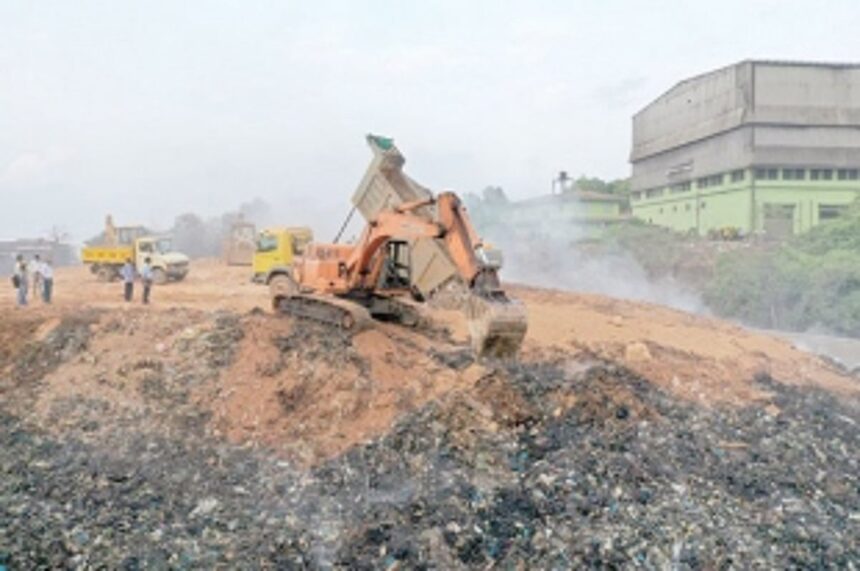
Amidst calls of removal and treatment of waste besides capping, an expert has said there is no solution to the Sonsoddo saga and that the only conclusion is to just seal the site and find another landfill.
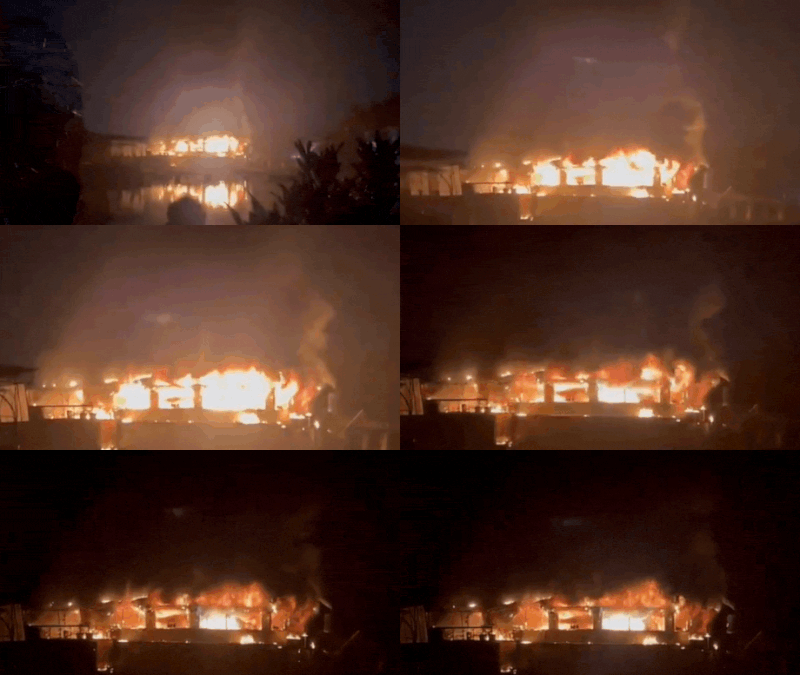
It may be recalled in the last week of May that the dump site at Sonsoddo caught fire which took the firefighters nearly a week to tackle the major blaze.
Surely, it was the biggest fire Goa had witnessed with over 4,70,000 litres of water used to douse sections of the flames. However, the methane gas trapped in other sections made it difficult to control the fire, which kept erupting around the slopes of the giant dump. Herald spoke to former Goa University scientist Dr Joe D’Souza, an expert in microbiology, who said there is no solution to Sonsoddo.
“The only solution is to get a secure landfill. The Sonsoddo site has to be sealed and channels have to be drilled letting in oxygen and output for carbon dioxide and water,” D’Souza said.
He said he visited and inspected the site for an entire day and discovered that all kinds of waste are being dumped there, which he pointed out is toxic and hazardous.
“They have now dumped medical waste, hotel waste, and construction waste. There are also worms, flies and snails. It is going from bad to worse. In the next two years there will be another fire,” he opined, adding that it has now become hazardous. “You cannot ask garbage cleaners to go there and die as the leachate is highly toxic,” he added.
He further pointed out that the leachate flowing down to the residential areas is highly dangerous for humans.
“The leachate has to be channelled properly and treated in a scientific manner and then discharged,” he said.
On the recent fire, he said, nobody has applied their minds and that spraying of enzymes was not a solution at all.
“The enzymes were another scam,” he remarked.
He said the methane is produced by thermophilic bacteria by converting paper, starch leaves into methane at 70 to 80 degree Celsius.
“To prevent methane formation, there has to be aeration. This happens under anaerobiosis. If methane is generated, it will convert into carbon dioxide and water. There has to be channelling with an inlet for oxygen and outlet for carbon dioxide and water is essential,” he said.
Asked what the solution to current Sonsoddo crisis is, he replied saying it requires a secure landfill and not just dumping.
He added that there was a study conducted by Professor Irene Furtado on ground water in Margao in 2013-14.
She found that the water is contaminated with heavy metals, organic matter and metals like cobalt which are found in batteries and lamps, syringes, medical waste which can cause cancers, kidney diseases, and typhoid.
He also questioned the role of Fomento Green so far.
“What has Fomento been doing since 2009. They should show us one tonne of fertilized produced till date. They get almost 20 tonnes of hazardous waste everyday which is enough to produce 5 tonnes of fertiliser everyday,” he said.