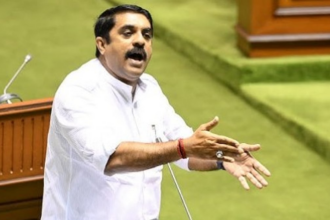
NEW DELHI: Goa’s very own Shripad bhau is the architect of the entry of Marathi into the hall of classical languages of the country, the seventh such language in the league Tamil, Sanskrit, Kannada, Telugu, Malayalam and Odiya.
The North Goa MP and the Union Minister for Tourism and Culture, oversees the Linguistic Experts Committee. In a written reply to a question by Shiv Sena MP Sanjay Raut in the Rajya Sabha on Wednesday, Minister of State for Culture and Tourism Shripad Naik said a meeting of the Linguistic Expert Committee will be held “very soon” to consider Marathi’s case. The government grants the classical language status on the recommendation of this committee.
He said the Maharashtra government had submitted a proposal on November 16 last year to declare Marathi as a classical language and the same was sent to the Sahitya Akademi on March 14. The Akademi in turn entrusted the work of preparing a report to a scholar who has submitted his findings on July 14 to the Sahitya Akademi.
Both the reports of the scholar and the Maharashtra government will be placed before the Linguistic Experts Committee for its consideration, Naik added.
The government had decided in 2004 to declare the classical languages in India, based on high antiquity of their early texts/recorded history over a period of 1500–2000 years, with a body of ancient literature/texts, which is considered a valuable heritage by generations of speakers.
The criteria fixed are that the literary tradition of a classical language should be original and not borrowed from another speech community; the classical language and literature being distinct from modern, there may also be a discontinuity between the classical language and its later forms or its offshoots.
Tamil was the first language accepted as a classical Indian language back in 2004, followed by Sanskrit in 2005, Telugu and Kannada in 2008, Malayalam in 2013 and Odiya in February 2014.
The Centre gives special grants for promotion of the classical languages. The benefits that accrue to a language declared as “classical” include creation of a certain number of professional chairs in that language for its scholars of eminence, establishment of a centre of excellence for studies in the classical language and two major annual international awards to scholars of eminence in the classical languages.