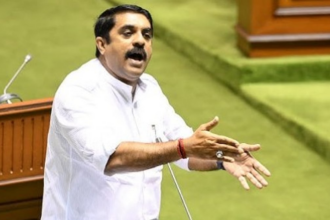
PORVORIM: “If every new born child in Goa is burden with loan liability of Rs 86,195, then the same child is born with income into his or her credit of Rs 2,71,091,” Chief Minister Laxmikant Parsekar told the State Legislative Assembly on Wednesday justifying that the State borrowings are within the permissible limit. Parsekar informed the House that the total public debt of the State as on March 31, 2015 stood at Rs 9,936 crores with Goa ranking first in the per capital income. “That means that the per capita public debt in the State is Rs 68,195 while per capita income is Rs 2,71,091,” he defended the State financial position. Raising the issue of financial crisis looming large on Goa, Independent MLA Vijay Sardesai pointed out that there were discrepancies in the figures provided by State government and Reserve Bank of India (RBI) on the financial position. The MLA told the House, that though the State figure reveals that the total public debt as on March 31, 2015 is Rs 9,936 crore, the RBI has put the same figures as Rs 14,530 crore. “For the current financial year that is from April till June end, government has borrowed nearly Rs 6000 crore from the market,” he said. Sardesai said that as per government the fiscal deficit for the year 2015-16 is pegged at Rs 1552 crore, while RBI claims it Rs 2713 crore. Claiming that State is inching towards the debt trap, Sardesai, quoting RBI, said out of every rupee spent by Goa government only 78 paisa is earned, while rest is from borrowings. Explaining the State financial position, Parsekar said that the State debt does not include the loans borrowed from the public sector bodies like Economic Development Corporation, etc. “Our borrowings are within the permissible limit. The finance department has fixed upper limit on the borrowings and we cannot exceed that,” he said. “The current government is clearing off the borrowings done by the previous government as the market loan installments starts only after ten years,” he explained. The Chief Minister said the borrowings made by the state are spent towards creation of infrastructure and not to fund the social welfare schemes or salaries
State borrowings are within permissible limit: CM
Discrepancies in the figures provided by State government and RBI: Vijai