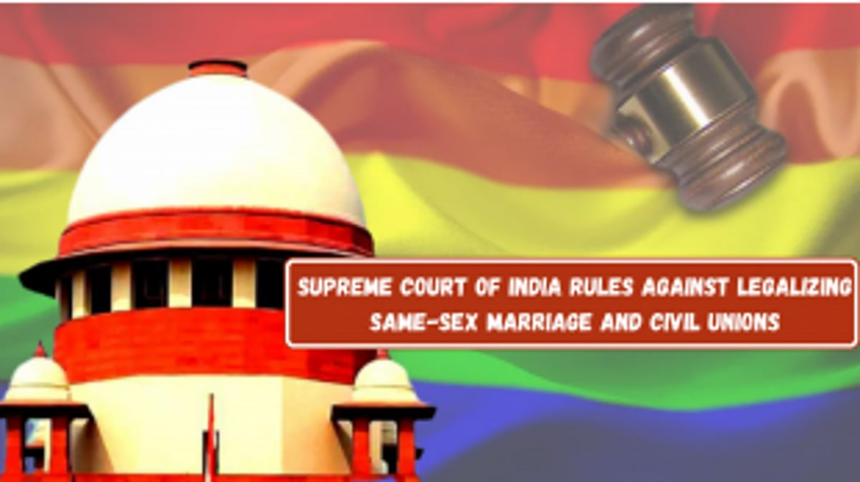
In a significant decision, a five-judge bench of the Supreme Court, led by Chief Justice DY Chandrachud, issued an unanimous ruling today, declining to legalize same-sex marriage in India. The bench, which also consisted of Justices Sanjay Kishan Kaul, Ravindra Bhat, Hima Kohli, and PS Narasimha, voted 3:2 against civil unions for non-heterosexual couples.
Chief Justice Chandrachud has deferred the matter to the Parliament for resolution, expressing support for civil unions for non-heterosexual couples. He emphasized that the Supreme Court does not possess the authority to strike down provisions of the Special Marriage Act (SMA) or interpret its wording differently. The focal point of the petitions revolved around seeking a gender-neutral interpretation of the SMA, a secular legislation designed to facilitate inter-caste and inter-faith marriages. Petitioners argued for a broader interpretation to include same-sex marriages.
Justice Kaul believed that recognizing civil unions for non-heterosexual couples was a step towards achieving marriage equality. However, all five judges concurred that there is no inherent fundamental right to marry, and, in a majority verdict, the court ruled against same-sex marriage. It was determined that the legislature or Parliament should be the entity to decide on the introduction of same-sex marriage.
During the 10-day hearings in April and May, a range of arguments were presented, covering topics such as the right to equality, the right to privacy, the legal benefits and rights associated with marriage, and the potential effects of same-sex marriages on children. Opponents of the petitioners included the Central government, the National Commission for Protection of Child Rights (NCPCR), and the Jamiat-Ulama-i-Hind, an association of Islamic scholars.