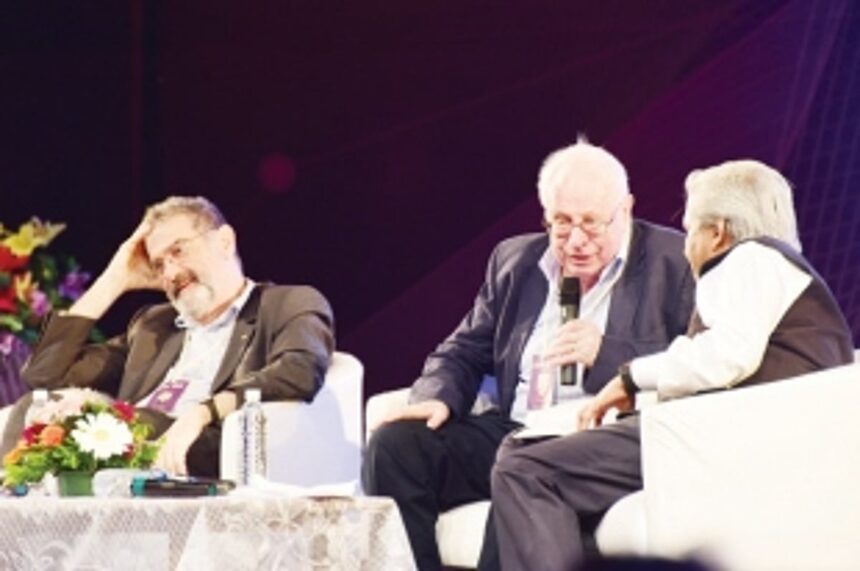
PANJIM: Nobel Laureates Professors Richard J Roberts and Christiane Nusslein-Volhard, in a dialogue on Friday advised students that endurance is the key to success in any scientific discovery and stressed on a strong education system which recognises the importance of science.
Addressing the students, Roberts said parents are overprotective of their children, especially in the cities. “Children living in farms are healthier and closer to nature. Parents must let their children free to explore the wonders of science. We must follow our own interests and develop talent. If you do not like a field, do not hesitate in switching, take risks,” he said.
Answering a question raised by a student about essentials of the best research, Prof Volhard claimed that a good surrounding or environment was essential for best results. “A healthy setting broadens our views. Be your own master and discover things. Learn from what you have,” Volhard stated.
Answering a question about work-life balance, the laureates agreed that it’s their love for science which has kept them motivated.
“If one wants to jump into research, it is mandatory that one travels to foreign universities in order to derive new perspectives and broaden scientific horizons. However, after a certain period of time, they must return to their homeland. India is a hub of the world’s best universities. Hence, make the best use of your own resources,” Roberts said.
Volhard added, “Find a niche which is less populated. It helps in building realistic and original content. Have confidence in yourself and believe that nothing is impossible. Come out with good ideas. Understand the basics, read more books, sort out your priorities, be creative and love science. Only then will you succeed.”
In the second session, Prof Serge Haroche and Prof Tomas Lindahl spoke about teams in scientific research. “To obtain the best research project, one must have colleagues who have a different viewpoint. If you have a good team, you get the best results,” Haroche said.
Lindahl stressed on the need for a strong education system which recognises the importance of science. “Science is a universal agent of truth. Understanding its history is essential. It is important not to be misguided and to be careful with your opinions. The foundation training should be robust,” he said.
Volhard, in her address said that science is not only meant to improve mankind but to encourage basic research. “Basic research is not directly aimed towards discovery but to understand complications.