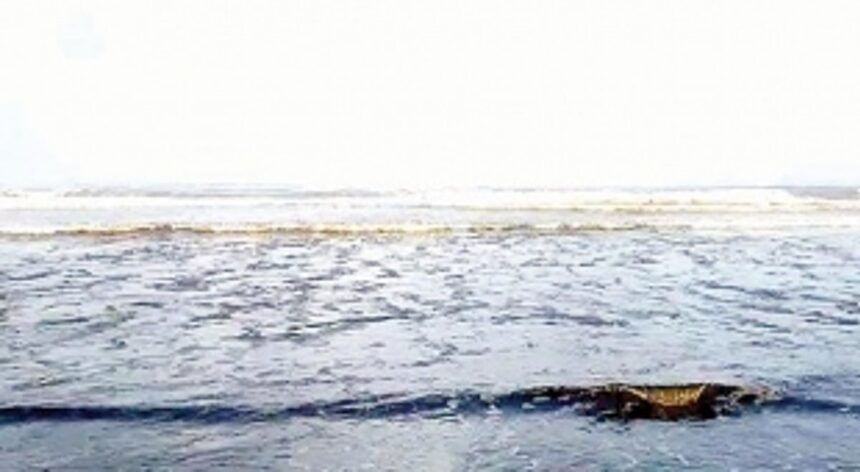
PANJIM/VELSAO: Morning walkers on the soft white sands of Velsao beach, untarnished by the pitfalls of irresponsible tourism, screamed out “Black sea, black sea”. The waters were jet black and were rapidly brought to the shore by the tides depositing the polluted water onto the sands
From Velsao in Mormugao taluka to Cavelossim in Salcete taluka, the presence of these tar balls has got the local residents
asking for the government to carry out immediate inspections.

In Velsao, locals pointed to past studies that were done by the National Institute of Oceanography (NIO) and local agencies like the Goa State Pollution Control Board (GSPCB).
It may be recalled that this issue had been raised in the Assembly last year, where Environment Minister Nilesh Cabral had said that following NIO’s study, the government had attributed the source of the tar balls to oil spills from the Bombay High region, an offshore rig off the coast of Maharashtra.
Interestingly, Cabral had added that the State has its own State Oil Spill Disaster Contingency Plan. Importantly, this plan was passed in 2015, but each year several beaches have been hit by the menace.
Dixon Vaz, Chairman of the Cavelossim Biodiversity Committee pointed out that the pristine beach in Cavelossim is fully covered with tar balls, which is posing a danger not only to the environment but to tourism as well.
“For the past few years we have taken up the matter with higher authorities such as the Environment Ministry, Goa State Biodiversity Board (GSBB) and Coast Guard, but still the issue remains,” he stated.
Vaz said he had raised this issue before the GSBB member secretary and had asked that they act at the earliest before there is any permanent damage.
Roy Barretto, a social activist added that tar balls are not only noticed on Goan beaches but on the entire west coast of India. “Now, the tar balls are coming on to the coast and destroying the ecosystem/biodiversity/ and in general the environment of the coastal areas. It is an environmental disaster.
“The tar ball menace can be avoided by regularly checking logbooks of shipping tankers, who import crude oil to India from the Gulf countries. They are responsible for tar balls as they wash their oil tanks before they could take another consignment from India for export”, Roy charged.
Meanwhile, Tourism Minister Rohan Khaunte said, “This spillage doesn’t take place directly from Goa or ships. Various departments are working together to keep check. The Pollution Control Board has been given the mandate to act on such things.”
Goa State Pollution Control Board (GSPCB) chairman Mahesh Patil said, “NIO was given a project to conduct a study. As per the NIO study, these tar balls generate likely at Bombay high. Undercurrents during monsoon wash them to shore.”
Former NIO scientist Baban Ingole said, “Tar ball formation could be from multiple sources, though the major ones contributing to it could be offshore washing of tankers, offshore oil installation, etc.”
Another former scientist Antonio Mascarenhas explained, “We are getting directly hit by westerly waves, so whatever material comes in its way will be thrown on the beaches. Our beaches are suffering for 20 years, in terms of morphology, the rising sea level, whatever comes on its way, it will dump on the beaches.”