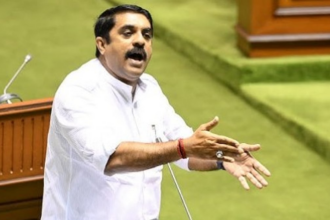
One of the biggest shows during elections are public meetings, of various sizes and shapes. The conducting of these shows is now given to ‘professional’ meeting contractors who, like events managers, manage the venue, hire the crowd and plan everything according to the order given by the big political party.
The bigger the leaders in the political set up, the greater the charges for the meeting. But one thing is sure here. The party or the leader doesn’t have to worry about anything. Even the claps are paid for and orchestrated. So is the laughter. Even the photos are planned in a manner to depict a huge crowd.
There is no tender floated for this meeting contract. It is straightway given to someone trusted and who takes and money and does the job.
Even the front row is reserved – for those who want favours from politicians.
Very often, the front rows of these public meetings are reserved and occupied by those who need to be there. Very often they are people who need to get their work done by politicians and their presence there is an important step in that process.
After the meeting, the after-party starts – a full feast, including biryani and drinks
This is another show by itself, organised by the meeting contractor. Here people from the village are called and told how big the meeting was and this reflected the popularity of the party/candidate. Massive feasts are organised where even the plates have the symbol of the party or candidate.
Everyone is then asked to vote accordingly since it would now be “clear” who is going to win. All this is fake.
All big parties or politicians do this. Even ‘bhumi-putra’ parties from outside Goa who want to win some seats
The big parties with big stakes but declining popularity are in a position to give maximum jobs to the meeting contractors. But there are other parties who have never won in Goa who follow the same method and book these meeting contractors.
Do you want parties to fool you with these fake meetings? When nothing is real?
These fake shows have become a tool for judging popularity. And those who get manipulated here are not the rich but the ones who struggle. There are no big luxury cars parked outside these meeting venues. So, what is happening here? It is simple. After more than four years out of the five-year term of doing nothing, parties don’t have the time to reach out to people, even to speak lies. That is when they hire meeting contractors to organise these shows for a fake display of their popularity. And they hope that these displays will make the poor people think that the party or candidate is going to win. This is nothing but drama. Or you could call it a ‘One Time Settlement’ with voters, after failing to serve them.
Is this the way to conduct or even try to win elections? Will genuine Goa parties be able to afford it?
You must educate people about this. Tell others and show them the real face of election meetings. Very often these kinds of meetings are held days before the polling date when there is little time to find out what is real and what is not. Deals are almost done overnight. After these meetings, very often money is handed over to someone influential in the community and group for it to be distributed. But like most government schemes, most of this money never reaches the poor and is siphoned off by the person asked to distribute it. Elections are all about middlemen making enough money for the next five years even before a single vote has been cast.
In the good old days, candidates were one of us. They went to people’s homes to seek blessings. Now they have to go to offer money or rations
This is very different from how elections were held earlier. With no money and lots of goodwill. Candidates were chosen by the people. Usually, it would be a lawyer, a doctor, a writer or someone who was known as wise and learned in the villages in the constituency.
And they would go door to door to seek blessings’. These days they go door to door to offer money and rations.
Someone would contribute some money for the candidate’s petrol expenses, village artists would make posters and simple banners and go on their own to stick them with glue. Street corner meetings were held with a simple mike or gramophone in the squares of villages or after mass at Church or in Temple compounds and after football games.
Yes, elections were fought and won without money and by people’s candidates
In the olden days, elections were all about people. And that is what Goans should show again. It is the common Goan who can stand up and lead the way towards having an honest people’s election with no money spent. After all, the money that is spent by big parties and candidates is the money of loot. Pumped back into the election system.
Is it hard-earned money?
When the meeting contractors organise meetings, do ask yourself whether it is really possible for parties and candidates to spend so much money. At times the cost of one meeting is more than the annual salary of a minister. Shouldn’t one, therefore, conclude that this cannot be hard-earned money? And isn’t this is being spent so that the same loot can continue for another five years?
People want change by choosing people’s candidates for a people’s party
That is why people want a change in the way people are elected. By people choosing candidates. Once candidates are endorsed by the people, there will be no chance of fake meetings and money distribution. Meetings where even dummy candidates specially fielded to slow down the competition, financed by the big guns, are present.
Ask yourself, do you want a system where you get biriyani to attend political meetings or a system where you can put food on the table for your family for a lifetime, through your hard-earned work? Your job is to identify the meeting contractors, the vote splitters and all those who have made elections a dirty business.
Keeping it simple and real is your choice. It has to be the choice of all Goans.
The election drama is set to unfold: Beware of fake, fully paid public meetings
Election “meeting contractors” give cash-rich political parties a full package – venue, programme orchestrated claps and after-parties with lavish food and drinks