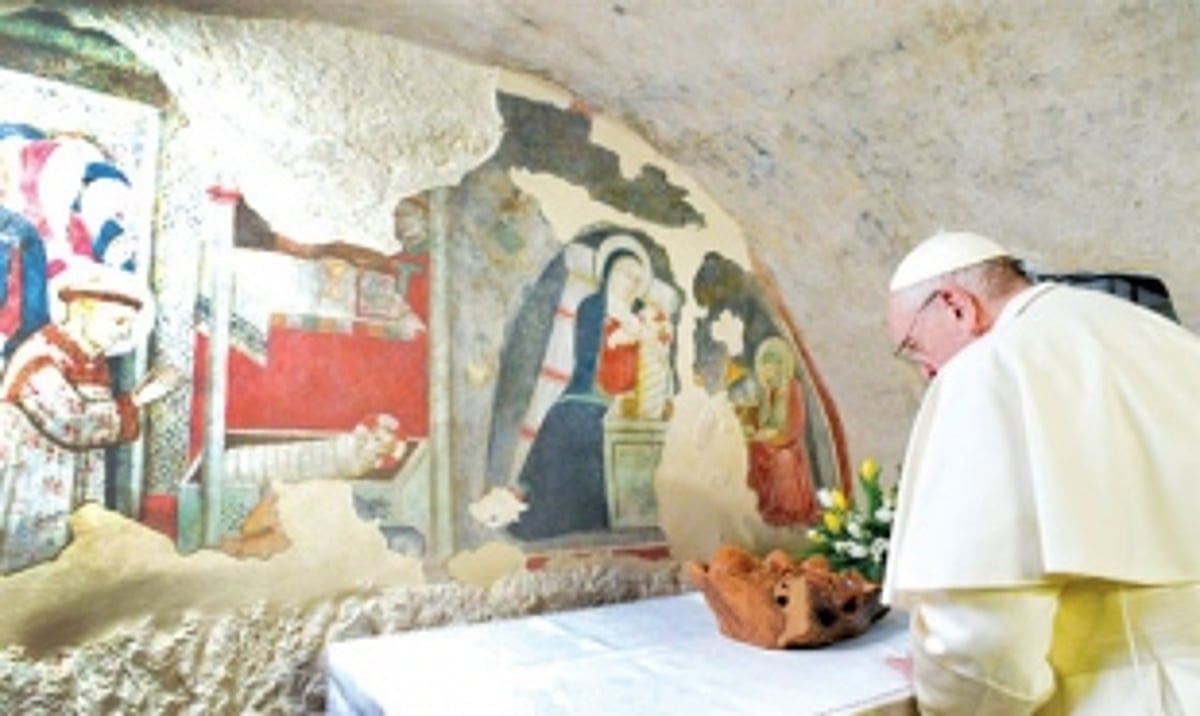
The Holy Father, Pope Francis, a man a God that he is, is simply amazing and marvellous, as the crux of the Ignatian spirituality is to see and find God in all things, events and persons which is as if contemplation in action. A man of action that he is. He is astounding! as on 1st December 2019 , he stunned the whole world with his incredible writing on the meaning and importance of the nativity scene through his Apostolic Letter, ‘Admirabile Signum’ meaning “A wonderful sign”. Another shocking act from His Holiness, is that Pope Francis made a brief visit to the Italian town of Greccio on Sunday 1st December, to sign his Apostolic Letter “Admirabile signum” on importance of the Christmas crèche, the place where the origin of the crib came from.
Well, I remember as children we did crib at home and most of the time was spent at the church in preparing the crib with variety of ideas being presented but the youth stole the joy of children, ‘hey, sogllim inga khuxin vochat’! Later, lot of cribs were done with beautiful imaginations. Few days’ back Pope Francis allowed me to reminiscences the few last decades with his beautiful letter, where he says: With this Letter, I wish to encourage the beautiful family tradition of preparing the nativity scene in the days before Christmas, but also the custom of setting it up in the workplace, in schools, hospitals, prisons and town squares. In a particular way, from the time of its Franciscan origins, the nativity scene has invited us to “feel” and “touch” the poverty that God’s Son took upon himself in the Incarnation. Implicitly, it summons us to follow him along the path of humility, poverty and self-denial that leads from the manger of Bethlehem to the cross. It asks us to meet him and serve him by showing mercy to those of our brothers and sisters in greatest need (cf. Mt 25:31-46).
Much engrossed in the contemplation Pope Francis continues: But let us go back to the origins of the Christmas crèche so familiar to us. We need to imagine ourselves in the little Italian town of Greccio, near Rieti. St Francis stopped there, most likely on his way back from Rome where on 29 November 1223 he had received the confirmation of his Rule from Pope Honorius III. Francis had earlier visited the Holy Land, and the caves in Greccio reminded him of the countryside of Bethlehem. It may also be that the “Poor Man of Assisi” had been struck by the mosaics in the Roman Basilica of Saint Mary Major depicting the birth of Jesus, close to the place where, according to an ancient tradition, the wooden panels of the manger are preserved.
The Pope continues: The Franciscan Sources describe in detail what then took place in Greccio. Fifteen days before Christmas, Francis asked a local man named John to help him realize his desire “to bring to life the memory of that babe born in Bethlehem, to see as much as possible with my own bodily eyes the discomfort of his infant needs, how he lay in a manger, and how, with an ox and an ass standing by, he was laid upon a bed of hay”. At this, his faithful friend went immediately to prepare all that the Saint had asked. On 25 December, friars came to Greccio from various parts, together with people from the farmsteads in the area, who brought flowers and torches to light up that holy night. When Francis arrived, he found a manger full of hay, an ox and a donkey. All those present experienced a new and indescribable joy in the presence of the Christmas scene. The priest then solemnly celebrated the Eucharist over the manger, showing the bond between the Incarnation of the Son of God and the Eucharist. At Greccio there were no statues; the nativity scene was enacted and experienced by all who were present. This is how our tradition began: with everyone gathered in joy around the cave, with no distance between the original event and those sharing in its mystery.
Holy Father makes a mention of the following in this letter: Thomas of Celano, the first biographer of Saint Francis, notes that this simple and moving scene was accompanied by the gift of a marvellous vision: one of those present saw the Baby Jesus himself lying in the manger. From the nativity scene of that Christmas in 1223, “everyone went home with joy”.
The Pope asks us to reflect on the various elements of the nativity scene in order to appreciate their deeper meaning. First, there is the background of a starry sky wrapped in the darkness and silence of night. We represent this not only out of fidelity to the Gospel accounts, but also for its symbolic value. We can think of all those times in our lives when we have experienced the darkness of night. Yet even then, God does not abandon us, but is there to answer our crucial questions about the meaning of life. Who am I? Where do I come from? Why was I born at this time in history? Why do I love? Why do I suffer? Why will I die? It was to answer these questions that God became man. His closeness brings light where there is darkness and shows the way to those dwelling in the shadow of suffering (cf. Lk 1:79).
The imaginative Pontiff deepens his reflection: The landscapes that are part of the nativity scene also deserve some mention. With what emotion should we arrange the mountains, streams, sheep and shepherds in the nativity scene! As we do so, we are reminded that, as the prophets had foretold, all creation rejoices in the coming of the Messiah. The angels and the guiding star are a sign that we too are called to set out for the cave and to worship the Lord.
“It is my hope,” he continues, “that this custom will never be lost and that, wherever it has fallen into disuse, it can be rediscovered and revived.”
The letter invites us to reflect and meditate why does the Christmas crèche arouse such wonder and move us so deeply? May we feel and touch, the ‘wonderful sign’ of God in our families and everyone we meet at work place and in public places. Let us in silence behold the beauty of the face of the baby Jesus, the Son of God, born in a lowly state.