Margão has always been the principal village of Salçeté, which was intern always the principal taluka of Goa. Margão known as Mathgram, the village of Mathas (religious schools) since the Indo-Aryans who conquered it from its original tribal settlers. It is however also most likely that the name Margão comes from ‘Mhar-ganv’ i.e. the village of the Mhar community. The Mhars are the basket weaving community which settled in Goa in the post 1500 BC period.
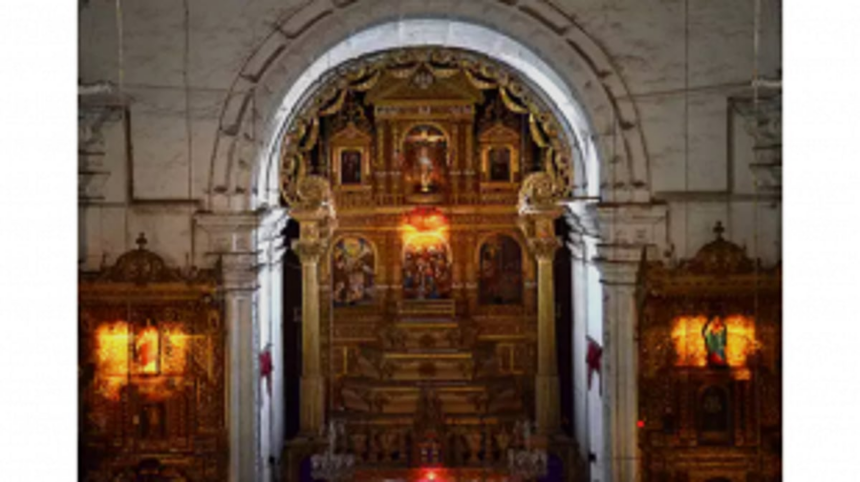
The first church in Salçeté was built as a chapel in 1521 in Ráchol by the Dominicans who accompanied the Portuguese garrison to the fort in Rachol. The Holy Spirit church in Margão was the second church to be built in Salçeté in 1564. The current edition of the church however was built in 1675 in a style known as ‘The Indian Baroque’. Many believe that the existing structure was designed by Bro. Francisco Aranha, a Portuguese Jesuit architect claimed to have designed some other churches in Goa and even in Salçeté like the one in Cortalim. However, it is highly unlikely that Bro. Aranha, designed the present Margão church edifice of 1675, since he was martyred in 1583 in Cuncolim -Salçeté. Fr. Francisco de Souza, a provincial of Jesuits in Goa, described the present church as an edifice “all vaulted, very bright and pleasant, the biggest and most beautiful of Salçeté and capable of competing materially with the good ones of Europe and formally with the best of Europe”. In the mid-19 th century, António Lopes Medes, a Portuguese agronomist, described it as “one of the most splendid and grandiose churches in Portuguese India”. The edifice is one of the five late Baroque-styled churches in Goa. According to Mr. Sarvesh Sinai Borkar, an archeoastronomy enthusiast, from Borda baixo in Margão, the building has a near perfect East-West orientation, at roughly 70֯ East and 270֯ West. Unlike the other four late Baroque styled Jesuit churches in Goa, the oculus or the circular window (characteristic to many Baroque façades), of this building is not far above the choir loft window. He calculated that this structural positioning, of the oculus window along with the smaller rectangular windows of the choir loft, would render three spotlight beams of sunlight directly on the emblem of the Holy Spirit on the main altar retable and the statues of the Sacred Heart of Jesus and Immaculate heart of Mary on the left and right altar retables respectively for a few mesmerizing minutes, during the equinoxes of 21 st March and 23 rd September. These are the days when the sun crosses the equator. The equinoxes are the only time when both the Northern and Southern Hemisphere experience roughly equal amounts of daytime and nighttime. Not satisfied merely with theorizing, Mr. Borkar visited the church on the evening of 23 rd September 2014 and shot the spectacle on his phone. The results were then published in an article ‘The astronomical mysteries of Goan Churches’ in a magazine. The original temple of Margão’s gramdev, Damodar in Fatorda also had an East-West orientation, but was built facing the East. Hence when the sun rises it shines on the Damodar linga and when it sets, it illuminates the three altars at Holy Spirit Church in Margão during the days of the equinoxes. The ray from the oculus at first strikes the foot of the main altar, and slowly rises upward across a time span of roughly 20 minutes, thus ultimately illuminating the altar the Holy Spirit. Before coming to rest on the emblem of the Holy Spirit, on the main altar, the beam illuminates up the scene representing the washing of the feet of the apostles by Christ, seen in the central, post Vatican council II altar.
The Dove, an emblem representing the Holy Spirit, forms part of an ensemble depicting the Pentecost, a special moment in the Bible, when the Holy Spirit descends onto the eleven apostles and the Virgin Mary, fifty days after Christ rose from the dead. The spring equinox occurs during the season of Lent, and the church being dedicated to the Holy Spirit, makes this phenomenon both, spectacular and special. Fr. Nascimento Mascarenhas, who has documented church history in Goa said, ‘the construction of the church can be attributed to the wisdom of the Jesuits’.
The church is packed beyond its capacity with people, including astronomy enthusiasts wanting to witness this 20-minute astronomical spectacle. The church is open on the days of the equinox to whoever who wishes to experience this celestial event.