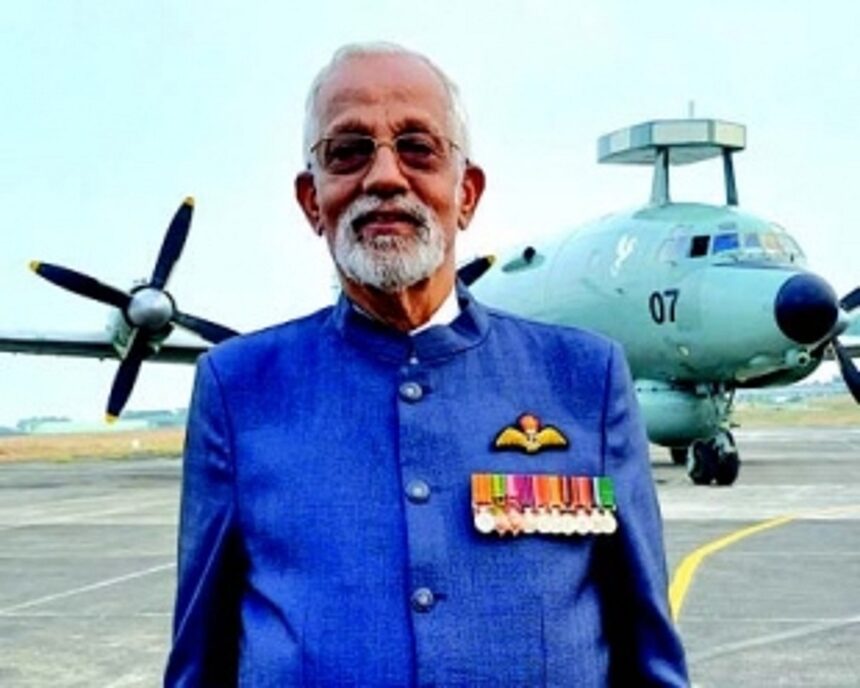
VASCO: It was 46 years ago when Rear Admiral K Mohanan (Retd) flew the Indian Navy’s Ilyushin (IL)-38 Sea Dragon Long Range Maritime Reconnaissance and Anti-Submarine Warfare aircraft from Russia (erstwhile Soviet Union) to Goa, to be part of the Indian Naval Air Squadron (INAS) 315, at INS Hansa. When the old workhorse of the Navy was getting decommissioned after 46 years of glorious service to the nation on Tuesday, RAdm Mohanan was standing in front of the aircraft to bid emotional adieu to this majestic aircraft.
Reminiscing his journey with the ‘Winged Stallion’ as the INAS 315 was called, and the aircraft, RAdm Mohanan said, “It is a mixed feeling for me. While on one hand I feel sad that the aircraft won’t be part of Navy’s inventory anymore, but I am happy to have served the squadron, which has had the longest life in the Indian Navy.”
Considering that the aircraft was made in Russia and had a huge size, there were many challenges that RAdm Mohanan and his team encountered, before getting fully adjusted with the aircraft.
“Earlier, I was flying the French-made Bréguet 1050 Alizé, a turboprop-powered aircraft carrier-borne short range surveillance and anti-submarine aircraft. I flew it from the older INS Vikrant aircraft carrier during the 1971 Bangladesh Liberation War. It was a single-engine aircraft that could accommodate three persons,” he said.
Immediately after the war, a need was felt to have a more advanced version of maritime patrolling aircraft. Ultimately, the IL-38 was acquired in 1977 from the USSR.
“But there were multiple challenges before it could become fully operational in India. To begin with, we had to learn the Russian language for six months since all the flying instructions and instruments were marked in Russian. Also, the aircraft was almost four times the size of Alizé aircraft. So we had to get acquainted with the avionics as well,” he said.
Also, it could accommodate up to seven crew members and fly up to nine hours in one sortie.
“Lot of coordination amongst crew members and physical endurance right was required. It could not be landed with too much fuel in it. There weren’t any toilets in it,” he said.
Yet, despite these hurdles, the IL-38s prevailed, excelling in their missions. INAS 315, the squadron operating the IL-38, can proudly list various operational achievements, from its role in Op Brasstacks, Op Cactus, and Op Vijay. The successful anti-ship missile and torpedo firings in 2017, achieved without original equipment manufacturer support, highlighted the squadron’s capability.
When asked about the most memorable event attached with the aircraft, RAdm Mohanan said, “In 1988, India foiled a coup attempt in Male, Maldives through a military operation named Cactus. I was in-charge of the air operations at INS in Goa at that time. During the operations, it was informed that a merchant vessel MV Progress Light was hijacked by the mercenaries. The IL-38 flew from Goa and detected the vessel from the air.”
“Soon, it directed the Indian Navy warship INS Godavari towards the hijacked ship, captured the mercenaries and freed the hostages,” the senior navy veteran said.
In his message to the officers and men who will be handling the new generation of maritime surveillance aircrafts, RAdm Mohanan said, “Continue with the same spirit and professionalism we showed while operating IL-38 in the last 46 years. Absorb the new technologies that are coming and move forward.”