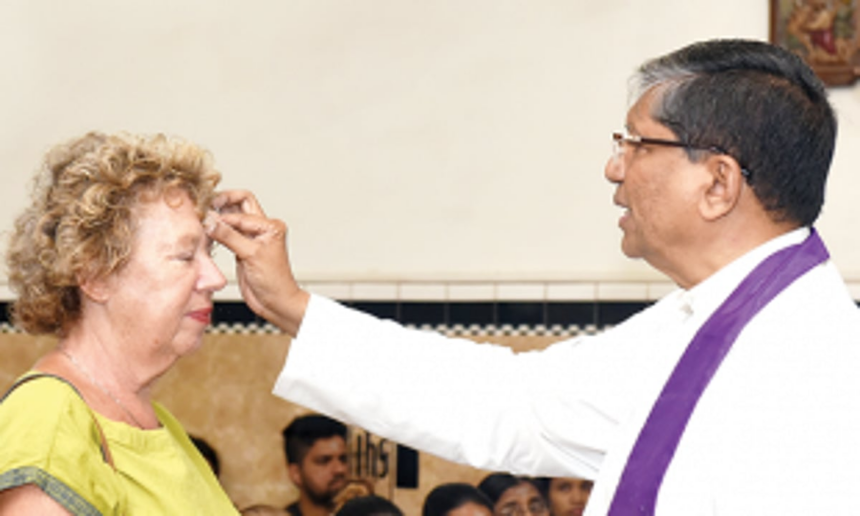
PANJIM: Like all the major days in the Church Calendar during the pandemic, Ash Wednesday will also be conducted differently.
Usually it is a very well-attended service and it marks the beginning of the penitential season of Lent.
This year however, it will have a changed look and feel, because of the COVID-19 health protocols that discourage physical contact and encourage social distancing, wearing masks etc. Meaning, packed congregations, which were a common sight with long queues for receiving the blessed ash, will not be seen this year. Nevertheless, the faithful will be participating in the same in a new way with the same solemnity and seriousness as before.
Traditionally, on Ash Wednesday, blessed ash in the shape of the cross is imposed on the forehead of the faithful and the priest recites ‘Dust thou art, and unto dust shalt thou return’ to each person.
This year, there will be a change, and in this regard, the Vatican has sent a note about this sacred observance, which the Archdiocese of Goa and Daman has endorsed and sent to parishes across the State.
“In the light of these guidelines, as briefed to the Deans on February 1, 2021, the manner of blessing and distribution of the Ashes at the celebration of the Eucharist will be according to the note,” said Fr Afonso Mendonca, Director, Diocesan Centre for Liturgy.
As per these directions, ‘the Priest will say the prayer for blessing the ashes and then sprinkle the ashes with holy water, without saying anything. Then he addresses all those present and only once says the formula as it appears in the Roman Missal, applying it to all in general: “Repent, and believe in the Gospel”, or “Remember that you are dust, and to dust you shall return”. The Priest then cleanses his hands, puts on a face mask and distributes the ashes to those who come to him or, if appropriate, he goes to those who are standing in their places. The Priest takes the ashes and sprinkles them on the head of each one without saying anything’.
Fr Afonso also mentioned what will be the norm for those faithful who are unable to attend the celebration of the Eucharist at their respective parishes on this day.
“The Ashes could be distributed at home by following this procedure: the Ashes that are blessed at the celebration of the Eucharist are taken to the individual homes in small quantities; a very short Penitential Service (in 2 forms) prepared by the Diocesan Centre for Liturgy may be conducted,” he added.
The blessed ashes can be collected from the respective parishes by family members of those who cannot physically attend the service on Ash Wednesday due to the restrictions or other ailments, and taken home.
“People will still participate, if they come in person and receive the ashes or if they stay at home and do it as a family,” said another priest while speaking about this change in proceedings.
He explained that when foreheads are marked with ashes, it is an outward symbol of what one hopes will happen internally. This year, he added, while the fundamental way it takes place differs, it is still a very important day for all the faithful who will be starting their Lenten journey by turning themselves over to God where they can experience God’s love, forgiveness and grace.
Incidentally, there will be a change with respect to masses as well, with more than one mass being held in most churches given the enforced limited seating capacities. These masses are divided as per the wards of these respective parishes, where in some cases; smaller-sized wards have been grouped together.
Many of the parishes are holding two masses in the morning and later, in the evening, a mass for senior citizens will be held. Few churches that have a biggger seating capacity will have just one mass.
When it comes to the ‘Way of the Cross’, here too, in some cases, wards of respective parishes have been allotted timings. For instance, if one ward is being called on one Friday, the other wards are called on Fridays of other different weeks.
Arrangements have also been made for it to be telecast live on various platforms.
In many parishes, weekday masses in the morning will resume from the coming Monday, February 22 with the exemption of Fridays, where the Way of the Cross followed by Mass will be held in the evenings.
There has also been sufficient time given for adoration and confessions with some having it for 24 hours on specific dates.
Priests and members of Parish Pastoral Councils also emphasized that sanitisation and social distancing are to be followed by all.
Prayers, reflection and acts of fasting etc that are followed at home will continue as well.