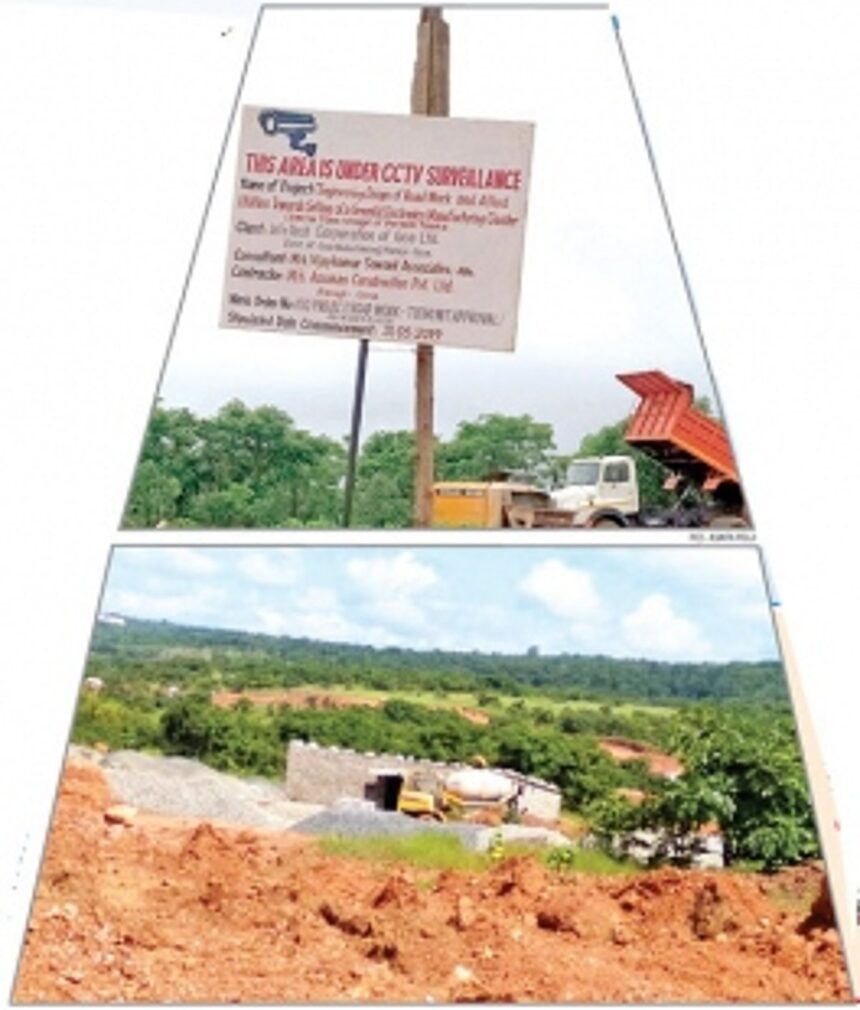
The farmers of Tuem are looking at the new Pramod Sawant-led government to show them some sympathy and compensat them for the land, which they allege has been acquired “illegally” for the ambitious Electronic City Project.
Envisaged by Prime Minister Narendra Modi, the project was started by former Chief Minister and ex-MLA Laxmikant Parsekar. The IT Electronic System Design and Manufacturing (ESDM) Park was proposed to be set up in Tuem village, which incidentally, is part of Madrem constituency that was earlier represented by Parsekar.
The IT ESDM Park has been designed with the capability to generate around 5,000 to 6,000 employees for a period of 3 to 5 years, as per the government.
The authorities concerned identified an area in Tuem, admeasuring 5,97,125 square metres in 2014.
This consisted of Alvara-Aframento land of Tuem villagers along with government land.
The project was undertaken under the Government of India’s scheme for Greenfield projects.
Accordingly, the Ministry of Electronics & Information Technology (MeITY), Government of India gave the final approval for setting up Greenfield EMC at Tuem-village, Pernem Taluka and would be providing a grant –in–aid of Rs 73,77,50,000/- against an approved cost of Rs.161,32,35,501.
Farmers’ woes
The area earmarked are Survey numbers 81/0 (Govt.), 82/0- Dhondu Krishna Naik (Lease Holder) , 84/0- Keshav Babaji Naik (LH), 85/0-Govt.,98/0-Govt.,99/0-Ghanu Bablo Naik(LH), 100/0-Pudalik Tato Kandolkar(LH), 101/0-Govt., 102/0-Pundalik Tato Kandolkar(LH), 103/0-Govt., 104/0-Govt.
Till date, the farmers say that neither a single letter nor any intimation has been given to the lease holders about the proposed project. They add that they only got to know about it when the matter came up for discussion during the State Legislative Assembly session.
“When we enquired about this issue, we were informed that the authorities concerned have considered the proposed land as government land and without any acquisition it was transferred to the Directorate of Information and Technology,” says Tuem Sarpanch Nilesh Kandolkar.
He added that when information was sought under RTI, the authorities replied that the Directorate of Survey and Land Records, Panjim reported that the Aframento is withdrawn and possession was taken by Mamlatdar of Pernem way back in 1970 but the names were not deleted from Form I & XVI.
Accordingly, he says, the District Collector North directed the Mamlatdar of Pernem to correct the survey records and accordingly the Pernem Mamlatdar deleted the names of lease holder from Form I & XVI.
“The above process was done unilaterally without giving any intimation or any notice to the concerned parties, thus denying them their basic natural justice to put forward their grievances,” Kandolkar adds.
Another land-loser, Devaki Naik Gaonkar says that they after getting the knowledge of this grave injustice; they had taken their grievances to the then Chief Minister, Revenue Minister, IT minister, Chief Secretary, Collector North but received no response whatsoever.
“It is true that the only way to get justice is to approach the court of law, but we cannot afford such a financial burden to go to the court. We are in the process to convince the authorities about the grave injustice done to the land-losers. We are seeking justice to ensure we get what’s due to us legally,” she said.
Their legal argument
For the farmers, their point of argument revolves around the fact that the land in question has been granted under Decree No.3602 of 1917.
The decree has its own conditions and accordingly the land was bestowed to the lease holders.
It may be pertinent to make reference to Article 34 and Article 35 of the Decree no.3602 dated 24/11/1917, which read thus:
“Article 34- The duration of provisional assignments shall be of 10 years, during which the assignee cannot sell, mortgage or transfer by any way the property of the land that is assigned to him provisionally, which land, as a State(Government) property, cannot undergo any seizure, except that of the fruits harvested or to be plucked.“
“Article 35 – After the expiry of 10 years of the provisional assignment the assignee or his heir shall be considered for all legal purposes, the Emphyteuta of the land assigned, as soon as he gets the respected title of Emphyteusis in accordance with the present decree.
Sole para: If any trees belonging to the state (Government) form part of the assigned land, the assignee should acquire them at the scheduled prices that may be in force, without which the respective title of emphyteusis shall not be issued to him.
Therefore, as is apparent from the said Articles 34 and 35, at the end of the period of the provisional concession (i.e 10 years), it is incumbent upon the authorities to grant the concessionaire the title of the Emphyteusis, they say.
They argue that after liberation, the Revenue authorities had conducted an inspection of the Alvara lands and accordingly reverted some of the lands for not fulfilling the conditions.
“The above process was conducted haphazardly and even after registering the land, which was cultivated, it has been reverted unjustly. This was brought the notice of the authorities,” Kandolkar explains.
He says this has been categorically clarified by our High Court in the case of Govind Pai Raiturkar v. Union of India (WP/86/80/B). Pursuant to such order dated 17/09/1969, which is invalid and a nullity, a document came to be executed on 25/03/1970, which refers to the possession being taken over by the Government.
Also, accordingly, the Revenue Department has issued an order to The Directorate of Land Survey dated, March 28, 1969 to cancel the reversion orders and issue fresh orders of allotment of lands, he adds.
“This provides clear proof to ascertain the legal right of the Project-affected people over the proposed land and for which we pray to the govt. for necessary justice,” he explains.
Kandolkar further says that the government is
misinterpreting the law and that Alvara land cannot be reverted so easily.
He also clarified that the people are not against development or the project.
“We need development. We are not raising objections to the project but the Alvara land- holders have to be compensated handsomely,” he added.
—
The Project so far (as per IT reply in Assembly)
* Companies such as M/s Smartlink Network Systems Ltd., M/s GIT Electronics Pvt. Ltd., M/s Optel Vision India Pvt. Ltd. and M/s Aequs Pvt. Ltd. have already shown their interest for setting up their units as well as joining the Special Purpose Vehicle (SPV) in the Electronic Manufacturing Clusters (EMC)
* Land admeasuring 5,000 square metres has been handed over to the Public Works Department (PHE – N) for construction of 650 m3 OHR and Sump and shifting of the existing 450mm conveying main. The estimates for the same have been prepared by the PWD
* PWD, Works Division XIII (R), Mapusa, has also prepared the land acquisition plan and the estimates for land acquisition for the proposed road from the National Highway NH17 connecting to the proposed Electronic City. The said proposal of ‘Land Aquisition’ has been submitted to the office of the Deputy Collector, Pernem
* Land admeasuring 15,000 square metres has been handed over to the Electricity Department for setting up of a 220 / 33 KV EHV substation along with associated link line. The estimate for the same has been prepared by the Electricity Department.
* The proposal of Conversion Sanad for an area of 3, 92,645.21 square metres of has been submitted to the office of the Additional Collector – II, North Goa District and is under process
* Tenders have been floated for the works by M/s Info Tech Corporation of Goa Limited (ITG), which has been identified as the Implementing Agency for setting up of IT ESDM Park at Tuem in Pernem Taluka (the details of which are enclosed at Annexure “C”)
* This includes conducting survey by using Electronic Total Station and demarcation of road and plot layout including clearing bushes wherever required and fixing of boundary stones for Electronics Manufacturing Cluster (EMC) in Tuem village of Pernem Taluka
* The IT ESDM Park has been designed with the capability to generate around 5,000 to 6,000 employees for a period of 3 to 5 years.