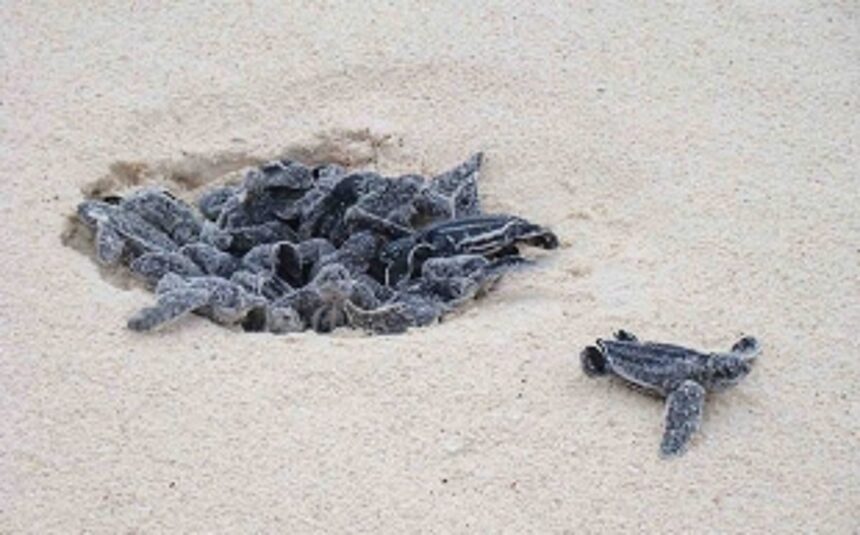
CANACONA: Marine lovers in Canacona taluka are puzzled as not a single Olive Ridley turtle has made it to the shores of Galgibaga and Agonda beaches earmarked for the turtle nesting.
The nesting season starts in November and lasts till April, but the records of the past few years reveal that the first Olive Ridley to arrive at Galgibaga and Agonda beaches has only been reported in January.
Scientists say the change in climatic patterns is the sole reason behind this delay. Worried local marine life lovers say together with the change in climate, the constant sand erosion along the beaches in Canacona may also be the reason for the non-arrival of these sea turtles for the last few years.
Environmentalists expressed concerns over the damage of nesting sites due to sand erosion on the taluka’s coast which is home to seven beaches, two of which are reserved as turtle nesting sites.
The beaches in Canacona, besides being battered by the monsoon waves, had to bear the brunt of massive cyclonic waves washing away a sizeable amount of sand.
In the past two years, Canacona’s coast has been battered with an average of five powerful cyclones originating from the Arabian Sea causing mass erosion of the already deposited sand, environmentalists say.
Elaborating on the delay, Manoj Prabhugaonkar, a local environmentalist informed that he has filed a petition before the National Green Tribunal praying for the installation of light and sound barriers beside the Mashem-Galgibaga section of the highway which he claims would provide relief to the turtles while approaching the beach for nesting.
“It is scientifically proved that the light and the noise emanating from the fast moving traffic can disorient the mother turtles and hence it is not only important but a must to install these barriers”, he said.
“Last month, the authorities installed “No Horn Zone” boards on either side of the Galgibaga-Mashem Bridge, this has puzzled not only me but commuters who travel along this newly built highway road. Is it to submit photographic evidence to the NGT that the PWD has installed boards for the motorists not to honk when the case comes up for next hearing”, he asked.
“Apart from this, several times heaps of trash that gets washed ashore on southern side of the Galgibaga beach is burnt on the beach on a regular basis, if we need turtles to come on our shores the authorities have to prevent all this”, Prabhugaonkar said.
Sources in PWD (Highways) informed that the GCZMA while granting NOC before starting the construction of the Char Rasta-Mashem (now Manohar Parrikar sea-side link) bypass had put a condition to install “No Horn Zone” boards on Galgibaga-Mashem Bridge and hence they have erected these boards.
On the light barrier, sources informed that the GCZMA had put a pre-condition that the street light should not disperse in the nearby sea water and that’s the reason why they have positioned the light arms along the road at this stretch otherwise normally all arms are across the road.
“Where ever the light gets dispersed we have painted the glass cover with a black paint,” sources clarified.