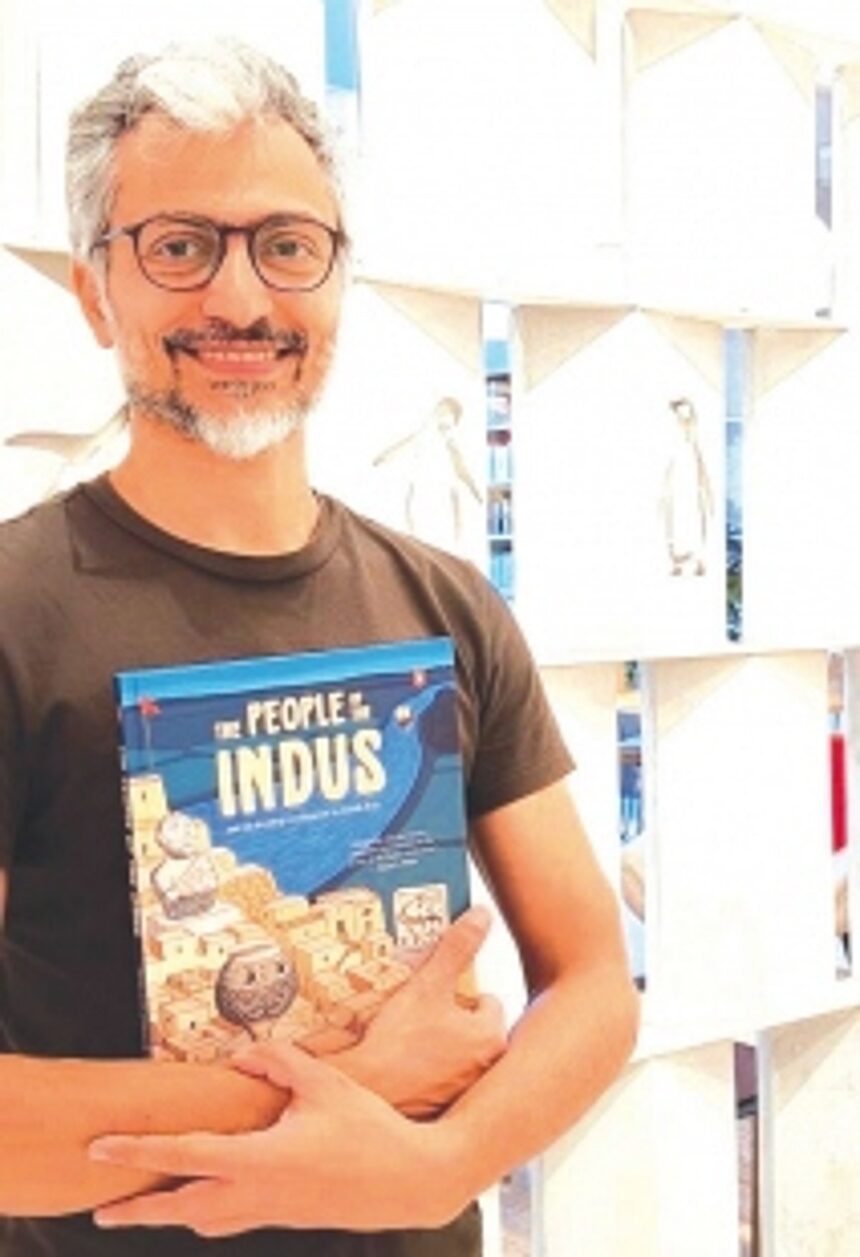
Goa-based Nikhil Gulati loves stories and to make it more interesting, he loves to tell these stories through comics, which are informative, entertaining and shows more details. His debut book tells a lot about his passion for not just comics but to get the right information through the correct sources. He worked on ‘The People of the Indus and the Birth of Civilisation in South Asia’ with Jonathan Mark Kenoyer, a professor of archaeology and anthropology, who has been excavating the site of Harappa for over 35 years and is considered one of the foremost authorities of Indus archaeology. Nikhil grew up in Delhi but lived in many places over the years. Always interested in drawing, he never thought it was something he could make a living with. A graduate from the University of Texas, Austin and the Indian Institute of Management, Ahmedabad, he was also in search of something that he could contribute to in a larger way. “My search for meaningful work took me to an MBA degree. I found that the jobs that were available were quite meaningless. This is when I decided to go back my childhood interest of drawing and telling stories and I chose to make comics,” says Nikhil. He finds comics to be a very powerful medium. “Traditionally, it was seen as a medium for either light-hearted funny stories or stories about superheroes saving the world. It was meant for young readers. However, it is a medium, just like films or novels that can be used to tell all kinds of stories. Its power lies in the fact that it is a hand-drawn medium, which makes it very expressive,” he explains. He further adds, “If I want to tell you how a character feels, I can show it through their body language. If they are sad, I can make them hunched over. I can exaggerate this posture to emphasize that they are feeling sad. Or if they are nervous, I could draw their legs as wavy. Specifically for history, which has been my topic recently, I like that through comics we can show graphically what we are talking about. I can draw the ruins of Mohenjo Daro on one page, and then when you flip the page, I can show how Mohenjo Daro might have looked 5000 years ago. Same with the artefacts. I don’t need to explain their artworks. I can just show them to the reader.” ‘The People of the Indus and the Birth of Civilisation in South Asia’ published by Penguin Books, is divided into five chapters that spans through Mohenjo Daro, Harrapa and the major differences between the Indus Valley Civilisation and other powerful civilisations of that time period. Where else would one find Egyptian Hieroglyphs, Demotic Script, Greek script, Old Persian script, Babylonian Cuneiform, Bhistun Inscriptions and Elamite, all on one page? He has also brought to life the hand counting system and the exquisite jewellery created with marine shell, ivory and an artificial glass-like material called Faience. Nikhil has drawn them beautifully as he narrates the journey of the people through the pages. “There’s a lot of academic research that has been done over the last 100 years since the discovery of the Indus Civilization. Most of it is in thick textbooks, academic journals and excavation reports. The quality of this research is top-notch. Some of this research has tried to depict the sites and artefacts, which were my inspiration. However, I had to use my imagination as well since there are many gaps in the visual depictions. In this, I was helped by my co-author Dr Jonathan Mark Kenoyer, who has excavated the site of Harappa for many decades,” says Nikhil. Is this the first ever illustrated book on the Indus Valley Civilization? “There have been others, including a colouring book by Dr Kenoyer, however, as far as I know, this is the first fully graphic book that not only recreates the major sites but also depicts many different artworks that have not been seen in a work for the mass audience.” One of the main challenges that Nikhil faced was that there is a plethora of information and research that has been done over a 100 years. To sift through all that information and present it in a way that a general audience can read and enjoy was a big challenge. “I had to write the narrative and design the drawings in a way that I could stay true to the academic research as well as be able to keep a general reader’s interested,” he says. Dr Jonathan Mark Kenoyer is one of the most senior and respected archaeologists in the study of the Indus Civilization. He has been the lead excavator of Harappa since 1986 and has published hundreds of papers and several books on this topic over the years. “He came on-board after I had already completed a full manuscript of the graphic novel. I had used a lot of his research in my book, and once I was done with the manuscript, I sent it to him. To my surprise, he wrote back and commended the work, but pointed out that there were several issues with the way I had interpreted the academic literature as well as some of my depictions of people and places. He came on board and we worked on the book for another few months and went over every line and every illustration and fixed any issues and added details. The book is much richer due to his contributions,” he adds. His target readers are people of all ages. “Most of us have heard of the Indus Valley but don’t know much about it. It is for anybody who is curious about the topic and about how civilization in India started roughly 5000 years ago. Civilization was an experiment in organizing large numbers of humans, which began roughly at the same time in 3-4 places around the world. Egypt, Mesopotamia (modern Iraq and parts of Iran), India and China. However, the Indian variety is completely different from the others. It had no kings and no organized warfare, and yet the people lived a materially rich life. They were also sailors par excellence,” Nikhil elaborates on the civilization. He further explains, “In other civilizations, we find hierarchical systems of organization where one person or family at the top (the kings) had all the power and wealth while the common population was poor. Here, in the Indus Valley, we find the picture is reversed. Power seems to be decentralized and wealth was distributed. Hence, the lives of the common people were relatively better off compared to the other civilizations. How was this achieved? How did this civilization survive for over a 1000 years without ever having masswarfare? There must have been conflicts and disputes. How did they learn to deal with conflicts without resorting to war? These are the questions I deal with in the graphic novel. I hope the readers will come away with an appreciation for this society that decided to do things differently.” Nikhil is working on some more fiction which are also digital comics designed for the screen rather than for the printed page. If anyone is interested they can follow him on instagram @oddball_comics to see examples of my current and future work. The book is available in most book stores as well as online platforms.
Using graphics to tell the story of ‘The People of the Indus’
After five years of researching and illustrating every minute detail of the Indus Valley Civilisation, Nikhil Gulati recently released his book, ‘The People of the Indus and the Birth of Civilisation in South Asia’ with Jonathan Mark Kenoyer. Working from his desk here in Goa, he opens up the world of the early civilisations through this first fully graphic book