The serene, quite village of Velsao, is one of the few villages, which still retains its old world charm and has not been affected as much from rapid and haphazard urbanisation, as compared to other villages.
The traditional ramponnkar, ie the fishing community is a prominent part of Velsao’s population and they have stood strong when it comes to protecting and preserving the coastal village’s ‘Goenkarponn’.
According to the 2011 census, the village has a population of 1520 persons, of which, 743 are male and 777 are female.
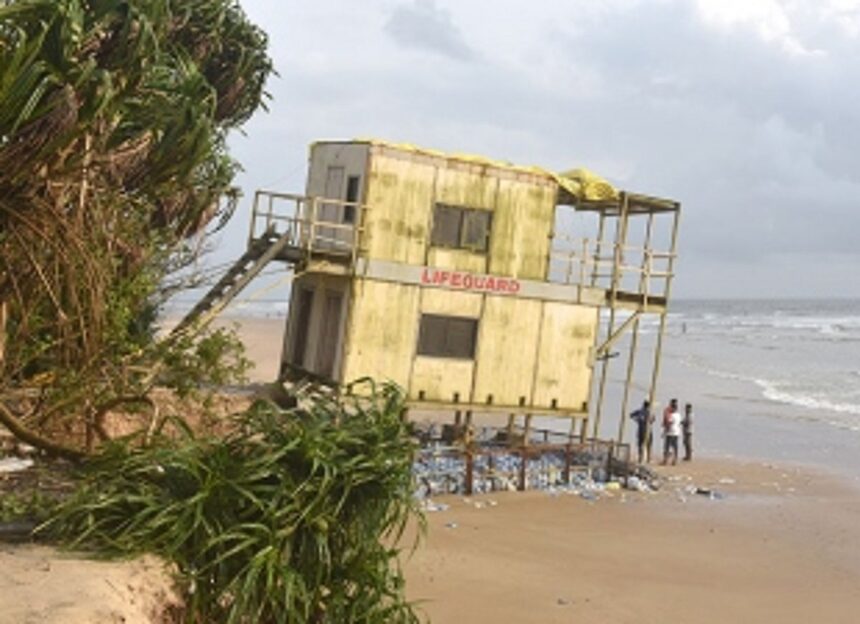
While the village is famous for its beautiful beach, which is a popular attraction for Goans and tourists alike, there are major concerns about the damage caused by sand erosion. Over the years, this has been an issue that has affected temporary structures as well trees that line the beach, the ongoing heavy monsoons has unleashed nature’s fury upon Velsao.
From the fishing community to those involved in tourism trade, the ever-changing landscape at the beach has led to fears about the condition of the beach in the years to come.
“Protecting the beach is of utmost importance. Massive sand erosion has taken place this year and the authorities concerned have to attend to this issue immediately before it’s too late,” said Agnelo Rodrigues, the president of Goenchea Raponnkarancho Ekvott (GRE).
This is a view shared by people who have visited the beach recently and the sight of uprooted trees itself evokes feeling of anxiety.
Sarpanch of Velsao-Pale-Issorcim, Henrique Demello also concurred that this matter needs to be looked into urgently.
“The government authorities need to work out some solution at the earliest to tackle this issue,” he added, while also describing how Velsao has suffered from substantial sand erosion.
Another issue faced by the villagers of Velsao, Pale and Issorcim is that of the proposed land acquisition for the doubling of the railway track, which also affects other villages in Mormugao taluka.
It may be recalled that recently, locals had confronted the Deputy Collector and South Western Railway officials over the double-tracking issue and strongly opposed the project. They listed out various points such as how it would cause damage to the houses including heritage homes as well as health hazards due to the high frequency of trains transporting coal, which would pass through these villages.
Cortalim MLA Alina Saldanha has also backed the villagers and had stated that she won’t give the NOC for procuring land from her property for the project.
Velsao Sarpanch also highlighted how the double-tracking would be detrimental to traditional houses, which are over hundred years old.
On a different issue, that of the complaints pertaining to the garbage collection in the village, Demello stated that they have identified a place for garbage treatment and will soon be moving ahead with this project.
When asked why the newly-built fish market cum community hall complex is under utilised, Demello revealed that the construction of toilet to this complex is still pending and that once this is completed, the infrastructure will be operational.
Some of the residents also called for the completion of basic civic services and lamented that some of the roads can be seen littered with garbage and that the street lighting in some of the wards are not functioning properly.
A farmer named Aniceto, also stated that the nullahs near the paddy fields need to be desilted. “This year, due to the heavy rainfall, water was overflowing from the nullahs and it reached the paddy fields. The bhandaras also need to be repaired by the authorities,” added Aniceto.
Another big topic of discussion in the village has been over a cellular tower.
But for the ramponnkars, the major issues revolve around their traditional fishing activity, which they have been doing for generations. They are opposed to bull trawling and robust mechanised forms of fishing, which they feel will hamper the marine eco-system.
“There are many families from Vasco who are ramponnkars and have been earning their bread and butter this way for centuries now. Late Matanhy Saldanha fought tirelessly for the benefit and upliftment of our community. This is why GRE was formed to raise our issues and we still actively take up the fishermen’s issues,” added GRE president Rodrigues.
Speaking about what can be done to augment the infrastructure in Velsao, Rodrigues said that the fishermen need a cold storage facility, an ice factory among other such utilities, which will be beneficial for the ramponnkars to store their catch.
Sarpanch Demello also said that the majority of the people are in favour of the government declaring Velsao-Pale-Issorcim villages as ‘fishing villages’. “This will protect and promote the interest of the traditional fishing community,” Demello concluded.