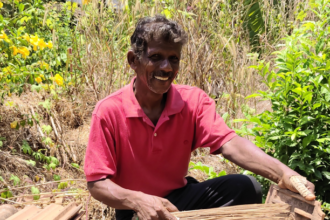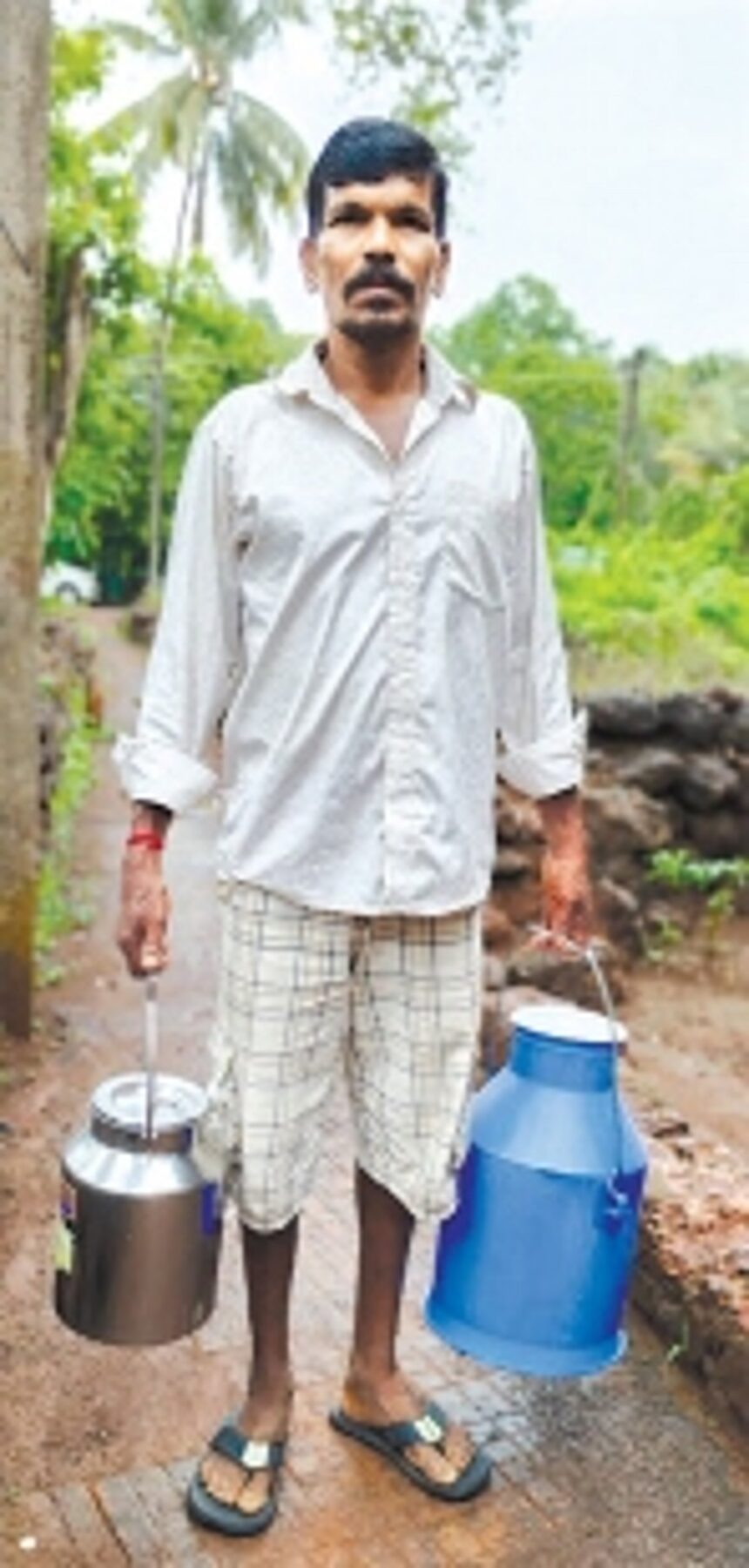
ALDONA: Farmer Krishna Chodankar, a resident of Grand Carona, rues the decline of traditional farming methods in Goa. Chodankar’s varied work history includes being a bus conductor, mechanic, and working at a petrol pump, but he returned to farming during the lockdown.
“I have cows and have spent my entire life working in the fields with my family. My cows are high grade, and I supply milk to Goa Dairy early every morning. I’ve been farming for 35 years, while my mother has been at it for 45 years and still works in the fields at 85 years of age.” He believes farmers are undervalued and unappreciated despite their hard work. Chodankar lights up when he talks about the benefits of ‘zoth’ ploughing, which, although time-consuming, provided perfect and good yields with proper soil mixing. “Our ancestors believed in ‘zoth’ ploughing. We also had ‘ghaddo,’ a method of traveling long distances by tying cows,” he recalls. His father also made coconut ‘vashem,’ contributing to their livelihood. “Today, technology has surpassed this method with machines for everything, making the age-old tradition of ploughing fields obsolete. The future generation will never see it,” he laments. Chodankar learned to use ‘zoth’ from his father, who crafted parts of the ‘zoth’ from good tree branches.

He highlights the challenges of maintaining cows, which require continuous attention and healthcare. Many have discarded their ‘zoth’ due to the arrival of modern machinery, he says. “One needs physical strength and the ability to control the cows to plough fields with ‘zoth.’ Many parts of the ‘zoth’
are not available due to low demand. The future
generation may long to see it, but it will be too late. We need to preserve this tradition for others to see,” he emphasises.
People from Delhi, settled in Aldona, come to him to buy cow dung for organic manure to grow vegetables. He recalled importance of farming during the Covid-19 lockdown, when even those with money struggled to find food. “ We used to sell cow dung cakes for cooking and heating water, but people stopped buying them once gas became available,” he recalls.
Chodankar notes the shift from traditional to machine-assisted farming, which is simpler and faster. “Our children won’t go to fields in their nice clothes and with their mobile phones,” he says. Fields are being left barren or converted into buildings, while people buy cheap, preservative-laden food from supermarkets. “During our time, if we were hungry, we’d eat homemade food, only buying bread from the poder. Now, children spend money on fast food,” he recalls.
Chodankar describes the bureaucratic hurdles in obtaining subsidies or building cow sheds, which discourage farmers. “Any work involves hard work. There’s no shortcut. Once paddy cultivation is done, we gather hay for the cows and clean the fields for vegetable cultivation,” he explains.
Hoping his children secure government jobs, Chodankar believes they, and others, should also be capable of working in fields. “Farming has no fixed hours or seasons. It’s always open to all,” he notes. Chodankar urges people not to rely on expensive migrant labourers who work strictly by the hour, unlike local farmers. “Nowadays, everything is costly, and we can’t afford to pay that much,” he concludes.