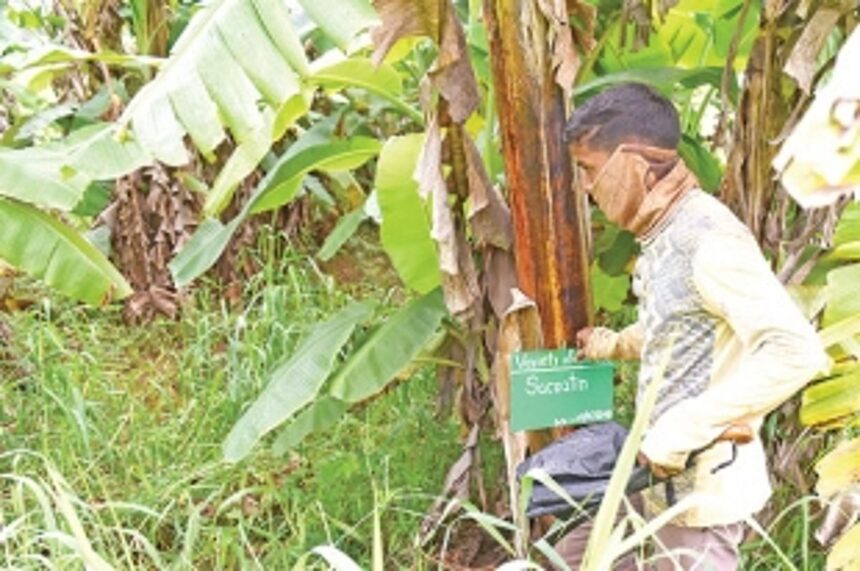
SULCORNA (QUEPEM): Two young scientists, one a PhD in horticulture and the other in agriculture, walk their talk on the farms of the Don Bosco College of Agriculture in Sulcorna, in Quepem. They talk to the plants, the sugarcane, they caress the paddy, dipping their feet into the fields full of rainwater, they beam as they show off the great crop of bananas and after being coaxed, reluctantly decided to pose on the fields. This was their catwalk, their stage and they were the models of development of a new normal Goa.
They are part of the larger narrative; Team Herald has been trying to report on and reflect on. Throughout Goa, in farms and institutions, there are people who believe that it is in the fields and farms of Goa, where we will see a revival. And that is a hope that all students of the Sulcorna Agricultural College have. While the need to get steady employment dominates those who want to become entrepreneurs or study further, every hand on the deck counts. Be it in government or a public sector undertaking or even in academics, so that colleges like this can be run.
But the prize for students, teachers and community is when these trained talents go back to the farms and work with the community.
Dr Rakesh Kawale, one of the senior teachers, standing next to the paddy fields of the college says “For over six months, final year students live in a village and work closely with one farmer, spending all his time with the farmer’s family. They learn and in turn impart some of their own learnings”.
Dr Kawale, who holds a PhD in Agriculture, further said that students study the farming techniques, the way the farmer manages his economics and their practices. After imbibing this, they at times offer alternate suggestions or small improvements, which may benefit the farmer based on their own earnings in the college. Both benefit. This is how a new generation of agriculturists, learn from the practical experience of farmers and in turn, give something back to them.
Dr Gourish Karanjalker, a PHD in Horticulture, adds, “Students also grow their own crops in the college and take it right to the market. They, in turn, get 50% of the sales proceeds. Hence their education is in sync with what Goa needs”
There’s one aspect that needs course correction though. The college comes under the Department of Education while the outcome of the work it does is the direct mandate of the Agriculture Department. However, the synergy between the two departments at the state level appears to be missing.
For instance in May, when the economic downslide due to COVID-19 had started, the Education Department asked the College to prepare ‘A strategy for the revival of Agriculture on Goa’ under ten heads, including agriculture and allied activity in Khazan lands. The final report was submitted on July 15. Interestingly the Agriculture department was nowhere in the picture on an important strategy initiative during this process or thereafter, till now.
Summing up, the Director of the College, Fr Allwyn D Souza, said the main task of institutions like these, was expanding the community through training and exposure programmes and going beyond the college and its students. He spoke of the seed development initiative, which has revived traditional varieties of fruit and vegetables like lady fingers and brinjal.
As the college completes its fifth year and awaits it its accreditation from the Indian Council for Agricultural Research, institutes like the Don Bosco College of Agriculture need to be taken on board. And there’s no denying that agriculture can be the X factor to turn Goa around. All we need to do is get to the farms.