The pen hurts writing this as the heart is heavy. What have we become? Can India matter if Indians don’t? Each Kuki and each Meitei in Manipur is an Indian. An Indian abandoned and neglected. Each is on a mission to survive, even if it means destroying the survival of their own fellow Manipuris, with whom they have lived together in peace and affection, in a beautiful land devoid of conflict.
India is a land of peace. The majority religion has also been of peace, harmony brotherhood, and embracing the minorities. Left to themselves the people of Manipur or the whole of north east will not even lift a stone to hurt. For the people of the hills, humanity resides in all its peaks and valleys. Why has this changed in Manipur?
Who started the fire? Because it was not always burning
The nation has blood on its hands. Blood flows freely through the streams and hills of the breathtakingly beautiful Churachandpur hills and on the streets of Imphal. Manipur to many is in the grip of a civil war, but in reality, it is a war of hurt punctured constantly, by the sound of cries, like bullets piercing the sky of silence.
The hatred between Meiteis and Kukis is manufactured, not natural
We will go- later- into the shock, the pain, the hurt and the divisions in Manipur where Kukis and Meiteis alone have not been hurt. They are more than that. They are fathers, mothers, children, relatives, doctors, teachers, lawyers, writers, singers, poets, entrepreneurs, and those employed in the government and the private sector. They have all shed tears and many have shed blood, as love and bonding over the years have transformed into hate.
A State cut into two
The Kukis have been forced to flee from the Imphal valley areas to the hills of Churachandpur, where the Kuki population lives and the Meiteis have all converged the Imphal valley as if the State has been cut into two. For 60-odd days the burnings the killings, the rapes and torture have happened with victims on both sides.
For 60 days, the victims faced silence. What do they need? – A shoulder to cry on
Silence has cut through the darkness like a flame in Manipur, but sense has not yet prevailed.
What do victims of violence of any kind need from the system? When hope is lost, when there is death and destruction what does a human being want? Simply, a shoulder to lean on and a hand to hold.
It’s been 60-plus days since the first round of violence started. The Kukis are living in refugee camps on their own lands. They are short of medicines and food, blankets, and medical treatment. They have built bunkers around their villagers not to protect them from the enemy country, but from brothers of their own land, who have suddenly become Meiteis and Kukis.
But what have we as a nation done? When will Indians make a call to save their brothers and sisters in Manipur?
Is Manipur too far? Is it a land we don’t know of? Are they, not our brothers and sisters? When the brave Nirbhaya was raped in a moving bus in Delhi and later succumbed to multiple wounds inflicted by the gang of rapist demons, the whole of India came to the streets to protest, march, light candles and force the government to bring the rapists to justice and make the rape law more strict and tough. At that time the whole country fought for one girl. Can’t we as a nation pray for the 30-odd lakh people of Manipur? And help heal in any way we can?
And then let’s turn to those whose mandate is to heal and not hurt.
The minimum price that a person who seeks votes is their presence when people need them
An elected person is like a parent or guardian. When land is divided along caste, community or religious lines for any reason, those who govern need to be there for all, not be players on one side. Is that the reality in Manipur?
Let’s hear a seasoned regional expert opinion on this.
Walter Fernandes is Director, of Northeastern Social Research Centre, Guwahati. In his recent column in The Telegraph of Kolkata headlined A Land in Trouble he writes, “One would be justified in concluding from these events that the conflict was well-planned, funded, and executed with precision by people in power. In most cases, the security forces remained mute spectators.”
This should be heard by all elected people in this country, including Goa, because sometime somewhere some of them are guilty of what Walter Fernandes said. As large tracts of land are converted from forests and farms to “settlements” for mega projects of outsiders, forests are burnt and hills are destroyed, let not the fundamental duty of an elected person- of ensuring peace and harmony for people to live decent lives ever be forgotten. But many of their actions or actions have actually led to destruction, of either land or communities, both harming the future
In Manipur, there were differences but never hate
The people of Manipur are torn apart. And for many of our readers, an insight into the tribal and other of Manipur will give a context, but not the root cause, of the conflict
According to Walter Fernandes, Manipur has predominantly Christian Naga and Kuki tribals and the most (not totally) Hindu, non-tribal Meitei who form 53% of the 2.86 million population (2011 census) living on 10% of Manipur’s land in the valley.
In his column in The Telegraph, he wrote “The Meiteis complain that they cannot own land in the hill areas while tribals can own land in the valley; they thus call this arrangement unjust. The tribes rebut by saying that the Meiteis monopolise jobs as well as economic and political power in the State and that they cannot claim land over and above what they have.
He further explained that the flareup started when a single bench judge of the High Court ordered the government of Manipur to consider recommending tribal status for the Meitei to the Union government. On May 3 the joint Naga-Kuki demonstration against the High Court judgment was attacked. The Supreme Court has since reprimanded the Manipur High Court.
But the damage had been done. A tribal status (which will lead to claims over tribal land), and what experts and locals feel, is the bending of the government toward the Meiteis, is what has catapulted the situation out of hand. Instead of being a referee, the government of Manipur is alleged to have become a participant, playing for one side.
This has thrown Manipur out of order. Women are getting raped, a child whose one parent was Meitei and the other a Kuki was attacked along with his mother. As they were being taken in an ambulance to hospital in Imphal their ambulance was burnt by those who belonged to his mother’s community, killing the child and his mother as well. Ultimately human lives are lost. What was the child’s fault? Was he both a Kuki or Meitei? Or was he born an Indian? Can any of us be proud Indians in the world’s largest democracy, with the world felicitating us, with companies promising billions of dollars of investments when our land is ripped by community disturbances?
Can money buy peace? Can money buy responsibility for one’s people? Can money buy harmony? These are priceless.
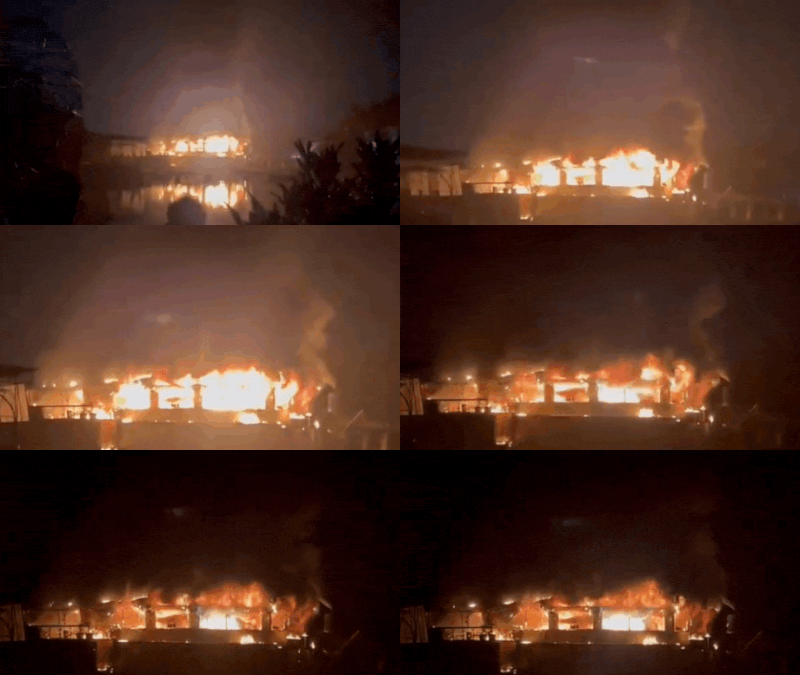
What has happened in Manipur is that loot and mayhem have gone unchecked. Over 125 have been killed. Ministers’ homes were burnt, 500,000 bullets and 3,500 guns were stolen from the State armoury and used for violence while the police remained silent. The country has not seen anarchy like this before. There are reports that the Army has been forced to release Meitei militants under pressure from the Meitei women under the umbrella body “Mothers of Manipur”.
Why was Rahul Gandhi therefore welcomed in Churachandpur and other areas?
In the middle of this mayhem Rahul Gandhi arrived. After being blocked on the way he went to Imphal and took a helicopter. All he did was listen, hold hands, lend his shoulder and put an arm around people. He refused to play politics or blame anyone. He was greeted with chants of ‘We want peace’ and he echoed those chants. With folded hands, all he said was, “Let there be peace, let the victims get solace and help. I will not do any politicking or blame game. Let peace come back to this beautiful land.” He did not do much but he did something very big. He spent time.
What will be the fallout if Manipur is not healed?
There will be a total loss of trust and faith in the ruling system. They will not trust those they vote.
The venerable The Hindu in a report headlined Manipur violence: Catholic Church-BJP honeymoon ends in Kerala writes: “The Kerala Catholic Bishops’ Council (KCBC), the apex body of Catholic Churches in Kerala, has followed suit with its sharp criticism of the ruling party and its parent organisation, the Rashtriya Swayamsevak Sangh. The report under quote further states, “Over 300 institutions under the Church have been vandalised and Christians belonging to both the Meitei and Kuki tribes are being selectively targeted. The ongoing violence in Manipur forms part of a larger plot by the Sangh Parivar to eliminate the Christians in India,” says Jacob G Palackapilly, official spokesperson of the KCBC.
Significantly, The Hindu report also mentioned that Metropolitan Archbishop of the Thalassery Archdiocese of the Syro-Malabar Church Joseph Pamplany, who had earlier co-opted the BJP “on the pretext of ensuring better prices for rubber, has taken the plunge by openly disapproving the silence of Prime Minister Narendra Modi over Manipur”.
But this is more than a betrayal of a community. It’s a betrayal of humanity
But in this darkness, the flame of humanity also cuts through and shines the brightest. As Walter Fernandes writes, “A few Naga outfits and some political leaders based in Nagaland visited Kuki villages with relief material to express their solidarity with them. The chief minister of Nagaland sent a massive consignment of relief to the Kuki-majority Kangpokpi district.”
What is needed now is stringent action
Article 355 of the Constitution mandates protecting a State from external and internal States. Art 356 is used to dismiss a government that is facing external and internal threats which cannot be controlled. Indira Gandhi as PM had dismissed her own Punjab Chief Minister Darbara Singh and imposed President’s rule to control the communal riots in 1983, PM Modi can do the same to a BJP government in Manipur and dismiss the Birendra Singh government and impose President’s Rule. The drama of pretending to give resignations and tearing them should not be repeated.
But the biggest balm to soothe the people will be a show of solidarity and support and most importantly, for the people of India to tell Manipuris, “We are with you.”
It is this appeal for peace, which is made from these columns, as one of the many candles that need to be lit in this country to break the darkness in Manipur.