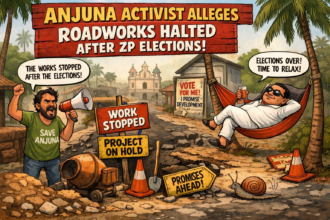
When a senior citizen of Panjim falls into one of the many pits dug by different agencies supposedly making Panjim smart, when truck after truck sinks in roads that are caving in, when untreated raw sewage gushes in front of or even through homes, carrying with it the excreta of inefficiency and the breaking down of systems or when a shopkeeper in the heart of Panjim has no option but to think of winding his family business because the road in front is massively dug, it is a picture of a town in absolute decay. That is what Panjim of today has become.
For how long can you put a board saying, “Today’s pain is tomorrow’s gain.” Since months and months of tomorrow pass with the pain of a city without services only increasing? The authorities speak in different voices without holding one authority which should be principally and criminally accountable for the absolute destruction of Panjim-The SMART City team. But this team is not supposed to sit in some ivory tower. It consists of elected politicians and selected officers from within the system, it works with departments of the government to execute but as always each department is in a universe of its own treating Panjim the way they feel, with no concern for the most important element in Panjim- its people.
But can people ask questions when they have already been gratified?
This is a sensitive and important question. When a person has sewage flowing outside his house and the road in front totally dug, trapping him within, can he exercise his right as a citizen, when he looks inside his house and sees a 56-inch TV, a new scooter or a bicycle all received as “gifts”, incidentally just before the last elections.
When he wants to protest against the bombing of his city, its bad roads and its crumbling services, can he do it if he remembers who “took care” of his daughter’s wedding expenses and continues to pay his son’s fees? Can he complain about no power for days or no water supply, when all he has to do is leave his monthly bills in “his’ office and simply get an SMS confirming that payment has been done?
You may get your scooter and your TVs but will you get your child’s future?
The choice is the people. Do they want to crucify their children’s future or not?
A favour, a bill paid or a gift got, may dictate how selections are made of people who will represent the area, but who calculates the long-term impact on how the panchayat, the council, the corporation or the
State is governed.
Accountability can be surely sought. But can you do that by devaluing the democratic process?
The management of Goa’s cities is only one of the major symptoms of an overall system failure of governance which cuts across parties. Each Sunday there are gram sabhas, the strongest platform of grassroots rural participative governance. It’s an outpouring of people’s hurt and anger on the non-delivery of grassroots governance. Every meeting of a council and the Panjim Corporation is stormy with mudslinging of the highest order witnessed.
Our courts have their doors knocked on several times each day with an appeal or petition against a government order, law, or amendment which seeks to make our hills weak, our forests deluded, our farmers unhappy, and our fishermen without a livelihood.
But let us go back to the fundamental question. Have the electoral choices people made of those who run the system been done honestly, to ensure that the system and its laws are meant to give service and justice to the most disadvantaged and the poor?
Can you imagine a charged-up electorate demanding services for the taxes they have paid, by law?
The Right to Service Act contains statutory laws and provisions to ensure the time-bound delivery of public services to citizens of India. It also defines the way officers who do not deliver can be punished. An alert and effective citizenry can easily expand the scope of this act through agitation and litigation, forcing legislative amendments, to extend to delivery of public projects in a time-bound manner. The massive cost escalation of the concretisation of the Miramar road project, similar escalations and delays of the big bridge projects, and most importantly the multiple digging and destruction of Panjim under the so-called Smart City Project should all come under the purview of the Right to Service Act. The act should not only have penalties but provisions to prosecute those in governance who have failed to deliver individually and collectively.
But rights can be exercised only when your conscience is clean
In every court, lawyers have to come with “clean hands”. So do judges and litigants. The right to vote is a unique privilege given in democracy that comes with duties and responsibilities. When this privilege is crucified in every election by a section of people, for the gratification of any kind, the second biggest weapon that people have after their vote- the right to ask questions and the right to protest gets blunted.
And that is the reason why authorities can get away with destroying a city like Panjim, which by their own admission seems to be spiralling out of control before the monsoons, with similar examples across the State.
Because people can raise their voices, only when they have clean hands.