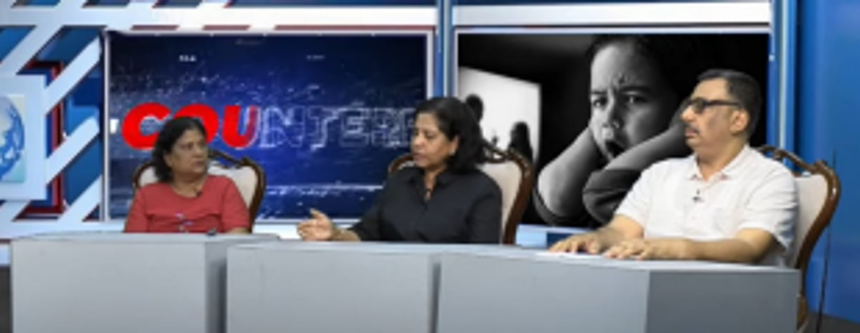
oa is faced with a troublesome issue, and that is the increasing number of domestic violence cases in the State. But the fact of the matter is that this in itself is not the problem. The problem is that Goa seems to have failed its people by not providing a proper ecosystem.
An environment of safety and comfort to victims of domestic violence, who somehow are absolutely helpless and unable to access facilities, is lacking. Domestic violence can only come down in any civilised State and country if there is a deterrent.
The problem with Goa is that these deterrent seem to be evaporating by the day and by the hour, where there is a basic feeling amongst victims that irrespective of whatever happens, we have a very long road ahead towards justice and whether the justice process is going to begin or not, itself is a matter of grave doubt.
At the same time, the system which specifically includes the police and other allied professionals who are supposed to aid and abet the police in carrying out its duty in handling domestic violence cases, itself seems to be geared towards not picking up these cases, which otherwise would have ensured that these cases were nipped in the bud.
The question that can be asked is why are we speaking about this now? Has there been a huge surge in cases? The point here is one doesn’t need a huge surge at any point of time. It’s not like a volcano waiting to erupt. It is actually not even a dormant volcano. It’s an active volcano, which simmers all the time. But probably one trigger is a recent incident that happened last month in Vasco. Just outside the town, there was an incident where a pregnant woman and her mother were literally burnt alive, ostensibly or purposely, initially due to a LPG gas cylinder blast, which was later whittled down to a vapour gas explosion.
But the long and the short of it is that, there were large discrepancies in the investigation and there was tampering of the scene of crime, which was very evident.
Secondly, artefacts and important objects such as the cell phones and others were not even seized as part of the panchnama.
Hence there were a lot of pointers to the fact that the investigation was completely botched up. After that the family of the deceased women, the brother of the younger woman, went to the extent of filing a report with the SDM, openly alleging that this was not an ordinary gas cylinder blast. It was a pre-planned case of murder related to dowry demands by his brother-in-law, who happens to be employed with the navy.
In spite of all this, no FIR has been lodged against the person who has been accused of committing the murder. Of course investigations are still on. The point here is that irrespective of which way the whole issue flows, we are seeing that there are a lot of major acts of violence and deaths that are happening, which seem to be just normal accidents, which ultimately turn out to be domestic violence cases.
Sabina Martins, Convenor, Bailancho Saad said that domestic violence is very much prevalent in Goan society.
“In Goa, domestic violence is very prevalent now. In this case, because the person is from outside the State, it looks like a cylinder blast and these things happen only in North India and it doesn’t happen in Goa. But in Goa also we have very acute cases of domestic violence, like putting hot iron in hot water or hitting the leg. So, there’s all kind of brutal assault. People look at it only when it is brutal, but there is also mental torture inflicted through constant abuses, not allowing the woman to go to her parent’s house, then depriving children of food,” Martins said.
“So you know, to trouble the woman, she is not allowed to go to work. She is put under pressure by objecting to the way she dresses and lots of other issues, which finally trigger domestic violence. So it’s very much prevalent,” she said.
“The second issue which comes over here is it looks like there was no prevention and that is an issue which we need to focus on more. How do we prevent and what are the mechanisms to prevent domestic violence from happening. So, here in this case. There was no prevention. If the woman was suffering or had problems, whom did she go to? She only spoke to her family. Did she have any support in this area in Vasco, where this incident happened?” she asked.
“Then is the prevention aspect of it, which is about the action taken when a crime has been committed. Did the family get support? Did the investigation happen in a proper manner? Did it require media organisations, NGOs and other people to see that the investigation gets done? Because, if the marriage is less than seven years, it has to be investigated by the SDM,” she said.
“Only when there is public pressure, then it goes in the direction of domestic violence, otherwise police just register it as accidental death or unnatural death and close the matter,” Martins said.
The figures put out as far as the annual data of domestic violence is concerned, in 2022 there were 189 cases, which seems absolutely ridiculous. On top of that, it was shocking that the Directorate of Women and Child Development (WCD) department released a statement after that saying that not even five percent of these cases are genuine. It’s a WCD statement, where the government department turns around and says that most of these cases are not genuine, they are just completely made up and hence we don’t take it.
Responding to the statement, Adv Caroline Collasso, Human Rights Lawyer said, “A woman does go to the police station only after a series of really unbearable violence. Even when she goes to the police station, the police would register what is called a non-cognisable case. So, only if physical abuse causes actual dislocation or a fracture, it would be considered as grievous and only then it would become a cognisable offence for the police to consider it an offence and register an FIR.”
“Knowing how the patriarchal society works and still continues to work, sadly it’s like when a woman goes to the police station, she is told that it is still a family matter and she should try to sort it out. So therefore, a large number of women are turned away or in case she insists, it becomes a non-cognisable (NC) case and that’s the end of story, because in the NC case, the police have no powers to investigate. They would have to take permission from the court,” Adv Collasso said.
According to her, it rests there and the woman files a complaint. What more could she have done?
But what stage do lawyers come in? They obviously come in if a woman has been courageous enough to approach a senior lawyer independently and s/he takes up the case independently and then fights. But very few women would be able to actually even come to a lawyer.
“They approach a woman lawyer thinking that we would be sensitive enough. But, it is very difficult for women from far flung areas like Valpoi, Bicholim or Pernem to be able to locate a lawyer. They don’t always know that you know whether the lawyer is available for free or not. We handle most of the cases pro bono. But it is my discretion to do so,” she said.
“Therefore it puts a question mark on the functioning of the Block Development Officer (BDO), who is a Protection Officer. Why isn’t he a full-time officer at the taluka level? What has happened to the legal aid forums, providing free legal aid, who should have been out there telling them you don’t need to pay for the lawyer as the State pays for the same so that it would give them the courage to go ahead and file a case,” she said.
“At the initial stage itself, if they are not being given the backup to file the case and streamline the support system, and being told that yes even if you want to leave the house there is a halfway home or you don’t want to leave the house but just want the husband to be counselled, then there is a counsellor. But if all this backup is not there, then it’s a complete failure of the system,” Adv Collasso said.
About a decade ago, the then DGP called T N Mohan had set a protocol for women and children on the International Day for the Elimination of Violence against Women. He had worked on the protocol. It was accepted and the DGP that time had said that in case a woman makes the complaint and stands by it, the complaint will be registered. He had laid down a detailed protocol on what needs to be done. He also said that 300 women police officers were sanctioned, of whom 80 would be Police Sub-inspectors (PSIs), and they would be posted in each and every section. But it seems all these were like dream declarations.
Speaking about his experience in dealing with domestic violence issues, Arun Pandey, Director of ARZ (Anyay Rahit Zindagi), said, “Goa is one place where we have one of the best legislations, like the Protection of Women from Domestic Violence Act. You have various provisions in IPC, you have the best scheme like the One Stop Centre. We have the best legislation in this State. Unfortunately, the problem lies in implementation. When we talk about domestic violence, unfortunately this term domestic has caused the most harm because everybody considers it as a domestic issue.”
“In fact, even if the victim is being physically, verbally, sexually and financially being exploited at home, she keeps on tolerating it, thinking that it is a domestic issue and it has to be sorted out. This is because she knows that when she goes out, it will be termed as a domestic problem. So the problem starts with this term. When she goes out, we find that most of the time, the family discourages it,” he said.
The worst response doesn’t just come from the family. When she goes to the law enforcement agencies, they discourage her, even though the law is very clear. In fact, if you see the Protection of Women from Domestic Violence Act, it has provided various good provisions and also provided for Protection Officers. The police have a very important role to play. It was felt that the police, because of the type of selection and training, may not be sensitive. But see the situation in Goa. You will find that the BDO, who is the revenue officer, has been appointed as a Protection Officer.
“The Protection Officer has a major role to play is starting from listening to the victim. Providing protection, shelter, immediate relief right up to filling up the form. Now the Protection Officer works from 10 am to 6 pm. Most of the time he is not available at the office. There is no space in his office to sit and listen neither is trained. The Act says the Protection Officer has to be female. How many BDOs are females?” Pandey asked.
“So that is when there’s no privacy in his office to listen. So in fact, I think the police station would have been a better place for the victim to go and ask for relief, because there are lady police officers, infrastructure is there, or go to a designated special area. So what is happening here is that, unfortunately, we are not paying attention to this issue because we are seeing it as a domestic issue,” he said.
“What we further want to add is, we get one or two cases every day related to domestic violence from different caste, class, religion, literate and illiterate housewives, working women – everybody facing a similar issue. Recently, we had a meeting wherein we called the State Legal Service Authority Protection Officer and various women came and gave testimony. Most of them said that they have become like football. The women say that they committed a mistake by asking for justice for the violence committed against them,” he said.
“Like a football, they keep going from one place to another place, without any sense of getting justice,” he said.
Throwing more light about the One Stop Centre what it is and where it exists, Pandey said, “One Stop Centre is a very good idea. It is a central government scheme. In 2015, this scheme was introduced. It envisaged that women who are victims of violence, go to one place instead of going to different agencies and asking for help. Like, suppose a person has been assaulted and has to go to police, then police will send her for medical check-up, then to shelter home and then for counselling. So a one stop crisis centre is a place supported by the central government.”
“As per the scheme, police will be there, the Directorate of Health Services will depute a compounder or a doctor. There will be ambulance and NGO representatives to provide counselling. There will be a shelter home. Everything will be there at one place. But unfortunately, we find that in Goa, the way this scheme had been planned and designed, is not being implemented. Now, what is happening is that it is unfortunately being run by a Non Government Organisation (NGO),” Pandey said.
“I am not against NGOs. If the government would have been running it, there would have been more resources. Also, there would have been participation from government authorities. In other places that are being run by the government, the Collector and Superintendent of Police are part of the management committee,” he said.
“So imagine a scheme which is being implemented under the direct supervision of the Collector and the Superintendent of Police, it would have more impact than a NGO running it. We know some NGOs are running the show, but are unable to manage it. They are not able to deal with the kind of requests that are coming to them,” the founder member of ARZ said.
“Also at the district level, okay we find there are issues. I come from Mormugao. Most of the victims complain that they are unable to get services from One Stop Centre and when we approach the Centre, the staff members say they don’t have don’t have human resources and they can’t keep them and provide them shelter. All these issues are there,” he said.
Under this whole veneer of civilization and the educated society that we have, if you scratch this surface and this veneer, you will come up with so many cases of hurt, battered, bruised and completely broken women, going to sleep each night where the nightmare of her life is worse than any nightmare she would have when she goes to sleep. What is ironic is that we pride ourselves as a country which focuses on the education of women to ensure that they can protect themselves and take care of all their rights and to live in the society as empowered human beings.
But the point here is that what we see is that this education beyond a point becomes useless if the system which should be empowering women who have this courage to take matters in their own hands and fight for justice, does not seem to exist at all. From the BDO to the police and then finally to the court, it’s a long journey of struggle and harassment, which sometimes becomes even more painful than the physical beating and the abuse that women suffer.
We hear success stories in neighbouring States which are much larger than Goa, where the system is empowered, where the government departments, the SPs, the District Magistrates and others are a part of the solution. In Goa, they are not. They don’t seem to be part of the solution. People are very upset that they seem to be part of the problem rather than the solution and you leave it ultimately to right thinking NGOs and other organisations to fight this battle by themselves, without any kind of support, without any support, like fund and infrastructure.
At the very end, when a woman goes to the police station and she’s called at night, there is not even a transport to drop her back. This ultimately sums up the apathy and the absolute neglect that we have kind of unleashed on vulnerable women in Goa. Ultimately, the way out is that the government must wake up and understand that you have to take action because God forbid, a day will come when your own home will see Wthis eruption of this vulnerability in a manner that you would have least expected and that is when it will hurt the most.