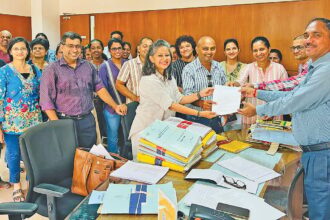
Herald: Hello and welcome. We are here with a very distinguished panel to discuss an issue which is burning in Goa, an issue of utmost seriousness, a people’s issue, and an issue which has been languishing for a very long time. We are here to debate the future of the regional plan. It was conceived during the time of Digambar Kamat. After that, things went completely off-track, as a result of which villagers are burning with a lot of anger and anguish, and the state is suffering from a lack of planning. The guests we have today are eminent and with the most expertise to talk on the subject. We have Dean D’Cruz, an eminent architect and a prominent member of the task force which went into the regional plan. Next to him is his former colleague Dr Oscar Rebello, who was also a part of this whole exercise and in a way he probably embodied the spirit of the people’s movement when it first started against the earlier flawed regional plan. Then we have Digambar Kamat, who in many ways is the architect of the regional plan. It was under his stewardship that the taskforce was conceived, the plan completely drawn up. We also have noted activist from Margao Shriram Raiturkar, who in his own way is fighting against several illegalities and irregularities in Margao. He will also speak a lot on the issue of the ODP, and we need to know why the regional plan and OPD need to be two separate entities when they can be one and controlled by one authority. All these are very important topics. We’ll divide them into three segments.
Herald: The first segment will be the start of the dream, if we can call it that. Dean, can you just elaborate on the whole start of the dream and where it has ended now?
D’Cruz: It really started with the 2011 plan which was released by the government. We realized there were a lot of defects in it, and from inside information we realized there was a great deal of corruption. Money was being paid to the town planning minister for conversion of lands; they are large tracks of land without any planning or norms put in place. With the realization that this was going on, the people were very upset about it. With that came the historic movement; the starting of the GBA, which had these enormous rallies in both Panjim and Margao with the clear mandate of the people that “this is not acceptable and we have to do something about it”. There the movement started. A three-prong thing: going to the opposition, filing objections in court, and of course, a street movement of the people. With that came the de-notification of the 2011 plan and an even bigger task of preparing a new plan. We at the GBA realized it’s very easy to stop the plan, but it’s far more difficult to create a new plan. However, when the new government put that plan process in place, it got Charles Correia, Edgar Ribeiro – two senior planners and men from Goa committed to seeing that the future of Goa was planned out well – to come on board, and then it created the task force, which actually got people, from the perspective of development and the people’s perspective, on board to create this new plan. It is a unique process called ‘participative planning’ from a ‘bottom-up’ process, where it really involved the people. There was a lot of time taken as there was no base data. The base date had to be got from various departments, it had to be taken to the people to try and understand what their aspirations were. That’s why the plan required a great deal of time. It was stretched to a level where people were frustrated about its fate. Also, this was done by the people and professionals who were taken on board. It wasn’t a full-time job by the task force. It doesn’t take a lot of time. The task force put whatever resources it could into the plan. Unfortunately, while the initial process of the task force was well conceived, in the actual implementation, a lot of the people’s aspirations were not taken into account and political influence, developer influence started coming into the plan.
Herald: Oscar, one of the most striking images that people have of the regional plan is of you standing on that stage with your fist aloft and clenched. That became a very iconic or defining picture of the whole movement. It is not about you personally, but it was about one man and people gathered around him. What was very important – and we also wrote about it – was that town and country came together to protest. That was the whole catalyst which changed everything. The fire really burned and people came in. I know ladies who were 80 years old and children who participated. Before we go on to other things, do you feel that people’s passion is lacking to ensure that particular plan or whatever was envisaged gets converted into it? Do you think governments take a lot of advantage of lack of the people’s passion to come forward and demand a good plan?
Rebello: I have always personally debated this with myself on so many occasions. To my mind, the GBA, or for that matter Dean or I or any of us – we’re just the excuse. We were just frankly the excuse for what the people of Goa really wanted. D D Kosambi has always said, “The history of a place is never written by its leaders. It’s written by the people.” The people’s aspirations are what ultimately matter. I think, ten years down the line since the agitation, we’re still grappling to crystallize in one form what those people’s aspirations are to reflect on the regional plan and how our land use, our culture, our heritage, our identity can be preserved. We are still struggling with that kind of debate, which is passionate sometimes and ferocious sometimes. I would like to point out that you can never really get a perfect solution. We’ll all be dead and gone or you’d be ready in 2041 to try and get a 2021 plan in if we don’t agree to certain non-negotiables in the plan and certain negotiable in the plan. I think the problem at the moment, which frankly we tried to do during the task force – we interacted with the industry, we interacted with housing, we interacted with so many other stakeholders in the development process. We just cannot eliminate them completely. You have to have some kind of a common minimum program by which you can get a plan going. I don’t think the activists who will say, “We want a completely perfect plan. Only then we will say yes,” will win that. Who is really going to win are the people who have access to political power, who’ve got the money, who’ve got the influence, who can peddle the influence to make Goa what it is, whether a complete dump-yard or slum. They are the ones who are winning simply because the rest of us sensible people, from all sections and not just activists or environmentalists, cannot seem to agree on one common minimum program as to what would be the environment plan for Goa, what would be the economic plan for Goa, and what would be the social plan of Goa. We need to get that triad going if we have to make any attempt to save Goa.
Herald: Digambarbab, if you had got the regional plan right, or if you had managed to close the issue and come out with a plan and seal it, you probably would have still been in power. Do you realize the failure to take the plan towards a logical conclusion has cost you power to an extent?
Kamat: I do not think so. We prepared the regional plan in consultation with the people. First time such an exercise has been done in Goa, and everybody will agree. The earlier regional plan was to the scale of 1:25000. We tried to draw a plan of 1:5000 at the panchayat level. Not only that; today the plan is digitized. You just go to the kiosk, press the survey number, and you get the zoning of your plan on your screen. Nobody can cheat anybody. See, the task force had prepared the plan. I took over in 2007. It was an enormous task as Dean said. It’s not that easy. Only those who go into it will realize how difficult it is. The task force submitted the draft regional plan in 2008, then the state level committee was formed, there was a lot of deliberation, the panchayat were asked to submit plans. Some panchayats even submitted two plans. To that extent there were litigations, fights, etc.
Herald: I agree with what you say, but what really happened is that once the plan was released, people saw there was a lot of difference between the draft plan and the final notified plan. Eco-sensitive zones came in, micro-economic industrial zones came in. That actually led to a lot of people saying there’s been a huge change from what we thought and what came out.
Kamat: Eco-sensitive zones were introduced for the first time. If I’m not mistaken, we said for Eco 1 and Eco 2 there should be no compromise. You will be surprised to know that what was zoned as ‘settlement’ in the 2001 regional plan, somewhere around 8 crore square metres of land has been removed from the settlement because of these Eco 1 and Eco 2. The demand of all NGOs when they met us was to reduce the FAR in the villages. We designed VP 1 and VP 2 status. We said VP 1 panchayats will have 80 percent FAR. If the area is more than 4,000, FAR drops down by another 20 percent. For VP 2, we said FAR will be 60 percent. That is because the demand of the villagers was that they should not have high-rise buildings in the villages. Even that was taken care of. It’s not that we didn’t take care of most of the points. We took care of most of them. Individually when you plan, and when the planners sit and decide, they cannot go into changing pockets or individual plans, which was happening earlier.
RHerald: Shriram, your opening remarks on two things: one is on what we’ve discussed. The other is that you belong to a town where there are a lot of issues and that town is not under the regional plan. So aren’t a lot of other towns. Do you feel the area of Goa that is away from the regional plan is where the maximum number of illegalities is happening, and if more and more of Goa is going in that direction.
Raiturkar: Wherever the ODP is finalized – Margao, Panjim – the entire city is a total mess. ODP is controlled by the politicians. Except for one member secretary of the authority, all are political elements. There is no parking in Margao or Panjim or wherever there is ODP. The way ODP is prepared is totally illegal. All PDAs have prepared illegal ODPs. There are certain sections in TCP Act 1974, section 29-37, which have to be complied with to prepare the final ODP. They have never complied with sec 31, a comprehensive development plan that shows parks or open spaces. In ODP, they’ve put up a fine picture that shows many spaces. As per section 41 of TCP Act, whenever the ODP is published, it amounts to section 4 of the Land Acquisition Act (LAA). Whenever it is finalized, it is section 6 of the LAA. Let me give you an example. Near the electricity department in Aquem, it was marked as an open space. Suddenly after that, a new ODP came and it was shown as a commercial zone.
Herald: Our second segment on our debate of the regional plan deals with challenges and opportunities. I’ll start off again with Dean. There’s one critical issue that we need to address. There are two terms that people use: one is the draft regional plan and the other is the final notified regional plan. There is a perception among large sections of people, including activists, that these two plans are poles apart. Why is this perception?
D’Cruz: It’s a bit of a misunderstanding. The draft plan was actually the 2001 plan mapped at a more detailed scale and eliminating the eco-sensitive zones, which is basically like the CRZ areas, forests, and fields. It did not show any new settlement area at all. The people’s aspirations were not taken into account in that sense. After that the people’s objections and suggestions came on board and the new regional plan along with the extension of settlement areas took place. The first plan was not even a people’s plan. It was the previous 2001 plan with these overlays or deletions in it. There naturally has to be a great difference between the two because that was not really a plan prepared.
Herald: When the first draft plan was made, there were certain people on board in the task force. You had somebody like Edgar Ribeiro. He was the only town planner in the whole group, which consists of many eminent architects. We still do not know the reasons Edgar why left, but after he did, he wrote a letter to the then chief minister giving complete details of why he wanted to leave. He felt the spirit in which the whole plan was envisaged was going awry. He protested against the micro-economic and eco-tourism zones. He felt a lot of things which were not there crept into the plan. The fact that an eminent and the only town-planner moved away from the task force, why wasn’t any attempt made to have another eminent town-planner on board, because town-planning is the whole essence of the exercise. This question is open to everybody here.
D’Cruz: Even though Edgar was a senior planner in the government, he was quite progressive in his views about planning. He realized he had morphed his planning
ideals over the years. He was happy with this whole people’s participative process. When he spoke to me he said the plan is really a policy document, so we don’t actually have to go down to a level of mapping each survey number. You just put the broad policies in place and then eventually the land use plan can be prepared. His thing was not to go down to the micro level. But, I think what the people of Goa were looking out for was actually, “Is my land in settlement area or is it out of settlement area?”
Rebello: That’s the conflict. That’s where the conflict took over.
Kamat: His way of looking at it was totally on a different level. And as Dean explained, people’s perception was about what is the status of their plot, whether it is affected by any zoning, whether it is affected by any road. This they wanted to know clearly.
Herald: The other issue, Digambarbab, is that when the plans went, the village-level committees and other people gave a lot of suggestions and it came back. The complaint against the whole planning process – and majority of the people said – was that plans made by the village-level committees did not actually reflect on the final plan. A lot of areas marked as non-settlement became settlement.
Kamat: The main problem, as Dean said, when the draft plan was circulated it had matched all the details of the draft plan 2001. As I said, between 2001 and 2010, thousands of conversions have taken place, which were not reflected on the regional plan. Lots of government buildings have come up. Lots of development had taken place which was not on the plan. We asked all departments to furnish the details. All were incorporated in the RP 2021. These are not converted now. Suppose an area of 20,000 is shown as settlement by a gazette notification, that is reflected in the final 2021 plan. It is mentioned there. You have the gazette notification. They had done many exercises that time. Naturally people thought a lot of area was being converted. If you go through the statistical data, the total percentage of developable land in RP 2021 will not exceed 15 to 16 percent.
Herald: The percentage of conversion, you mean?
Kamat: No, percentage of land available for development. In Dharbandoda, Sanguem, Canacona, the area available for development as per RP 2021 must not be even 8 to 10 percent.
Herald: But there are areas out of it, for instance the micro-economic zones, the eco-tourism zones.
Kamat: Why was the eco-tourism zone included? Many people wanted to put up resorts. They were asking for conversion of 5 or 10 lakh square metres of land. When they were called to give a presentation, one question put to them was: are you interested in putting up a resort? Or are you interested in putting up a colony of a residential building? They said they wanted to have only a resort, like a