The locals of Chandor and Guirdolim may have forced the South Western Railway (SWR) to pull its emergency brake as far as the proposed work in the southern side of the railway track that passes through their village.
According to the locals, Rail Vikas Nigam Limited (RVNL) has already caused extensive damage on the northern side of the railway track in Chandor and Guirdolim in the past.
They add that presently, RVNL has destroyed peoples’ properties, low-lying fields, freshwater streams and a lake, which catered to the irrigation needs of the farmers, by filling it up with mud.
It may be recalled that alert villagers had stopped RVNL who had brought in trucks laden with mud and industrial waste. They had engaged with various authorities, including the Maina Curtorim Police Inspector Sagar Ekoskar and the Water Resources Department (WRD) Minister Felipe Neri Rodrigues before RVNL could damage the sluice gate.
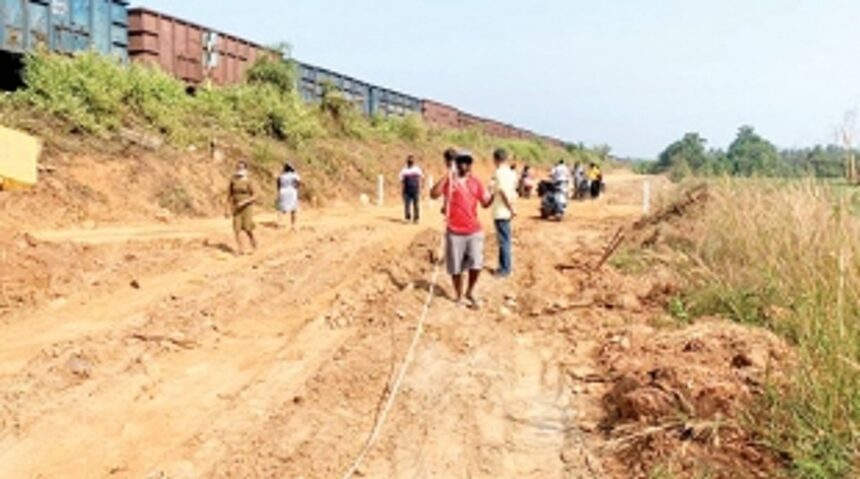
Right now, the work on the southern side is stopped, but the water bodies and the lake are not restored to their original condition, much to the locals’ frustration.
“In my opinion, our government should stop the Railway double-tracking project forthwith, as it is not beneficial to Goa. Goans will lose their ancestral houses, their environment, their water bodies, their fields, etc. The increased transportation of coal will create such a pollution that people of Goa will suffer lung diseases, cancer, children will be born with birth defects, and our pristine green Goa will turn into black Goa,” said Felix Furtado, a resident of Chandor who has been part of the agitations.
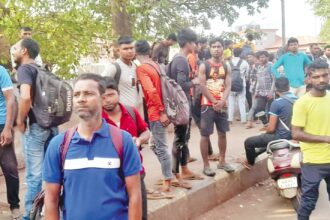
Guirdolim’s Biodiversity Management Committee (BMC) Chairperson Agostinho Antao, who had led the villagers to force the Guirdolim Panchayat secretary to conduct an inspection, lamented that the Railways, which already has double tracks from Sanvordem to Margao are trying to push ahead with its plans for Chandor which include new tracks and another station.
Some of the locals feel that RVNL plans for the new tracks is ostensibly to wash dirty wagons, to load coal, which will be brought by barges through river Zuari.
Locals have protested over how the Railways have cut trees, destroyed the tributary of Zuari in Guirdolim, the sluice gate between Chandor and Guirdolim, built huge retaining walls and dumped large quantities of mud in people’s properties without the consent of the land owners.
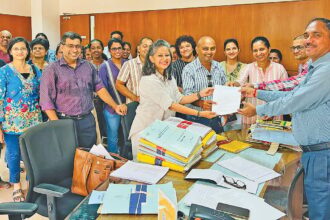
While the Guirdolim BMC has already submitted its report to the Goa State Biodiversity Board (GSBB), Antao added that they are doing the preparatory ground work before approaching the National Green Tribunal (NGT).
As of now they have forwarded the copies of the show-cause notice cum stop work order that was issued by WRD to RVNL and asked the authorities to ensure that the stop work order is respected and no further work is carried out.
They are also waiting to see what RVNL had to say in its reply to WRD, which in its notice pointed out to glaring irregularities and had asked RVNL to submit the details of the proposed construction in view of the possible flooding that may occur in the surrounding areas due to the alteration of drains and water body.
Besides this, there are two issues the locals are simultaneously looking at going forward.
The first one is regarding the entire land acquisition process that the locals have criticised and objected to.
Locals pointed out that RVNL, without waiting for the outcome of the Land acquisition, started work from Curchorem to Arrosim, by deploying a huge battalion of armed Railway Protection Force.
There is a sense of concern that similar fate awaits Guirdolim and Chandor too given that as per the Railway authority, the land acquisition process in many areas have been completed.
Locals pointed out that Guirdolim-Chandor land acquisition hearings were completed and orders were passed by the Deputy Collector, Mormugao on November 12 – the officer appointed for Land Acquisition.
The locals lamented that hearings were completed hurriedly without oral arguments. Moreover on November 12, till 10.30 pm, the Dy Collector kept them waiting and wrote the orders.
However, even though they had applied for a copy of the orders on that day itself, till date the orders have not been given to them despite having constantly followed up on the issue personally.
Much to their shock and exasperation, Railways recently came out with the final notification stating that they have acquired the objectors’ land under Railways Act.
This included those who were not giving their land but their land has been allegedly forcefully usurped under the Railways Act.
Against this backdrop, the villagers and others concerned had filed petitions in the High Court. Advocate Nigel Da Costa Frias, representing Chico Fernandes and others while Adv Carlino Collaso is representing Ganv Bhavancho Ekvott and others.
These two petitions and another have now been kept for the next hearing on January 11 as per the request of RVNL.
“We are not going to be taking what RVNL says at face value. So much has happened in the past that you can never know what is going to happen next. Local stakeholders should be consulted but that is not happening. We had a meeting with them earlier this year and asked to show what permissions were taken. We got contradictory statements. If we had not to come on the tracks to find and protect our land and lake, the situation could have been far worse,” said another local from Guirdolim.
Goencho Ekvott, the anti-coal group has also extended support to their protests and showed their solidarity with the agitating locals on the ground too.
Aside from their objections to the manner in which the land acquisition process was conducted and filling of the low-lying areas, locals have also questioned what had happened to the assurances by RVNL for restoring the sluice gates that were broken in the past.
For perspective, on the Northern side of the railway track, the water body moves out into River Zuari. This is where the sluice gates had been damaged and incidentally the former South Goa District Collector had asked RVNL not to block the flow of water by filling the low-lying area with mud. On the southern side of the railway track, is the Naukhazan lake that flows out to River Kushavati. This is where locals had stopped RVNL from dumping more mud into the lake and where multiple inspections were held earlier this month.
But it is the contention of the locals that nothing had been done to the now ten-month old report of WRD that had confirmed that RVNL had caused destruction to the water bodies and the ancestral sluice gates.
The WRD Executive Engineer Ankush Gaonkar, who had issued the recent stop work order, had earlier this year, submitted his report to the District Collector and other authorities which looked into reconstructing the sluice gates and restoring the water bodies at the site.
The report had emphasised that the nullah that connects to the River Zuari tributary was heavily damaged and had to be reconstructed along with a connecting outlet.
WRD had also said the existing pond had to be strengthened and that the Nacasana tank had to be desilted and improved keeping in mind the flow of water at the downstream of Nacasana tank.
In the latest order, the WRD had pulled up RVNL for filling up the earth in the Nacasona tank abruptly without consideration to the effect on surrounding areas.
Keeping that side, this is what has irked the locals.
According to RVNL, it had accepted the WRD’s report and at a meeting convened by the District Collector, they had agreed to bear the cost of restoration works. They had also agreed to bear the cost as per the estimates prepared by WRD and had already granted a sanction order to bear the cost worth Rs 2.98 crore much earlier.
WRD has stated that this proposal for the restoration of water bodies had been sent for expenditure sanction and is likely to be taken up soon.
Locals have bemoaned the delay in implementation of such works and given that the election code of conduct is coming close, this work could be delayed even further.
Scientist Antonio Mascarenhas, who has worked with the National Institute of Oceanography (NIO) and is a member of the Goa State Biodiversity Action Plan (GSBAP) Committee, has also emphasised upon the need to protect such lowlands.
“Lowlands of Goa have innumerable freshwater lakes and ponds that offer a large fishery potential, and represent the agro industry of yesteryears. Today, an integral part of our wetlands are lying in shambles due to neglect. The survival of paddy fields is dependent on them,” said Mascarenhas.
Farmers of Chandor and Guirdolim are already suffering from the consequences of damaged water bodies, bandhs and the sluice gates. Entry of saline water into the fields and spread of mangroves has also had its negative bearings on cultivation related activity.
“Also, it is not known how much sediment has accumulated in these basins. Investigations of bathymetry and limnology of these lakes is imperative. Several knowledgeable scientists have already documented the rapid degradation of, and the need for restoring these wetland ecosystems,” Mascarenhas added.
What the locals feel is that there needs to be a holistic plan in place to save the villages from further degradation. Not to mention the damage being caused by air pollution.
It is to be noted that in May, 2021, the people of Guirdolim and Chandor-Cavorim villages had written to the Union Railways Minister, Chairman and Chief Executive Officer of the Railway Board, General Manager of SWR and RVNL asking that they stop the ongoing works for doubling of Vasco-Kulem railway line immediately.
They based these demands on the report tabled by the Central Empowered Committee (CEC) that was appointed by the Supreme Court to investigate and compile a report on the feasibility of the three linear projects, one of which was the Railway double-tracking.
The extensive report clearly mentioned that these projects are not beneficial to Goa, although no judgement has been passed as yet by the Apex Court based on the CEC report.
‘Goyant Kollso Naka’, one of the organisations fighting to preserve Goa’s environment had also written a detailed letter to CEC against the double –tracking project with detailed reasoning about the long –lasting and irreparable detrimental impact of this project.
People of Chandor and Guirdolim have also appealed to WRD, Coastal Zone Management Authority, Department of Land Survey, Public Works Department, Department of Mines and Geology, Forest Department, Collector, Deputy Collectors, Police, High Court, South Western Railway and the local MLA Clafasio Dias to stop the work as this doubling of railway line does not benefit Goa. They alleged that the doubling of railway line will only benefit crony capitalists, to transport coal from Vasco to Southern Maharashtra and Northern Karnataka to run their thermal power plants and steel plants and questioned why the locals should bear such life changing costs where the heritage of their villages will not be preserved for the future generations.
As it is, locals are having problems accessing their own properties due to the double-tracking work while traditional activity as simple as cattle moving around and taking a dip in the water bodies has stopped. Biodiversity of the villages have already been impacted badly.
While they battled with RVNL throughout 2021 even during the pandemic and the previous years, they are ready for the battle ahead in 2022 and vow to continue their fight in the interest of the local community and environment. In the months to come, they will be vigilant to see if RVNL removes the debris dumped in the lake and low-lying areas and if the sluice gates are indeed restored soon.