Goa’s NAB or National Association for the Blind, is a sanctuary of learning for the visually-impaired. Established in 1983 by a group of friends who were passionate about making a difference, NAB has grown impressively over the decades. Rozendo Mendonsa, President of the association says, “Our objective is to cater to the needs of the visually-impaired in general. We have a special focus on education, and also provide vocational training for mature students. We encourage them to become financially independent, and train them in various crafts such as making candles, fancy paper bags, baking, and the latest – knitting cowl scarves, which are hugely popular now.”
These products are available for sale, and help the students become self-employed. “Eventually, our dream is to have a charity store of our own, where our students and other differently-abled youth can display and sell their products,” Mendonsa says.
When a visually-impaired individual first comes to NAB, he or she is taught mobility. Depending on whether the individuals are partially or completely visually-impaired, they are accordingly trained. They are taught to use the white cane to navigate their way around roads in the city. Mendonsa says, “Initially, we train our students to use the white cane and walk within our centre, and then in the outside world. Eventually, our goal is that all our students should become completely independent. We also offer computer training, managed by teachers Leena Prabhu, Mahadev Sawant and their team. We use special software named ‘JAWS,’ which enables visually-impaired students to efficiently use a computer. Additionally, students are taught Braille by visually-impaired teachers. At NAB, our council members are very committed to making a difference to visually-impaired youth. All the work they do is voluntary. We rely on the generosity of individual donors in order to meet the costs of running the centre.”
NAB follows the integrated education approach, where the visually-impaired students are enrolled in mainstream schools and colleges. Besides having more opportunities, this approach also encourages students to socialise and gain better exposure to the outside world. The integrated education programme is managed by the association’s senior vice president Usha Kamat, and has been extremely successful. One of the association’s students, Sumera Khan, secured the first rank at the SSC exam in St Cruz High School. Another student Taha Haaziq, now works for the Goa Public Service Commission. These are just few of the several success stories NAB has created.
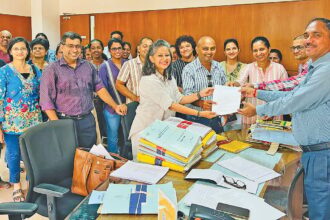
NAB’s future looks promising. As Mendonse says, “Our present campus is not enough to accommodate the growing numbers of visually-impaired students. We have already applied for Comunidade land at Chorao, where we aim to build a new centre which can accommodate 200 students. We aim to offer a variety of different facilities for the visually-impaired in this centre, including a swimming pool, theatre, gym, playground and accommodation. Additionally, we will also provide a home for senior citizens who are visually-impaired, and need care and assistance. Besides being taken good care of, they will also enjoy the company of young children…it will be a like a new lease of life!”
Rozendo offers some crucial advice, “I request all parents of visually-impaired children not to feel isolated. If your child is visually challenged, please get in touch with NAB. We will provide your child with the best training and assistance in order to excel in education, which will improve future career prospects.”