Goa’s last
positive case was on April 3 and the State has become COVID-free after all
seven patients were declared to be cured. However, the number of COVID-19
patients continues to rise in the neighbouring State of Maharashtra and
Karnataka.
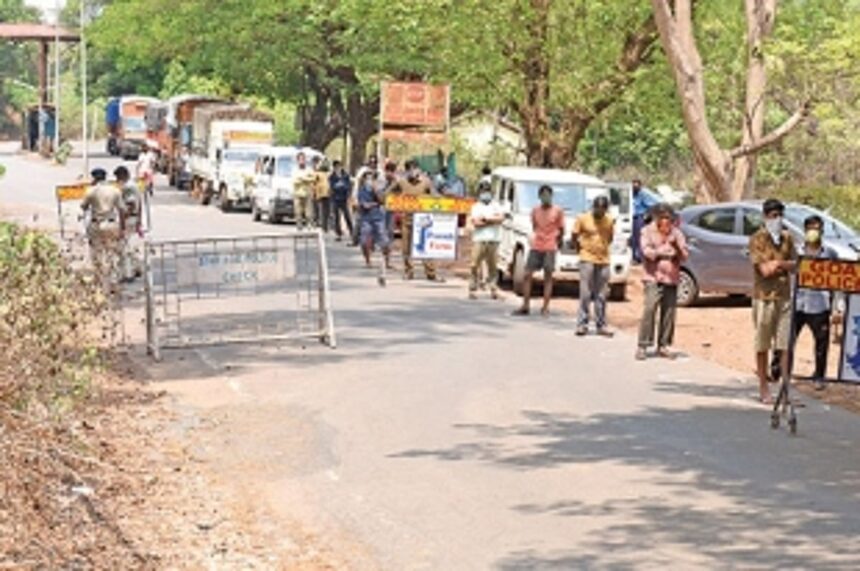
The State has
been maintaining a strict vigil round-the-clock at all border checkposts with
medical teams, executive magistrate and the police and excise teams stationed
at any given time.
As goes the
saying – ‘where there is a will, there is a way’, people from the neighbouring
States are taking to the internal roads to enter Goa, which could be dangerous.
Apart from the
checkposts, there is N-number of access paths into the State from Karnataka and
Maharashtra, which even the authorities, have no knowledge about.
After the news
spread of people from neighbouring are entering through secret routes the
authorities swung into action and sealed most of them but the locals say there
are several routes including the railway track route, which people have been
taking to enter the COVID-free State.
While the
locals have been blowing the whistle, the authorities seem to be slow on
sealing the railway line or maintaining vigil as they are in deep forests and
not easily accessible.
Overdependence on thermal guns
However, what
is disturbing to see is that the authorities are over-reliant on the use of thermal
guns.
Only if the
person is below a certain temperature, he is allowed to enter the State and if
not they are sent back. Use of ‘temperature guns’ is increasingly common as authorities screen
people entering the State.
However, the questions remain over transmission by
people who have not shown symptoms.
Although the guns can quickly measure surface temperature
without touching people’s skin, experts argue that using non-contact devices to
avoid spreading the infection means some accuracy has been
sacrificed.
The experts add that electronic ear thermometers and oral thermometers may be more
accurate but temperature readings would take more time and pose a higher risk
of cross-contamination.
80% of cases could be asymptomatic: ICMR
Even as
infections continued to double every seven and a half days, the Indian Council
of Medical Research (ICMR) said that the majority of COVID-19 cases in the
country could be without any symptoms.
“At least
80 out of every 100 COVID-19 patients may be asymptomatic or could be showing
mild symptoms. It takes a few days before an infected person begins to show
symptoms and the probability of being detected positive is highest when
symptoms begin to show,” said Dr R. Gangakhedkar, senior scientist at
ICMR, New Delhi.
“It is a
new disease but we are doing everything we can to combat it. As of now, we are
not planning to change the testing criteria,” he said, when asked if this
needed a change in testing strategy to include those without symptoms. Contact
tracing remains crucial.
Hence the
people in Sattari and Patradevi, Polem, Mollemetc feel that the government must
stop all vehicles unless there is decrease of cases in the neighbouring States.
“We can
survive without groceries and vegetables but once the virus spreads in Goa it
would be difficult to control and people will lose lives,” said Laxmikant Kerkar
from Sattari.
Keri (Sattari) checkpost
Goa gets most
of its supply from the neighboring district of Belgaum, be it vegetables,
flowers, meat, milk and groceries.
As per Suhasini
Satardekar almost 200 vehicles enter the State between 10 pm and 8 am in the
morning laden with vegetable, milk and other essentials.
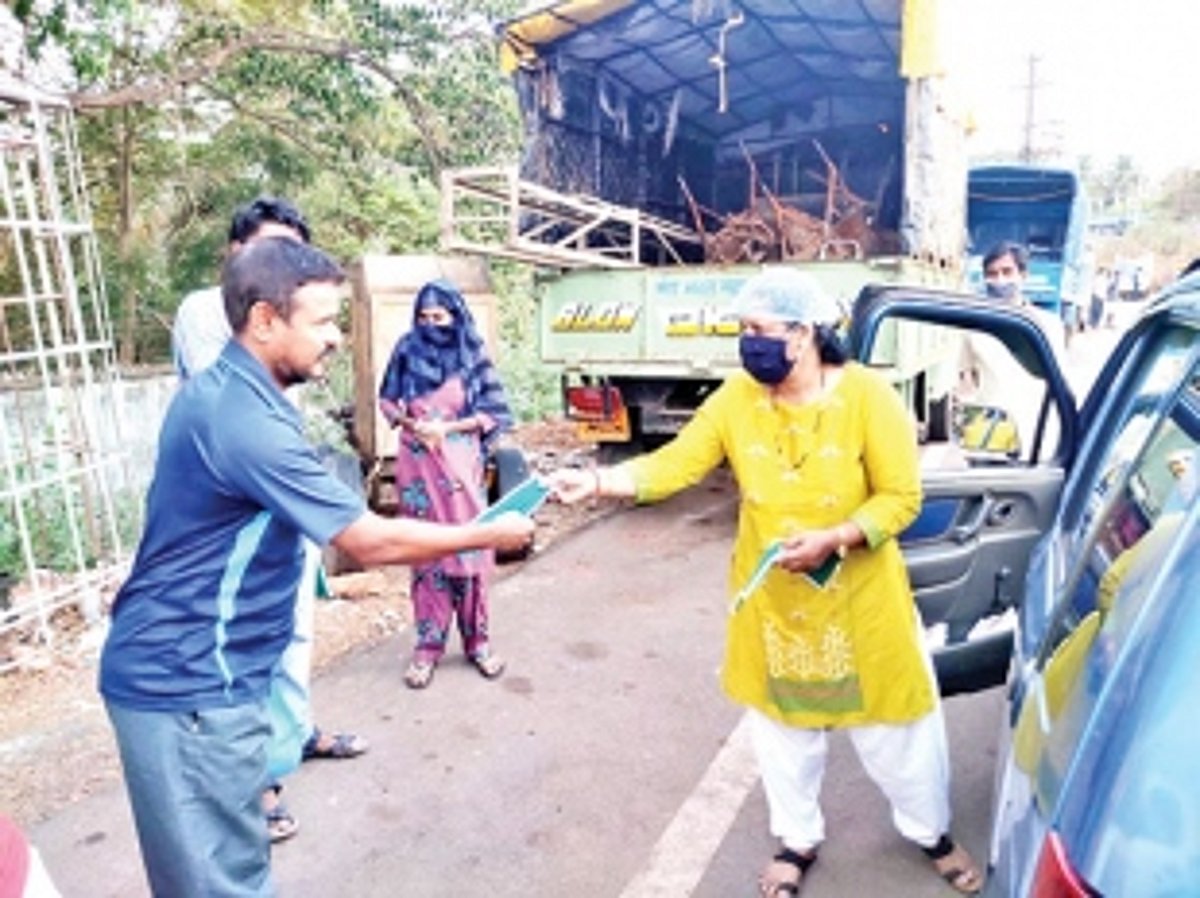
“Every driver
or person is checked for temperature with thermal gun,” she said.
When TEAM
HERALD visited the border checkposts, three drivers of the trucks were found to
have temperatures above 100 F and all were sent back along with the trucks.
There were
three medical staff, one executive magistrate and 13 police personnel including
one police inspector and one PSI.
The Police Inspector
on duty Ramkrishna Parab informed that without the order of the District Magistrate,
no trucks or vehicles are allowed to enter.
“In case of
vegetable or grocery trucks, we check it thoroughly, take the identity of
driver and cleaner and re-check when they are moving out along with the vehicle
number,” he said.
Poriem checkpost
This is a
small checkpost, sharing a border with Maharashtra and in fact, this seemed to
be at a strategically wrong place.
Just two
kilometres away from the checkpost, there is Maharashtrian village called
Aaint, and between the checkpost and Aaint, there is a road leading to
Kudchirem village near Bicholim.
While during
the day time, there are two police personnel on duty at the junction but at
night there seem to be nobody.
Villagers say
most of Maharashtra people and vehicles come at night and enter Bicholim
directly without checking.
Police
personnel stationed informed on condition of anonymity that there is no
arrangement made for checks at the cross junction and as such it was literally
impossible to station a police party there as there is no power supply or gate
or any other arrangement.
In fact no
vehicles enter Goa through the main Poriem checkpost.
Dodamarg checkpost
This is
another checkpost bordering Maharashtra and the police keep a strict vigil to
check every vehicle for the infiltration of people fro Maharashtra.
Police Inspector
Majik informed Herald that every vehicle is check be it for poultry, grocery or
any ambulance.
“Without the
Magistrate’s order, we do not allow anybody and everyone has to go through
medical scanning before entry,” Majik said.
Patradevi, Kiranpani and Satarda checkposts
When
authorities sealed the borders and stopped the movement of vehicles as well as
people to stop the spread of COVID 19 in the State, people especially from
Maharashtra started using the internal roads as a route to enter into Goa and
vice versa.
Not only
the people but even those people who were involved in illegal smuggling of
liquor used these routes to smuggle the liquor since these route pass through the
jungle area.
However,
when brought this to the notice of the authorities, that all the internal roads
as well as narrow access paths touching the Goa-Maharashtra borders, were
sealed by the authorities and deployed staff to keep vigilance.
Meanwhile,
the checkpost at Satarda and Kiranpani are completely sealed and police are not
allowing even a passerby to cross the border.
Teams of
Pernem police along with officials of Dy Collector and Mamlatdar have been
deployed at the Patradevi checkpost to keep a strict vigil on movements of
vehicles and people through the Patradevi checkpost.
The team
checks every vehicle passing through the checkpost as well as health check up
is conducted where in temperature of drivers and cleaners of vehicles are checked
using thermal gun.
Also, a
team keeps a record of vehicles entered and exited through the checkpost with
proper permission. Also more than three person including two drivers and one
cleaner is allowed and no personal entries are allowed.
A team of
Pernem Police consisting of Pernem PI, PSI, Traffic police and Police constables
are deployed there along with a paramedical team, remains present and does the
health check up.
Authorities
have sealed entry points of most of the internal roads which pass through
jungles and further connect to borders with the help of barricades, stones, mug
and bamboo sticks.
Hasapur,
Hankhane, Chandel villages are close to the Goa Maharashtra border, due to
which, there are several internal roads through which people can walk and cross
the border.
Also it
was learnt that people from Maharashtra are using internal road from Karmali to
enter into Goa. This internal road is almost 4 km where two-wheelers as well as
four-wheelers can pass easily. This route further connects to Sawantwadi, Banda
from one side and Belgavi from other.
After the authorities learnt that people are illegally crossing borders and
entering into Goa and vice versa through internal border roads, North Goa
Additional Collector Dasharath Redkar, North Goa Superintendent of Police (SP) Utkrisht
Prasoon, Pernem Dy Collector Chandrakant Shetkar, DySp Gajanan Prabhudesai and
Pernem PI Sandesh Chodankar immediately visited the spots on Wednesday and
sealed all the entry points of internals roads with barricades, mud, stones and
wooden sticks.
Also there is village named Kalane, on the Maharashtra-Goa Border near
Hasapur village and since it is located on the border, these people have cashew
plantation in Goa as well and also buy all their essential commodities from
Goa. Even some people of Goa have their cashew plantation in this village. When
the main road connecting to this village was closed, people started crossing
the border through a small walking road within distance of one km. When
authorities learnt about it, the road was sealed.
Mollem checkpost
Round-the-clock checking is underway at the Mollem
border while all shortcuts to neighbouring States have been sealed, three
Police Inspectors, several Police and Forest Officials are guarding internal
roads but villagers fear people from neighbouring States may enter from
forests at night time as Goa is corona-free State.
Locals add that during the day time, they can keep a
vigil but during the night, it’s difficult to keep watch as some may enter
through forest in search of job in Goa from Corona-affected Belgaum.
Not only Goans but villagers from Mollem, bordering
and neighbouring to Belgaum, are also scared about the prevailing
situation, given that 17 COVID positive cases were detected in Belgaum within a
day about a week ago, since than the locals are become active and keeping
strict vigil.
Their alertness forced the government to depute
medical and Police Staff for strict checking of vehicles. However, there are
shortcut pathway routes at Nandran, Zamboti, and Tambdi Surla from where
Karnataka people can enter reach despite being guarded by Forest
Officials.
Dharbandora Dy Collector Pradeep Naik says
though Mollem locals are worried the government officials including Mamlatdar,
Collem PI, and Health officials are making every effort that no vehicle crossing
Goa Border from Belgaum remains unchecked.
He added that details of every truck especially
loaded with commodities are checked thoroughly and that the details of
vehicles are taken manually as well as online. Even while returning to
Belgaum, the details of the vehicles and their occupants are checked.
”We conduct a thorough checking of vegetable
trucks. Two truck drivers and one cleaner is allowed for entry with their vehicle,
which is checked while leaving,” he said.
Mollem Sarpanch Snehalata Naik confirmed that
locals are anxious. The locals are not complaining about essential vehicles
coming to Goa but they are apprehensive when they see some private vehicles in a
queue on Goa Border at Mollem.
Sushanth Sawanth, an official with the Dharbandora
PHC centre working at the border for medical testing, said their team works in
two shifts.
“We conduct thermal testing. During the day time,
30 to 40 vehicles enter and medical screening of the occupants such as drivers
and cleaners is done, while in the second shift, around 100 vehicles enter Goa
from the border, mostly transporting vegetables and grocery items,” she
added.
Pollem checkpost
Elders from Canacona say that there are at least
10 clandestine ways to cross Karnataka border into Canacona.
With authorities keeping strict vigilance on the NH66 road passing
through Polem, initially there were allegations of people from across the
border trying to sneak into Goa for various reasons. However, with vigilantes
from the border villages in Canacona informing the authorities, all of these
hidden ways are now manned by different government authorities.
Couple of them are mud roads but motorable and
others are suited only to walk.
These hidden paths were used during Portuguese
times for smuggling of goods, also locals with no passport wanting to go to
Mumbai used to go by these roads.
Deputy Collector of Canacona, Pritidas Gaonkar
said that that they are aware of those hidden paths and have taken enough
precautions to see that no one crosses the Goa border from either side.
“We have barricaded the road
from Maigini in Karnataka to Marlem-Thirwal in Canacona, the forest department
and police officials are manning the forest checkpost and no one is allowed
entry from either side, forget about two wheelers we don’t allow anyone to
cross the Goa border on either side” informed Gaonkar.
When asked about the presence of
paths through Thirwan, right and left side of Polem checkpost, Nadke-Keri,
Bela, Dullgal, Konkan Rail route and the sea route from Polem beach, he said that
they are taking enough precautions to see that no one enters or exits through
these routes.
“As far as Polem sea route is concerned, the coastal police with
office in Talpona have been directed to keep strict vigil in the waters of the
sea in these areas” said Gaonkar.
“We know that, illegal boat landings as
well as any one trying to get into Goa remains the greatest threat as far as
importing further cases of COVID-19 into the State is concerned” informed
a source closely associated with the local administration. “Coordinated
land and sea patrols are in place and anyone attempting an illegal crossing is
being dealt as per the prevailing laws” another source added.
A source at Canacona police
informed Herald that on an average about 150 vehicles pass by the Polem checkpost
each day and all onboard these vehicles are checked by the health officials
with the help of a thermal gun.
Most of these vehicles carry
vegetables, fruits, liquefied petroleum gas, pharmaceuticals and industrial
goods.
Looking at the vulnerability at
the Polem checkpost, the administration has deputed an officer of the rank of
Executive Magistrate round-the-clock to see that only vehicles and personnel
with valid permissions are allowed to enter into Goan territory with full check
up by the health officials deputed at the Polem checkpost.