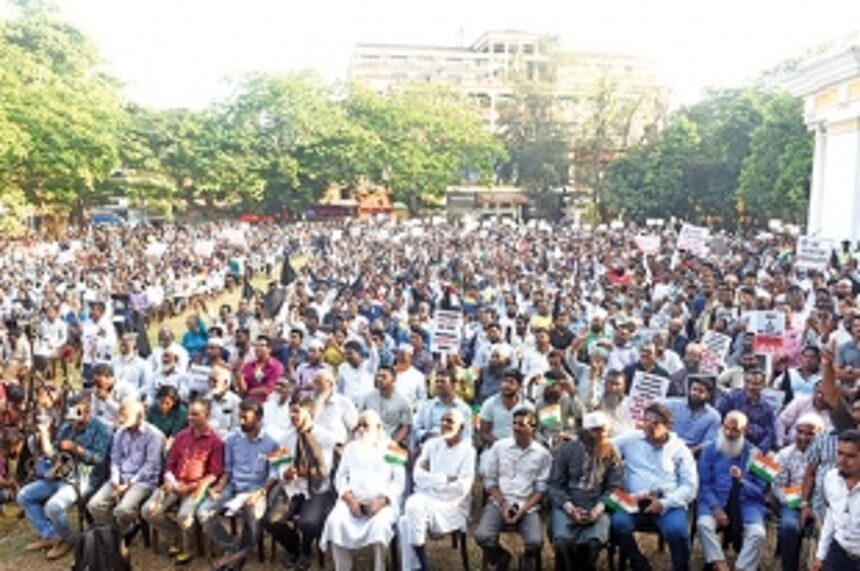
The BJP government under Prime Minister Narendra Modi and Home Minister Amit Shah has advanced its agenda of creating a Hindu nation by launching a double-edged sword- Citizenship Amendment Act 2019 (popularly referred to as CAB) and National Register of Citizens (NRC). The objective: to render Muslims in India stateless. Though Hindus and Muslims have both had their citizenship challenged by NRC in Assam, Muslims cannot apply under CAB for their citizenship to be restored. This legalised ethnic cleansing will pave the way for India to become a predominantly Hindu nation and for Muslims to eventually be forced to flee.
What is CAB – Citizenship Amendment Act 2019?
. CAB is an Amendment to the Indian Citizenship Act of 1955.
. Under CAB, Hindus, Sikhs, Buddhists, Jains, Parsis and Christians from Afghanistan, Bangladesh and Pakistan, who entered India on or before 31 December 2014, will be granted citizenship. This provision does not extend to Muslims.
. CAB has reduced the naturalisation time (to become a citizen) from 11 years to 5 years for these persons, surely intended to coincide with giving them the opportunity to vote in the next election.
What is NRC- National Register of Citizens?
. National Register of Citizens is amove in Assam to wean out alleged illegal immigrants from Bangladesh.
. The NRC list released on 31 August 2019 has excluded over 19 Lakh people who must file an appeal before the Foreigners Tribunals, the process for which remains unclear even over 3 months of this publication, putting lakhs in a precarious position.
. The burden of proving ancestry lies on the person seeking such inclusionand is based on a great unfettered discretionary power on the officer making such a determination.
. Detention Camps are also being set up to detain people declared foreigners or those against whom proceedings are still pending before the Foreigners Tribunal.
. Vide a Gazette Notification of 31 July 2019, and as clarified by Home Minister Amit Shah in Parliament, the essence of the NRC will eventually be extended to the whole of India.
How could CAB and NRC work together?
In the NRC process in Assam, one was required to furnish two kinds of proofs: Firstly, to prove that either of the person’s parents or grandparents appeared in the NRC, 1951 or in any voter list prior to 24 March 1971, or the person themselves appeared in any of these lists. After this, one must prove a direct connect to this person (legacy document), through the provision of “List B” documents. The issue arises also because proving this is more difficult than one can anticipate. The spellings in these documents must tally completely. For example, if my mother Sangeeta’s name is spelt as Sangeeta in her document, and Sangita in mine, I am disqualified from inclusion in NRC. Illiteracy, meagre finances and lack of access to legal aid further aggravates the situation for this group.
From the people who have been excluded from the NRC, the Hindus could then apply for citizenship under CAB, whereas the Muslims do not have any recourse under CAB and will effectively be rendered stateless.
According to the Statement of Objects and Reasons of CAB signed by Home Minister Amit Shah, CAB will welcome Hindus “since many of them have entered into India long back, they may be given the citizenship of India.” Yet it is the converse in Assam, as families who have been living in India for generations and even those who have been born on Indian soil to these parentsare being stripped of their citizenship.
Do these Amendments pass the test of reasonable classification and rational nexus as per Article 14 and 15 of our already vulnerable Constitution? Our compromised judiciary can hardly be relied on to adjudicate impartially, but it can be disputed that it won’t. CAB protects “communities (who) have faced persecution on grounds of religion” yet excludes the Ahmadiya Muslims from Pakistan or Hazara Muslims from Afghanistan who are being bombed by the hundreds. If the rationale is that these three countries have state religions, why were Sri Lanka (state religion Buddhist) and Myanmar (predominantly Buddhist) excluded? Sri Lanka has persecuted Tamil’s and Myanmar has Rohingya Muslims who have been expelled violently. This Act clearly discriminates based on religion, to exclude Muslims, which is unconstitutional under Article 14 and 15.
Another amendment that has been sneaked in CABallows the cancelation of Overseas Citizen of India (OCI)status when an OCI Cardholder violates any law in force, after being granted a hearing. The purpose behind this Amendment is unclear, as debates on this Amendment is being shadowed by the larger changes. However, violation of ‘any law in force’ gives quite a wide ambit for Government officials to harass OCI cardholders.
With an overwhelming majority in the Lok Sabha and Rajya Sabha, the BJP Government has been passing laws without Law Commission Reports, civil society consultations, stakeholder meetings. Constitutional challenges to laws in the Supreme Court are also hindered by bureaucracy and executive interference.
A United Nations Commission of Experts defined ethnic cleansing with regards to former Yugoslavia as “rendering an area ethnically homogeneous by using force or intimidation to remove persons of given groups from the area.” It went on to state that ethnic cleansing is a crime against humanity.
The BJP government is indulging in the ethnic cleansing of Muslims from India, in line with its agenda of establishing a homogenous Hindu nation. Its actions have time and again targeted Muslims and persist to relegate Muslims to illegal immigrants in their own home country.
When hearing about the Holocaust, my first thought was how did the Germans fail to halt it? Yet, history often repeats itself. Torn between lofty false promises of ‘acche din,’ or being silent spectators, we are turning a blind eye to the reality of the situation and merely condoning this atrocity. Our Government is deliberately and strategically wiping out Muslims from our country. If we acknowledge this, we can move on to mobilising against it.
.