Challenge: Traffickers located outside Goa are usually not arrested and they continue to be involved in trafficking girls to Goa for commercial sexual exploitation.
Solution: ACTION AGAINST THE TRAFFICKERS: To ensure that action is taken against all those in source, transit and Goa involved in trafficking of girls to Goa for commercial sexual exploitation, it is important that Goa has full time/dedicated police officials posted at the IAHTU (Integrated Anti Human Trafficking Unit), who are involved in collecting information, building information networks, surveillance, rescue of victims, coordinating with their counterparts in other states, countries, etc
Challenge: It has been found that hotel/lodges, flats, bungalows and massage parlours in Goa are used for commercial sexual exploitation.
Solution: SEALING OF BROTHELS: To curb this it is of utmost importance that action needs to be taken by the police, sub-divisional magistrates, panchayats, licensing authorities, RTO, etc against hotels, lodges, flats, parlours, shops, vehicles, used for commercial sexual activities, by sealing the establishment, withdrawing the NOC and/or cancelling the trade license. As per Section 18 in The Immoral Traffic (Prevention) Act, 1956, the Sub-Divisional Magistrate has the power of closure of brothel (place used for commercial sexual exploitation) and eviction of offenders from the premises.
Challenge: Once the women are released from the state protective home (SPH), it is difficult to follow up with them to prevent their re-trafficking.
Solution: PREVENTING RE-TRAFFICKING: The SPH should maintain contacts of the family members. Efforts need to be taken by the SPH as well as the NGOs in the source States so that they can follow up with the victims. When passing an order, the SDM can request an agency in the source State to oversee the victims well-being in the home State and maintain contact with them.
Challenge: Lack of follow up with the women poses difficulties in getting in touch with them when they are required to depose as witnesses in court against traffickers, thereby making prosecution extremely difficult.
Solution: DEPOSITION OF THE VICTIM: Apart from the solutions in the point above, when passing an order the SDM can request an agency in the source state to oversee the victims well-being in the home state and maintain contact with them. The Investigating Officer should also retain the contacts of the family members prior to the release of the victim from the SPH. Video conferencing could be promoted where possible so that victims do not need to travel across states or countries to depose as witnesses.
Challenge: Lack of proper maintenance and sharing of documentation and records is a challenge in stopping re-trafficking.
Solution: MAINTAINING AND SHARING DATA & DOCUMENTS: Each of the stakeholders involved should meticulously maintain records and share these with the relevant agencies so that traffickers can be identified, arrested and prosecuted and the victims can be provided services to prevent her from being re-trafficked. Data base of victims as well as traffickers should be shared with appropriate agencies.
Challenge: Huge delays in trials result in the traffickers being acquitted, as it is difficult to get the victim to come to the court.
Solution: SPEEDING PROSECUTION PROCESS: In Goa, it takes on an average four years for the trial to begin, and by then the victim is not available for deposition as most of the rescued victims are from outside the State/country. It is difficult to trace the victim after four years and most often, even if traced, they do not wish to come to depose as they are settled in a new life or they do not want to be forced to relive the painful experiences again. As a result, in most of the cases the accused are acquitted. There is a need for the establishment of a special court under Section 22 A of ITPA for speedy trial of offences under ITPA. Establishment of a special court will improve the conviction rate, which will act as a deterrent for the offenders.
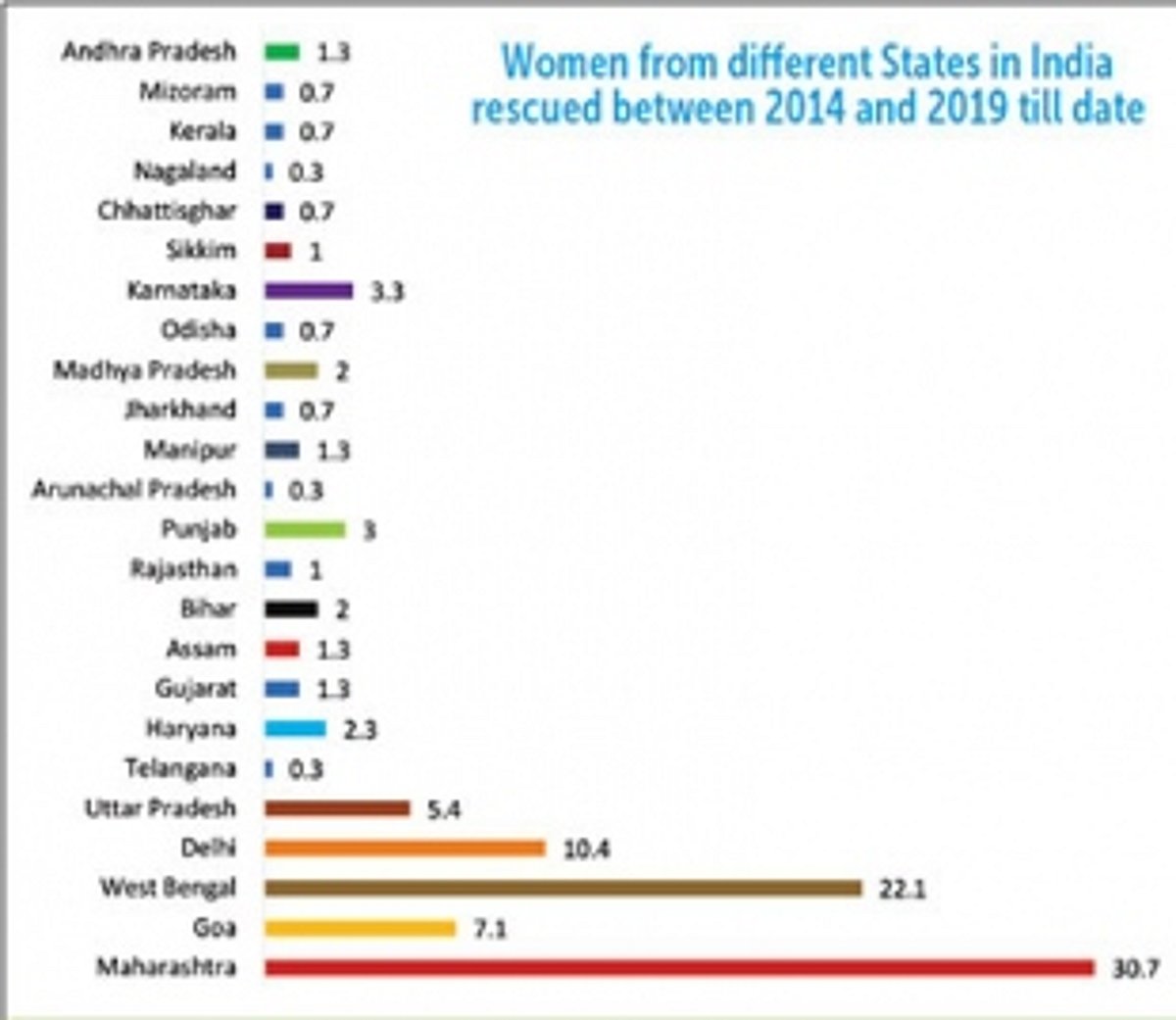
Challenge: Fake documents are being made in the source States; mainly Delhi and West Bengal.
Solution: PENALISING THOSE MAKING FAKE DOCUMENTS: Investigations into the modus operandi of how this is being done needs to be initiated by the police and action needs to be taken against the persons responsible for making fake documents.