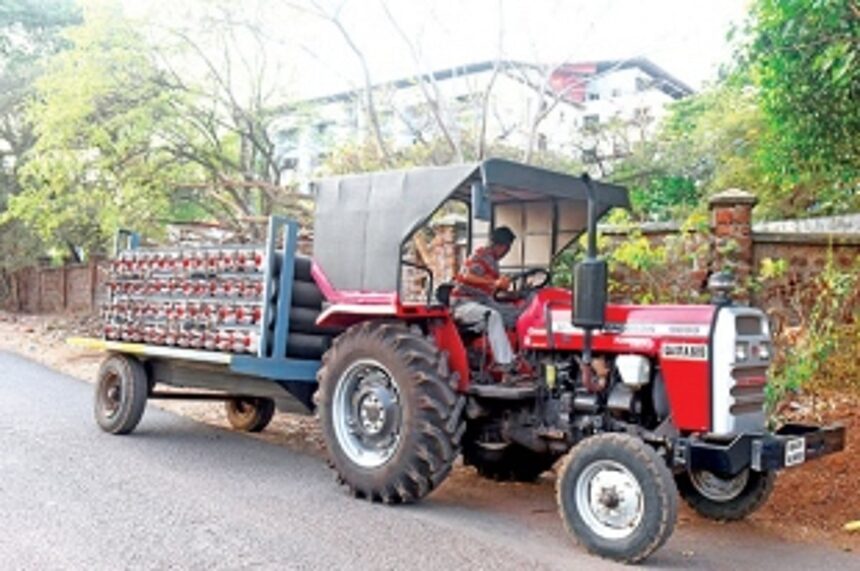
he Goa bench of the Bombay High Court held daily hearings over oxygen supply to the critically covid infected patients at GMC. At least 75 deaths were reported due to oxygen issue in Goa. The State with all its might could not find a solution to a small issue of working out the logistics of available oxygen. In other States people are dying for lack of oxygen. Here the deaths were attributed to administrative failure in arranging trolleys, drivers and such mundane issues. The court acted with caution and circumspection and passed carefully crafted orders to avoid adversity in the nature of the proceedings. Even when ICMR recommended no testing at borders, the court stood firm on covid negative certificate for entry.
Hailed by millions all over the country, the High Courts took up issues like shortage of oxygen, live saving drugs, availability of beds or overcharging by private hospitals. “Enough is enough, if you cannot manage it, tell us then we will ask the central government to send their officers and do it. We cannot let people die”, thundered the Delhi High Court. For almost two weeks the Delhi High Court monitored the availability of oxygen. ‘Death due to lack of oxygen supply is a criminal act and not less than a genocide’, claimed the Allahabad High Court. The high courts’ intervention in such firefighting measures was welcome, even if one life is saved. How many more lives would have lost, in case the high courts had not intervened is anybody’s guess.
The governments acted overconfident over the end of virus, with complete distrust for science and expertise. The governments did not plan for the second wave highlighting a sheer governance vacuum in covid management. Courts stepped in to hold Central and State governments accountable, as they abdicated their responsibility. High Courts and belatedly the Supreme Court gave directions in various matters of covid management.
It is a sad reflection of how elected governments in India and our State failed the people. Constitutional courts acting to ensure that governments do their jobs in difficult times like this provide legitimacy and credibility to the courts in administrative matters. Throughout the country the high courts are cheered by people as the judges breach that ‘Laxman-Rekha’ of adjudication boundary. The courts are seen as institutions of good governance and the only hope for justice as they see their elected governments as callous and inefficient, even in pandemic times
Arun Jaitely as union minister had always been advocate of separation of powers. He told the Rajya Sabha that the judiciary had been encroaching on legislative and executive authority and that “step by step, brick by brick, the edifice of India’s legislature is being destroyed”. Jaitely is not around now to see the courts monitoring oxygen supply or fixing the amount of oxygen for a State or working out the logistics of how the oxygen shall reach the needy. I wonder what would have been his stand!
K.G. Balakrishnan an ex CJI responding to Jaitely had said “.. Before criticizing the courts which serves as the whip of the people towards any wrong done by the State, other organs of governance must make sure their conduct is exemplary. “Another CJI T. S. Thakur said, “The governments should do their job instead of hurling the accusations and the people turn to the courts only after they are let down by the executive.”
Arun Jaitely may have been staring at the judicial overreach in his times. The highest court could be accused of under reach in the last half decade. But it is also the period when the elected government acted as a formidable wing of the State and the highest court failed to stand up. It could be said that the vigilante groups had good time as they took the law in the own hands. It could be said there was lethargy in disposing matters requiring urgent judicial attention, even when right to life and liberty is involved. The highest court remained a mute spectator when millions of daily labourers footed out thousands of miles without food amidst a sudden lockdown in 2020. Those images shall remain etched in our memory for a long time and the words from the highest court ‘why do they want money when they have been provided food’ still echoe in our ears. So where do we get that balance between the overreach and the under reach? I am reminded that in a stadium owned by the powerful, it is his team that has to win!
But what can happen when the highest court is formidable and the elected executive is robust was seen when President Franklin Roosevelt saw his new deal legislation set aside in the time of great depression. Mrs Indira Gandhi also faced her ‘new deal moment’ in the privy purses and Bank nationalization cases. Both Roosevelt and Mrs Gandhi had their way, but the highest court in India had its way in having its last word by inventing the ‘basic structure’ doctrine.
As the elected show complete incompetence and act venal every now and then and the courts step in to bring a semblance of rule of law and people hail them as ‘saviours’- in not a healthy sign in a democracy. The political system may give the impression of collapse with only the courts as functional. The over use of judicial power may blunt judicial prowess and further pulverise the civil society. This is not the type of democracy that the founders of our Constitution conceived. The political system must be made functional. The people showed that in 1977. West Bengal has given a ray of hope this year.
The questioning of the vaccine policy by the Supreme Court, this season and the powerful push back by the elected executive may lay down a new ‘Laxman-Rekha’ for our ‘good governance courts’.
In a country like ours, the courts must remain the last refuge of the underprivileged and the bewildered.