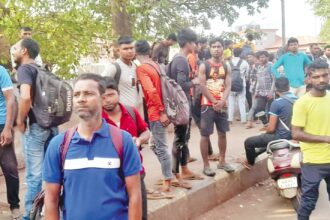
Far across the paddy fields and besides the Chadreswar Parvath, nestled in the mother nature with fresh air and greenery, away from the buzz of vehicles lies a tiny school established in 1982. The building may look in shambles and maybe overused by a school and higher secondary that share the same premises daily. But the over 313 children from families of migrant workers come together and work uniquely at Damodar English High School under their headmaster Norbert Fernandes and English teacher Maria Wilma D’Silva.
The two senior staff, who have completed over 30 years of service at the school, have been doing all they can do to empower the kids differently. “Our kids are very weak in English since they come from homes where their parents work in the fields, brick kilns, stone crusher and quarries or some in the distant mining industry. But we realised the kids have mobile phones and we wanted them to put these to good use. Hence we decided to get them to document the flora and fauna of the entire hamlet,” explains Wilma.
Wilma took a leaf of Rudyard Kipling’s work of The Monsoon Diary and inspired the kids to travel the village by foot and document the entire village’s flora and fauna and present it.
“We travelled the hills, the streams, the forests, the streets, the ponds and document all living things. We captured crabs, wild flowers, fish, livestock, plants and we were requested to present it. We took hundreds of pictures and 56 of us created collages of the images taken and presented the entire village of Gudi. The entire activity was a great learning experience,” explains Preeti Gaonkar, School head-girl.
Meanwhile Pranay Patil, a student in that school, tells us that the youth of today don’t want to step out but the students took the activity of documenting and presenting the entire village so seriously that they achieved a great end result.
The entire activity now lies on their wall in the school that is crammed for good infrastructure and comprises of rough cement walls which are in shambles. While Herald glanced at the presentation and awareness of the youth to explain their village to others and the pictures they have taken of the village, Herald stumbled on another treasure and aspect of the work of Norbert and Wilma.
“Our school has children who want to show their talents but are poor and we face a financial crunch despite government aid. Hence annually for our sports day and annual day, we personally make our own backdrop for the school to use,” asserted headmaster Norbert.
Norbert runs us through a series of images on his desk which are interesting to see but difficult to view since the school regularly goes through power failures.
Norbert over the years curates the school backdrop and gets his students to create the backdrop based on the dimensions and designs given by Norbert and Wilma. He also gives them the words and quotes and decides the colour of the background. Norbert has gone a long way in saving plastic and resources, as he gets the kids to work creatively despite no one really bothering him.