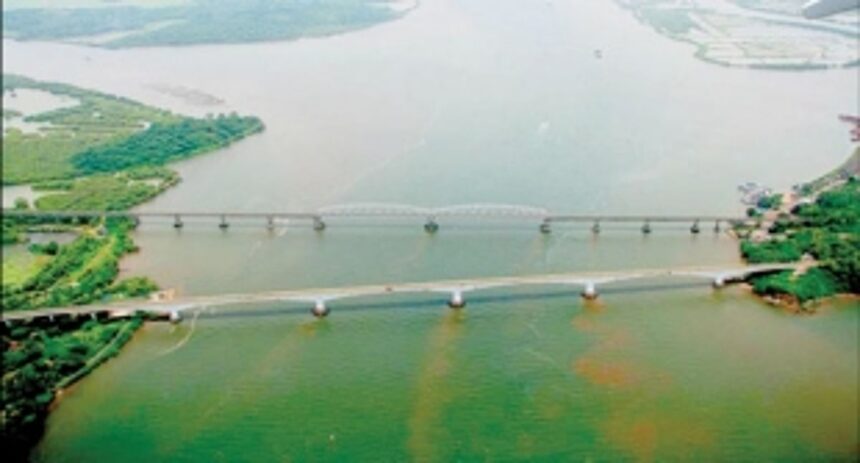
Increasing tourism activities, discharge/ dumping of untreated sewage and other waste, excess withdrawal of groundwater, river bank erosion on account of illegal sand mining and iron ore activities are some of the prime causes that have turned eleven river stretches of Goa unsafe for bathing and recreational activities. With government authorities having absolutely no control over these growing activities, the situation is expected to worsen in years to come.
Moreover, the monsoons worsen Goa’s water pollution problem, as it washes and moves solid waste and contaminated soils into its rivers and wetlands. As per the report, fecal Coliform count is highest during the monsoons season- May to October.
The fecal coliform count, which needs to be zero, is found to be between 2300 to 9000 colonies per 100 ml water. “Goa’s river waters have almost 80 to 90 percent of faecal coliform content, which is highly dangerous to human health,” GSPCB senior official said.
Central Pollution Control Board (CPCB) in its latest survey report submitted before the National Green Tribunal (NGT), has named river stretches of Mandovi, Zuari, Sal, Talpona, Assonora, Bicholim, Chapora, Khandepar, Sinquerim, Tiracol and Valvanti as polluted rivers under Criteria III, IV and V, that is having biochemical oxygen demand (BOD) between 10-20 mg/L, between 6-10 mg/L and between 3-mg/ L. The permissible limit is less than 3mg/L.
Total eight river stretches falls under Category V those are- assonora to sirsaim (Assonora), bicholim to curchirem (Bicholim), ponda to opa (Khandepar), along candolim (Sinquerim) along tiracol (Tiracol) sankli – bicholim to poriem(Valvanti) and curchorem to madkai (Zuari).
Two river stretches falls under category IV those are- marcela to volvoi (Mandovi) and along canacona (Talpona). The river stretch from khareband to mobor (Sal) falls under Category III.
“(BOD) greater than or equal to 30mg/L is termed as ‘Priority I’, while that between 3.1-6 mg/L is ‘Priority V’. The CPCB considers a BOD less than 3mg/L an indicator of a healthy river,” CPCB said.
Under the guidance of CPCB, State pollution Control Board under the National Water Monitoring Programme (NWMP), conducts monthly monitoring of water quality. The Board during its 12 month monitoring of the river, observed that most of the parameters like dissolved oxygen, biological oxygen and turbidity, are mostly within the permissible limit, except for faecal coliform, which is relatively higher, exceeding the prescribed limit.
“The fecal Coliform, caused as a result of sewage discharge, preferably needs to be absent from water for it to be considered safe for general human use, and for irrigation where coliform may cause disease outbreak from contaminated-water in agriculture,” official said pointing the River stretches of Tiracol, Sinquerim, Talpona, Chapora and Mandvoi are polluted as result of release of sewerage.
Official explains that with increasing tourism activities along Sinquerim, Talpona, Tiracol, more and more waste get’s discharged into the river bodies. “Having no dedicated pits to tackle the sewerage, it gets directly washed into the river bodies. Also other waste like garbage, plastic, municipal waste, also gets washed it directly,” official said.
Official also explained, with large number of migrants being housed along the river banks, especially Mandovi and Zuari, there is release of sewerage and other waste into the water body. “Against whom should we take action? You tell me. Along the coastal belts, no houses are connected with sewerage line. In fact, more than 60 percent houses in the State are not connected. So shall we take action against all?,” official questioned back.
For the same attitude, NGT has pulled up State pollution Boards for not been able to take adequate steps for keeping the standards of water within the prescribed limits
National Green Tribunal (NGT) has directed all the States to adopt ‘Polluter Pays Principle’ (PPP) to recover the cost of rejuvenation of rivers from those who are responsible for the pollution. “For this purpose River Rejuvenation Committee has to be constituted and they will identify the main culprits,” official said.
NGT Principal Bench, New Delhi, headed by Chairperson Adarsh Kumar Geol, has asked States to come up with action plan with two months for bringing all the polluted river stretches to be fit at least for bathing purposes. Chief Secretaries of the concerned States will be held accountable for failure to draft the plan.
“Tough governance is the need of the hour. If pollution does not stop, the industry has to be stopped. If sewage dumping does not stop, locals have to be made accountable and their heads are to be prosecuted. Steps have to be taken for awareness and public involvement,” the tribunal stated.
The Action Plan should cover the following:
A) Source control
1) Source control includes industrial pollution control and treatment and disposal of domestic sewage as detailed below:- (a) Industrial pollution control (i) Inventorisation of industries (ii) Categories of industry and effluent quality (iii) Treatment of effluents, compliance with standards and mode of disposal of effluents (iv) Regulatory regime.
2) Channelization, treatment, utilization and disposal of treated domestic sewage. (i) Identification of towns in the catchment of river and estimation of quantity of sewage generated and existing sewage treatment capacities to arrive at the gap between the sewage generation and treatment capacities; (ii) Storm water drains now carrying sewage and sullage joining river and interception and diversion of sewage to STPs, (iii) Treatment and disposal of septage and controlling open defecation, (iv) Identification of towns for installing sewerage system and sewage treatment plants.
(B) River catchment/Basin Management-Controlled ground water extraction and periodic quality assessment
(i) Periodic assessment of groundwater resources and regulation of ground water extraction by industries particularly in over exploited and critical zones/blocks. (ii) Ground water re-charging /rain water harvesting (iii) Periodic ground water quality assessment and remedial actions in case of contaminated groundwater tube wells/bore wells or hand pumps. (iv) Assessment of the need for regulating use of ground water for irrigation purposes.
(C) Flood Plain Zone.
(i) Regulating activities in flood plain zone. (ii) Management of Municipal, Plastic, Hazardous, Bio-medical and Electrical and Electronic wastes. (iii) Greenery development- Plantation plan.
(D) Ecological/Environmental Flow (E-Flow)
(a) Issues relating to E-Flow (b) Irrigation practices
(E) Such other issues which may be found relevant for restoring water quality to the prescribed standards.